When Should You Take Turmeric or Curcumin?
Food and formulation can change measured curcumin absorption, but the studies here don’t compare morning with evening.
The human studies cited here don’t compare taking turmeric or curcumin in the morning with taking it at night, so they offer no basis for choosing one over the other. One trial found that food-based formats changed absorption from a particular turmeric formulation, but it didn’t test taking a capsule alongside a meal or measure symptom relief. Follow the directions for the product you have. 34
Breakfast or bedtime is a different question from absorption
If you’re choosing between taking a curcumin supplement with breakfast or before bed, it helps to separate three questions: what time is it, is food involved, and which product are you taking? The human studies cited here investigated food-based formats and product formulations. They did not compare morning with evening dosing or test whether either time improves symptoms. 34
That leaves a practical answer rather than a universal schedule: use your product’s directions. If they don’t specify a time of day, these studies don’t give you a reason to favor morning or night. Choose a time that fits your routine rather than trying to apply a timing result from a study that didn’t test timing.
What the food study actually tested
In a randomized crossover trial, participants received one highly bioavailable turmeric formulation as a capsule and in several food-based formats. Researchers measured curcuminoids in blood over 24 hours. An oat-milk analogue, a nutrition bar, and a probiotic drink produced higher dose-adjusted blood exposure than the capsule. A fruit drink and gummies were bioequivalent to the capsule. 3
That’s useful, but it isn’t the same experiment as swallowing your capsule with lunch. The study compared ways of delivering a particular formulation, not capsules taken with versus without an ordinary meal. It also measured absorption, not whether people’s symptoms improved. It can’t tell you that every turmeric product works better with food, or that higher blood levels will make a particular health goal more likely. 3
So if your label says to take the supplement with food, follow that product-specific direction. If it doesn’t, this trial doesn’t supply a meal rule to add on your own.
Why the formulation deserves a closer look
Turmeric is the spice; curcumin is one of the compounds found in it. Curcumin’s low oral bioavailability has led to products that use different approaches to increase exposure in the body. That means a result for one formulation shouldn’t be treated as a result for every turmeric powder, extract, or curcumin capsule. 12
For example, a trial comparing a nano-liposomal curcumin product with conventional curcumin found different blood exposure after a single dose. Both products were given while participants were fasting. That tells us something about those formulations under those study conditions, not whether you should take a different product on an empty stomach or at a particular hour. 4
Is there a different schedule for women?
These findings don’t establish one. The nano-liposomal trial enrolled healthy men only, so it cannot show whether its results apply in the same way to women. The food-format trial’s abstract does not report a women-specific timing result, and neither study compared schedules across pregnancy, postpartum, cycling years, perimenopause, or postmenopause. 34
The most useful next step is to read the directions on the product you actually have. Keep the questions separate: when you take it is not the same as how you take it, and a measured increase in absorption isn’t, by itself, a demonstrated benefit for your goal.
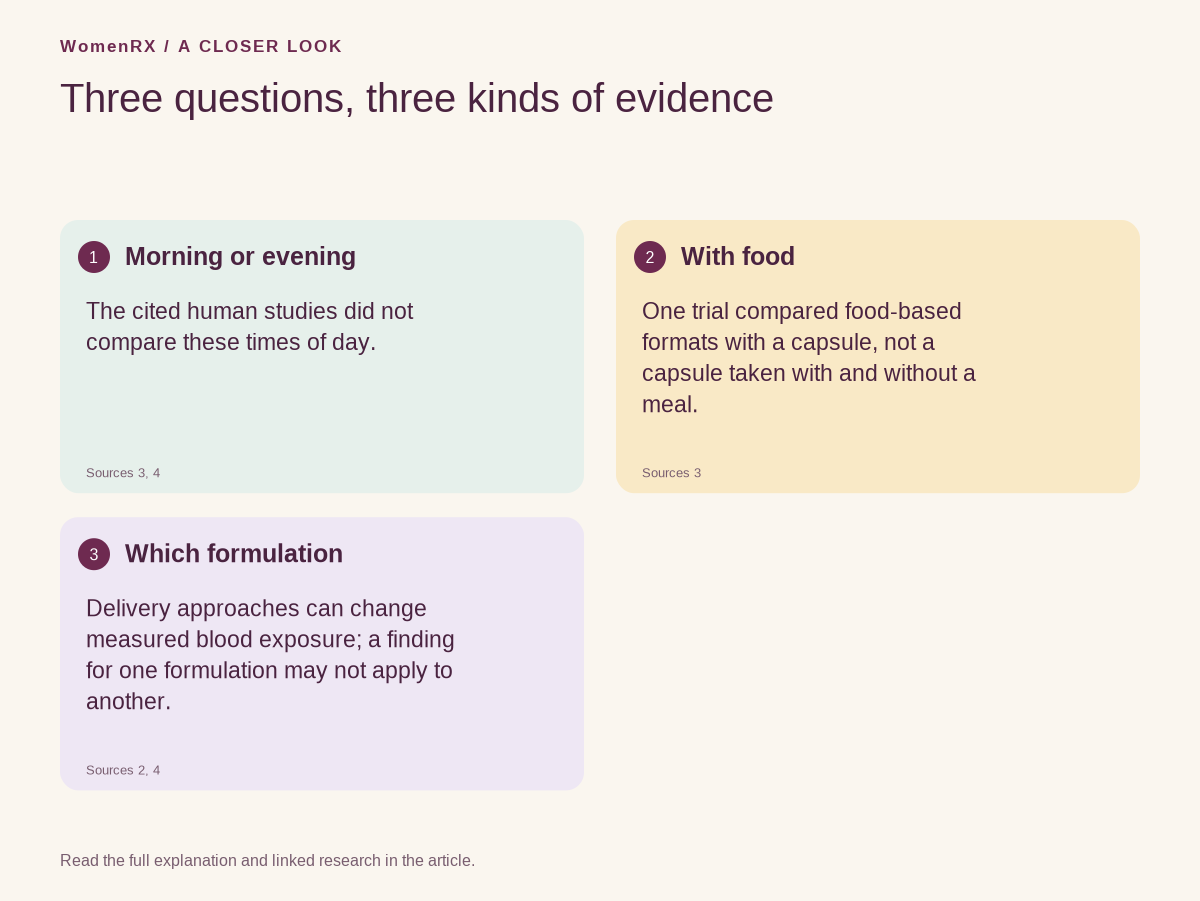
Three questions, three kinds of evidence
Morning or evening: The cited human studies did not compare these times of day.34
With food: One trial compared food-based formats with a capsule, not a capsule taken with and without a meal.3
Which formulation: Delivery approaches can change measured blood exposure; a finding for one formulation may not apply to another.24
Read the figure as text
A finding about one part of your routine doesn’t automatically answer the others.- Morning or evening: The cited human studies did not compare these times of day.34
- With food: One trial compared food-based formats with a capsule, not a capsule taken with and without a meal.3
- Which formulation: Delivery approaches can change measured blood exposure; a finding for one formulation may not apply to another.24
Sources you can check
- A Review on Curcumin: Pharmacological Promises and Biomedical Activities.Younis HM, Mohamed AA. · Archiv der Pharmazie · 2025Return to first citation
- Plant-food components at the microbiota-neuroinflammation interface: human evidence, translational limits, and sustainable dietary translation.Dunga KE, Izah SC, Dunkwu-Okafor A, Promise VI, Alum EU, Aliu OO, Aseibai ER, Ogwu MC. · Frontiers in nutrition · 2026Return to first citation
- The influence of food matrices on the bioavailability of curcuminoids from a dried colloidal turmeric suspension: a randomized, crossover, clinical trial.Schönenberger KA, Ranzini C, Laval J, Bellenger P, Tenon M, Fança-Berthon P. · Food & function · 2025Return to first citation
- Enhanced bioavailability of a novel double-layered nano-liposomal curcumin (BNT-C060): a randomized, double-blind, clinical trial.Kim DS, Kim HK, Ha KC, Jang GH, Park SH, Kim DH, Kim YM, Pyo J, Joo JC, Chae HJ. · Scientific reports · 2026Return to first citation