Turmeric and Curcumin: Why Supplement Doses Don’t Match
A turmeric powder, a concentrated curcumin extract, and an absorption-enhanced capsule aren’t equivalent doses, so the label and the study formulation matter.
The human formulation studies discussed here don’t establish a universal daily dose or a dose for osteoarthritis. Turmeric powder contains a relatively small, variable share of curcuminoids, while extracts and absorption-enhanced products can deliver different amounts and exposure. Human studies show that formulations can change curcumin absorption, but they don’t establish a dose that relieves osteoarthritis or is safe for every person. 2 3 4
Start with what the label is measuring
“Turmeric,” “turmeric extract,” “curcuminoids,” and “curcumin” aren’t interchangeable amounts. Turmeric powder contains about 2-8% curcuminoids by weight, and curcumin is the most abundant of those compounds. An extract may be concentrated or standardized, while another product may combine curcumin with an ingredient intended to increase absorption. 2
So a milligram amount on the front of a bottle doesn’t, by itself, tell you how much curcumin it contains or how much your body will absorb. Check the Supplement Facts panel and the rest of the label for the ingredient form, the amount per serving, and any added absorption enhancer. If you’re comparing a product with a study, look for the preparation and amount used in that study, not just the word “curcumin.”
More absorption isn’t the same as more benefit
Curcumin is poorly absorbed in some conventional forms, and manufacturers use approaches such as phospholipid complexes, piperine, and liposomal delivery to change bioavailability. Human studies show these formulations can produce different blood levels. That’s a reason not to assume that the same milligram amount means the same exposure. It does not show that a more absorbable product works better for pain or is a better choice for you. 2 3 4
For example, a small randomized, single-dose study compared a particular nano-liposomal preparation with free curcumin in healthy men. Eighteen participants completed the study; researchers reported higher dose-adjusted curcumin exposure with the liposomal formulation. The study measured pharmacokinetics over 24 hours, not osteoarthritis symptoms or longer-term safety. Its result applies to those specific preparations and study conditions, not to every liposomal product or a daily dose recommendation. 3
A separate open-label study compared three preparations in 14 healthy volunteers after a single dose, with blood sampling over eight hours. It found different absorption profiles across the tested products, but it was small and did not test whether participants’ symptoms improved. The study does not establish a women-specific result. 4
What this means if you’re considering it for joint pain
These studies help explain why formulations aren’t interchangeable; they don’t tell you how much curcumin to take for osteoarthritis. These absorption studies don’t establish a clinically effective daily dose for that goal, and an absorption result shouldn’t be mistaken for proof of pain relief. That’s an evidence limit, not proof that no relevant study exists.
For osteoarthritis, regular activity that includes muscle strengthening and general fitness is a core treatment approach in NHS guidance. 1 If you’re comparing a supplement with other options, keep the question practical: does a study test the same product, for the same joint problem, and measure symptoms that matter to you? A study showing a change in blood levels answers a different question.
Treat absorption enhancers as part of the product
Piperine, a black-pepper compound, is used in some supplements to increase curcumin absorption. A small product-comparison study’s discussion raises the possibility that piperine can interfere with drug metabolism and contribute to interactions. That paper did not establish which medicines are affected or quantify a person’s risk, so don’t assume every piperine product has the same interaction profile. If a product contains piperine and you take medication, ask a pharmacist or prescriber to check that specific combination. 4
Also, “enhanced absorption” is not a general safety guarantee. One single-dose study reported no clinically significant safety signal under its study conditions, and another reported no adverse events during its short observation period. Those findings from small, brief studies can’t establish long-term safety or safety for people who weren’t studied. 3 4
Pregnancy, breastfeeding, and women’s evidence
The absorption study in men cannot answer questions about use during pregnancy, breastfeeding, or across women’s life stages. The other product-comparison study does not establish women-specific or life-stage results. These studies therefore don’t establish an appropriate dose or safety in pregnancy or while breastfeeding. 3 4 If you’re pregnant or breastfeeding, review a concentrated turmeric or curcumin supplement with your clinician before using it.
When you compare products, use this short label-to-study check:
- Form: Is it turmeric powder, an extract, or a named delivery system?
- Amount: Does the label state turmeric, curcuminoids, or curcumin, and per what serving?
- Enhancer: Is piperine or another absorption strategy included?
- Evidence match: Did the study test this preparation and measure your goal, or only absorption?
Those details won’t reveal a universal “right dose.” They can prevent a more basic mistake: treating different products, research results, and risks as if they were the same.
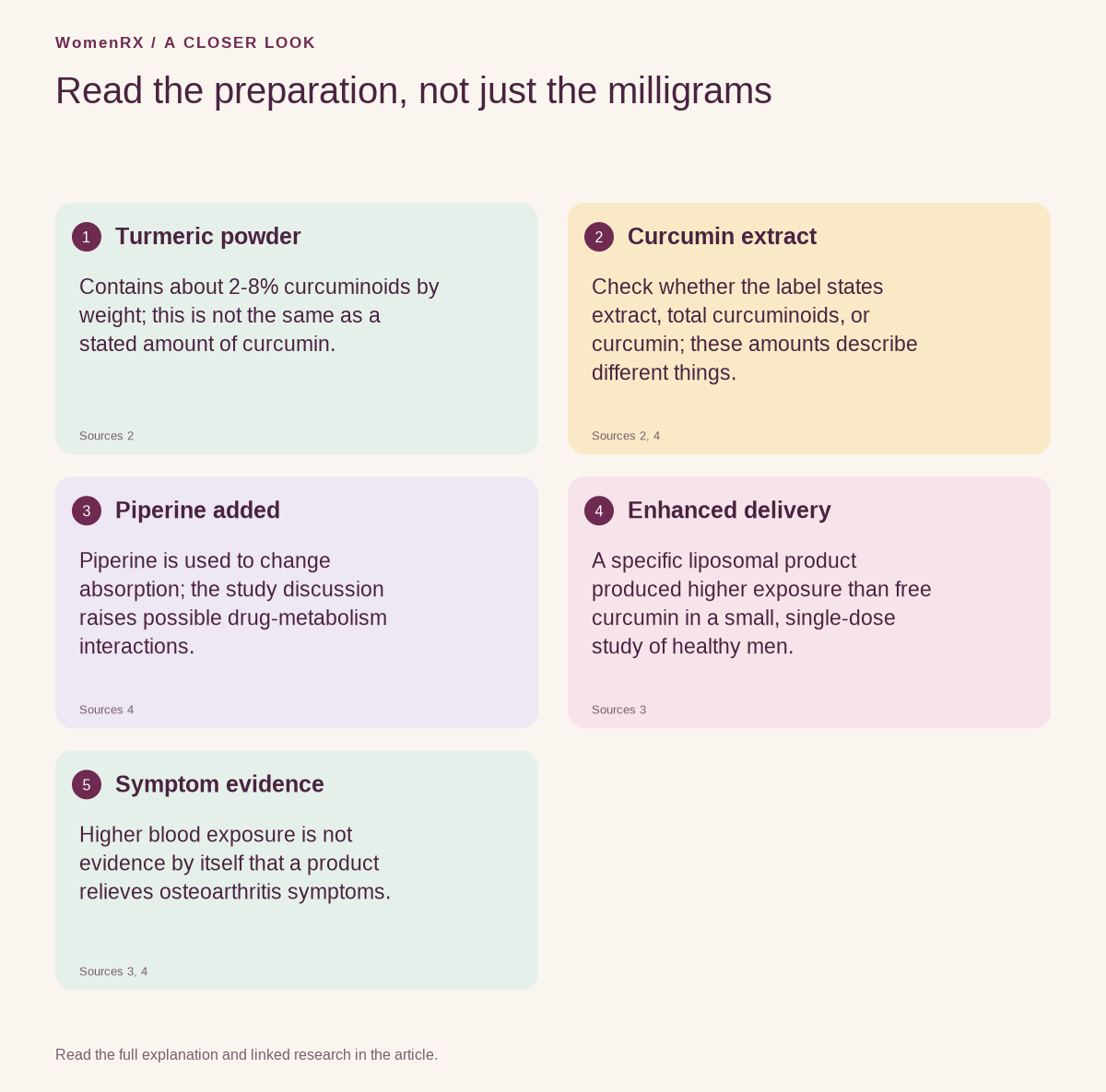
Read the preparation, not just the milligrams
Turmeric powder: Contains about 2-8% curcuminoids by weight; this is not the same as a stated amount of curcumin.2
Curcumin extract: Check whether the label states extract, total curcuminoids, or curcumin; these amounts describe different things.24
Piperine added: Piperine is used to change absorption; the study discussion raises possible drug-metabolism interactions.4
Enhanced delivery: A specific liposomal product produced higher exposure than free curcumin in a small, single-dose study of healthy men.3
Symptom evidence: Higher blood exposure is not evidence by itself that a product relieves osteoarthritis symptoms.34
Read the figure as text
Different turmeric and curcumin preparations can contain different compounds or produce different absorption. The human formulation studies measured exposure, not osteoarthritis symptom relief.- Turmeric powder: Contains about 2-8% curcuminoids by weight; this is not the same as a stated amount of curcumin.2
- Curcumin extract: Check whether the label states extract, total curcuminoids, or curcumin; these amounts describe different things.24
- Piperine added: Piperine is used to change absorption; the study discussion raises possible drug-metabolism interactions.4
- Enhanced delivery: A specific liposomal product produced higher exposure than free curcumin in a small, single-dose study of healthy men.3
- Symptom evidence: Higher blood exposure is not evidence by itself that a product relieves osteoarthritis symptoms.34
More questions, answered
Can I use the amount of turmeric in food to estimate a supplement dose?
No. Food turmeric and concentrated or absorption-enhanced supplements are different preparations. Turmeric powder contains about 2-8% curcuminoids by weight, and supplement formulations can change the amount and absorption. 2
Does a more absorbable curcumin supplement work better for osteoarthritis?
The human formulation studies described here measured curcumin exposure, not osteoarthritis pain or function. Higher absorption alone doesn’t establish better symptom relief. 3 4
Sources you can check
- Osteoarthritis - Treatment and support - NHSAccessed 2026-09-25Return to first citation
- Dietary Bioactive Compounds and Their Role in Allergy Prevention: A Comprehensive Review.Zafrilla P, Ballester P, Victoria-Montesinos D, Cerdá B, Marhuenda J, Arcusa R, García-Muñoz AM. · Nutrients · 2025Return to first citation
- Enhanced bioavailability of a novel double-layered nano-liposomal curcumin (BNT-C060): a randomized, double-blind, clinical trial.Kim DS, Kim HK, Ha KC, Jang GH, Park SH, Kim DH, Kim YM, Pyo J, Joo JC, Chae HJ. · Scientific reports · 2026Return to first citation
- An Open Label, Randomized, Comparative Bioavailability Study of BioTurm™ Extract Versus Curcuma longa Extract With Piperine in Healthy Adult Volunteers.Malhotra VK, Deshpande AC, Tamoli S, Soman GS, Sabnis Shinde R, Soman AD. · Cureus · 2025Return to first citation