Turmeric Benefits: What Human Studies Actually Tested
Curcumin has shown promising results for some specific outcomes, but other trials found no benefit, and the products tested differ.
Human trials have tested curcumin for endometriosis symptoms, PCOS measures, digestive symptoms, postmenopausal fatigue, and other outcomes. Some found improvements; others did not. Most findings concern a particular formulation, population, and short study period. They don’t show that turmeric in food or any curcumin supplement will have the same effect. 23459
Turmeric is a spice, and curcumin is one of its compounds. The studies below tested particular curcumin preparations, not turmeric as a general health habit. That distinction matters: an improvement with a product added to a prescription medicine tells you something different from an improvement with curcumin alone.
Endometriosis: Two pain trials, different results
For endometriosis pain, the human findings conflict. In a randomized trial of 68 women, curcumin capsules did not significantly improve pain or quality of life compared with placebo after eight weeks. In a separate trial of 86 women, nanocurcumin added to dienogest produced greater improvement than dienogest plus placebo on several pain measures and quality-of-life scores over eight weeks. It did not significantly change endometrioma size. The positive result was for an add-on treatment, not curcumin used by itself. 23
A third, smaller trial asked a different question. Among 50 women with endometriosis undergoing assisted reproductive treatment, a nanomicelle curcumin product was associated with improvements in some inflammation-related laboratory markers and measures including oocytes retrieved and high-quality embryos. Those findings are specific to women receiving fertility treatment. They don’t establish that curcumin improves fertility more generally. 1
PCOS: Some measured changes, not an across-the-board effect
In a randomized trial of women with PCOS, the curcumin group had lower fasting blood sugar than the placebo group after 12 weeks. The researchers also reported lower frequencies of absent or infrequent periods. They did not find significant between-group differences in measured cholesterol and triglycerides, insulin, testosterone, sex hormone-binding globulin, or hirsutism. A result for blood sugar or periods isn’t the same as showing that curcumin treats every aspect of PCOS. 5
After menopause: Fatigue scores improved, with a qualification
A placebo-controlled trial enrolled 74 postmenopausal women; 64 completed the eight-week study and were included in its final analysis. The curcumin group had better musculoskeletal-health scores and lower fatigue scores than the placebo group. But the musculoskeletal difference fell just short of the study’s threshold for a clinically meaningful change, and there was no validated threshold for interpreting the fatigue-scale difference. Depression scores did not differ significantly. Some participants reported stomach ache or headache, which led to dropouts. 9
This is directly relevant to the postmenopausal women studied, but it doesn’t tell us whether the same product helps during perimenopause or treats a diagnosed joint condition. 9
Digestive symptoms, hand pain, and other distinct tests
A functional dyspepsia trial compared curcumin, omeprazole, and the two together in 206 people. Symptoms improved in all three groups, with no significant differences between them. Women made up 73.4% of participants, but the reported results weren’t separated by sex. The trial therefore can’t show whether women responded differently. 4
A hand osteoarthritis trial tested a blend of curcumin and three other ingredients, not curcumin alone. Among 106 participants, 81% of whom were women, the blend did not significantly improve hand pain compared with placebo over 12 weeks. Because several ingredients were combined, the trial cannot isolate what curcumin contributed. 6
Other women-only studies illustrate why the outcome matters as much as the condition. A small trial in 40 women with obesity measured blood markers, including lipids and irisin, alongside curcumin and exercise interventions. Its reported marker changes do not establish that curcumin alone causes weight loss. In a separate trial, 150 women with advanced or metastatic breast cancer received chemotherapy with either intravenous curcumin or placebo. The curcumin group had a higher tumor response rate at four weeks of follow-up, but the report did not find significant differences in its other reported cancer outcomes. An intravenous treatment studied alongside chemotherapy tells us nothing about whether an oral turmeric supplement treats cancer. 78
What makes a benefit claim useful to you?
Match the claim to the outcome you care about, then check the product and comparison. Fewer pain symptoms, a change in a blood test, and a tumor response are different results. So are a standard curcumin capsule versus placebo, nanocurcumin added to dienogest, a multi-ingredient blend, and intravenous curcumin used with chemotherapy. They shouldn’t be rolled into one promise about “turmeric benefits.” 23568
Finally, check who participated. Some trials studied women at a defined life stage or with a particular diagnosis. Others included many women but did not report a separate result for them. Including women in a study does not, by itself, establish a women-specific benefit. 469
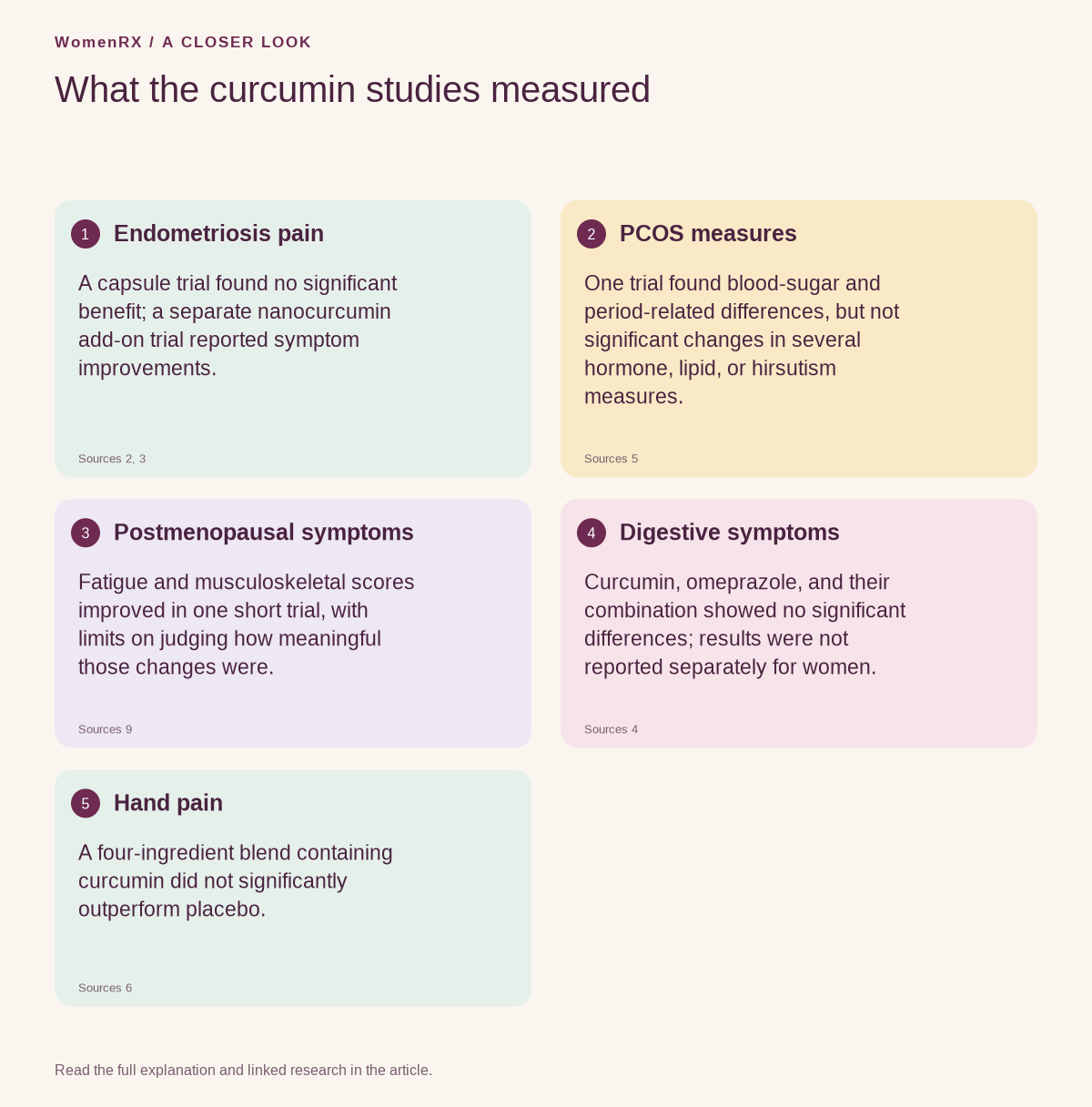
What the curcumin studies measured
Endometriosis pain: A capsule trial found no significant benefit; a separate nanocurcumin add-on trial reported symptom improvements.23
PCOS measures: One trial found blood-sugar and period-related differences, but not significant changes in several hormone, lipid, or hirsutism measures.5
Postmenopausal symptoms: Fatigue and musculoskeletal scores improved in one short trial, with limits on judging how meaningful those changes were.9
Digestive symptoms: Curcumin, omeprazole, and their combination showed no significant differences; results were not reported separately for women.4
Hand pain: A four-ingredient blend containing curcumin did not significantly outperform placebo.6
Read the figure as text
Each finding answers a narrower question than whether turmeric is broadly beneficial.- Endometriosis pain: A capsule trial found no significant benefit; a separate nanocurcumin add-on trial reported symptom improvements.23
- PCOS measures: One trial found blood-sugar and period-related differences, but not significant changes in several hormone, lipid, or hirsutism measures.5
- Postmenopausal symptoms: Fatigue and musculoskeletal scores improved in one short trial, with limits on judging how meaningful those changes were.9
- Digestive symptoms: Curcumin, omeprazole, and their combination showed no significant differences; results were not reported separately for women.4
- Hand pain: A four-ingredient blend containing curcumin did not significantly outperform placebo.6
More questions, answered
Do curcumin supplement studies tell us what turmeric in food will do?
No. These trials tested defined products, including curcumin capsules, nanocurcumin, a supplement blend, and an intravenous preparation. Their results don’t establish that turmeric used in cooking has the same effects. 2368
Sources you can check
- Nanomicelle curcumin improves oxidative stress, inflammatory markers, and assisted reproductive techniques outcomes in endometriosis cases: a randomized clinical trial.Jannatifar R, Asa E, Cheraghi E, Verdi A. · Naunyn-Schmiedeberg's archives of pharmacology · 2025Return to first citation
- Add-on effect of curcumin to dienogest in patients with endometriosis: a randomized, double-blind, controlled trial.Sargazi-Taghazi M, Ghaznavi H, Sheervalilou R, Razavi M, Sepidarkish M. · Phytomedicine : international journal of phytotherapy and phytopharmacology · 2025Return to first citation
- Effect of curcumin on painful symptoms of endometriosis: A triple-blind randomized controlled trial.Gudarzi R, Shabani F, Mohammad-Alizadeh-Charandabi S, Naghshineh E, Shaseb E, Mirghafourvand M. · Phytotherapy research : PTR · 2024Return to first citation
- Curcumin and proton pump inhibitors for functional dyspepsia: a randomised, double blind controlled trial.Kongkam P, Khongkha W, Lopimpisuth C, Chumsri C, Kosarussawadee P, Phutrakool P, Khamsai S, Sawanyawisuth K, Sura T, Phisalprapa P, Buamahakul T, Siwamogsatham S, Angsusing J, Poon... · BMJ evidence-based medicine · 2023Return to first citation
- The effect of Curcumin on metabolic parameters and androgen level in women with polycystic ovary syndrome: a randomized controlled trial.Ghanbarzadeh-Ghashti N, Ghanbari-Homaie S, Shaseb E, Abbasalizadeh S, Mirghafourvand M. · BMC endocrine disorders · 2023Return to first citation
- Efficacy and safety of a supplement combination on hand pain among people with symptomatic hand osteoarthritis an internet-based, randomised clinical trial the RADIANT study.Liu X, Robbins S, Eyles J, Fedorova T, Virk S, Deveza LA, McLachlan AJ, Hunter DJ. · Osteoarthritis and cartilage · 2021Return to first citation
- Curcumin supplementation combined with high intensity interval training modulates serum irisin and lipid profile in obese women: "A randomized double-blind clinical trial".Gharakhanlou BJ, Bonab SB, Amaghani A, Shiri-Shahsavar MR. · Contemporary clinical trials communications · 2025Return to first citation
- Efficacy and safety of curcumin in combination with paclitaxel in patients with advanced, metastatic breast cancer: A comparative, randomized, double-blind, placebo-controlled clinical trial.Saghatelyan T, Tananyan A, Janoyan N, Tadevosyan A, Petrosyan H, Hovhannisyan A, Hayrapetyan L, Arustamyan M, Arnhold J, Rotmann AR, Hovhannisyan A, Panossian A. · Phytomedicine : international journal of phytotherapy and phytopharmacology · 2020Return to first citation
- Effect of curcumin on fatigue and musculoskeletal health in postmenopausal women: a double-blind randomised controlled trial.Shabani F, Mashayekh-Amiri S, Mousavi Z, Shaseb E, Mirghafourvand M. · BMJ open · 2025Return to first citation