Turmeric After 40: Decide by the Symptom, Not Age
Curcumin has shown different results for different goals in small studies of postmenopausal women, so age alone isn’t a reason to take a supplement.
If you’re considering turmeric for hot flashes, fatigue, aches, or general health, start with the specific outcome you want to change. A few short trials in postmenopausal women found possible benefits for some symptoms, but the findings don’t establish a broad effect, a benefit from turmeric in food, or a reason to start at 40. 2 3
Start with the goal, not the birthday
Turmeric is a spice; curcumin is one of its compounds. The menopause studies tested curcumin capsules, not turmeric added to food. Their results don’t show that culinary turmeric eases menopause symptoms, or that every supplement has the same preparation as the one studied. 1 2 3
Nor do these studies make 40 a meaningful cutoff. They enrolled postmenopausal women, including women aged 40 to 60 in one trial. They don’t tell us whether the same results apply during perimenopause or to everyone over 40. 1 2 3
So “Is turmeric good for women over 40?” is less useful than “What do I want it to help with?” The evidence differs by outcome.
Hot flashes: a promising result from one small trial
An eight-week randomized trial assigned 93 postmenopausal women in Ahar, Iran, to curcumin, vitamin E, or placebo. At the end, the curcumin group had fewer hot flashes than the placebo group. The trial did not find significant between-group differences for anxiety, sexual function, or overall menopause symptoms. That makes this a specific hot-flash finding, not proof that curcumin treats menopause symptoms broadly. 2
A separate randomized trial enrolled 84 healthy postmenopausal women and compared curcumin, vitamin E, and placebo. Menopause symptom scores improved within all three groups. The reported advantage over placebo for anxiety was in the vitamin E group, not the curcumin group. Curcumin did change some blood markers related to inflammation and oxidative stress, but a change in a blood marker doesn’t by itself demonstrate symptom relief or disease prevention. 1
Taken together, the studies offer a reason to investigate curcumin for hot flashes further, but they don’t establish it as a dependable option for every woman. They were short and studied postmenopausal participants, not women across the full menopausal transition. 1 2
Fatigue and aches: encouraging results, with open questions
A 2025 placebo-controlled trial enrolled 74 postmenopausal women; 64 were included in the final analysis. After eight weeks, the curcumin group had a lower fatigue score and better musculoskeletal health scores than the placebo group. The average improvement in musculoskeletal health fell just short of the study’s stated threshold for a minimum clinically important difference. The researchers also noted that no such threshold had been validated for the fatigue scale, so it’s hard to tell how noticeable the average change might feel in daily life. 3
The trial did not find a significant difference in depression scores. Some participants reported stomach ache or headache, which contributed to dropouts; the reported results don’t give enough detail to estimate how often these effects occurred. 3
“General health” needs a more precise question
Blood sugar, cholesterol, and disease prevention are separate outcomes. A six-month trial in 120 postmenopausal women studied curcumin in a nanomicelle formulation and measured metabolic and hormone markers. The curcumin group showed changes in some markers, including fasting insulin and insulin resistance. The trial’s abstract reports significant placebo comparisons for glycemic indices, but this lab-marker finding does not establish that curcumin prevents diabetes or improves how someone feels. It also doesn’t show that an ordinary turmeric capsule works like the nanomicelle preparation. 4
That distinction matters if your goal is general health: a result for a particular formulation and a lab measurement is not proof of a broad health benefit. And because the menopause symptom trials tested capsules rather than turmeric in food, they don’t establish that dietary turmeric has the same effects. 1 2 3 4
A practical way to weigh the choice
Before considering a supplement, make the question specific: Are you looking for fewer hot flashes, less fatigue, or relief from aches? The best available match in these trials is not the same for each goal, and the positive findings are limited to postmenopausal participants over short study periods. 2 3
Next, compare the product you’re considering with the preparation studied. One metabolic trial used nanomicelle curcumin; the symptom studies used capsules. The studies don’t establish that different products are interchangeable, or which products are safe with particular medicines. If you take medication, have a pharmacist or clinician review the exact product and your current medicines rather than assuming that “turmeric” is one uniform supplement. 2 3 4
Finally, remember what the trials did not test: they compared curcumin with placebo, not with usual menopause care. Their findings don’t show that a supplement can replace care you already use or are considering. The useful decision isn’t whether turmeric is “worth it” after 40 in general. It’s whether the limited evidence for your particular goal is compelling enough to consider a specific product, given what remains uncertain. 2 3
Match the goal to the evidence
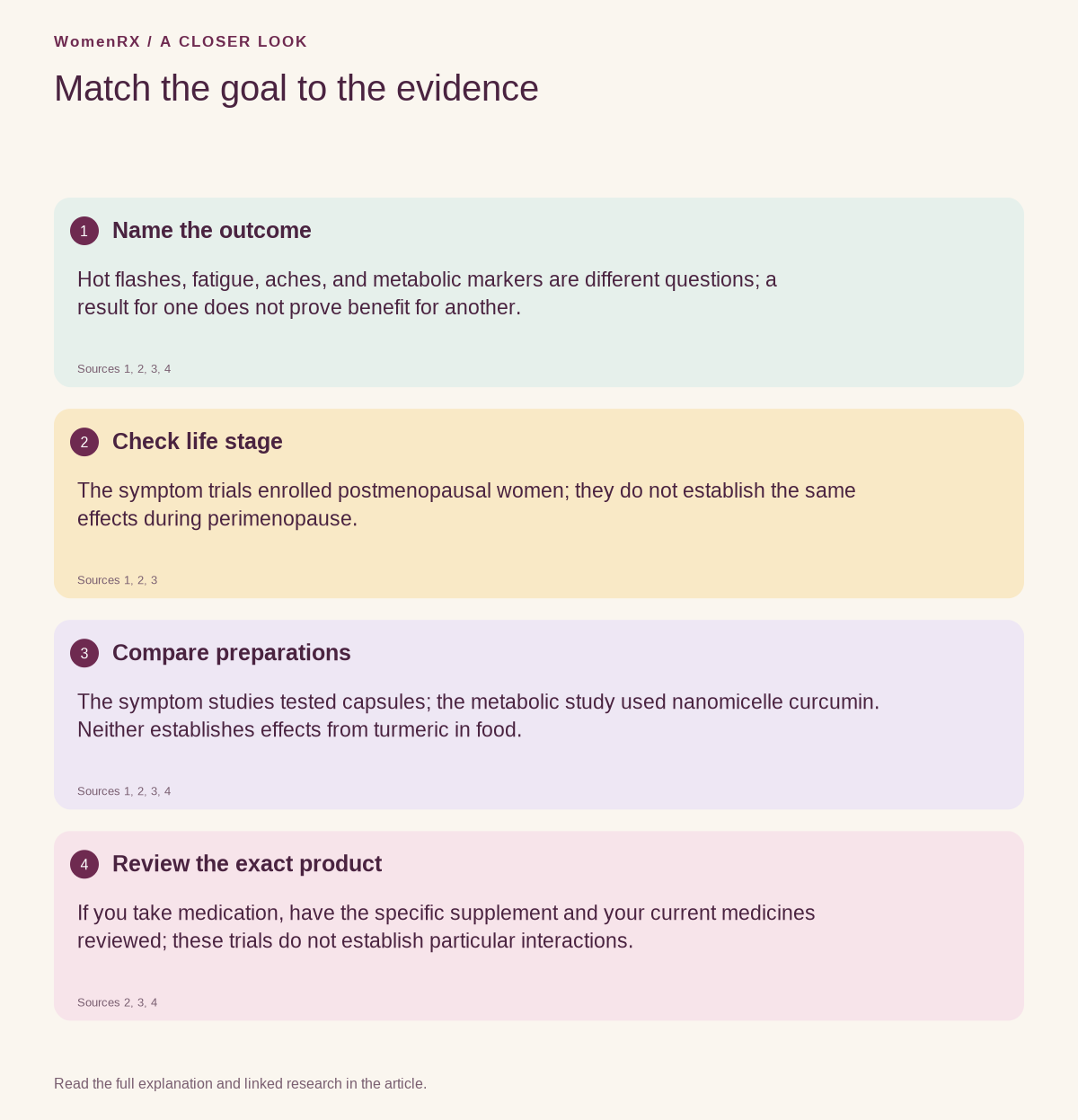
Name the outcome: Hot flashes, fatigue, aches, and metabolic markers are different questions; a result for one does not prove benefit for another.1234
Check life stage: The symptom trials enrolled postmenopausal women; they do not establish the same effects during perimenopause.123
Compare preparations: The symptom studies tested capsules; the metabolic study used nanomicelle curcumin. Neither establishes effects from turmeric in food.1234
Review the exact product: If you take medication, have the specific supplement and your current medicines reviewed; these trials do not establish particular interactions.234
Read the figure as text
Use this flow to connect the reason you’re considering curcumin with what studies in postmenopausal women actually measured.- Name the outcome: Hot flashes, fatigue, aches, and metabolic markers are different questions; a result for one does not prove benefit for another.1234
- Check life stage: The symptom trials enrolled postmenopausal women; they do not establish the same effects during perimenopause.123
- Compare preparations: The symptom studies tested capsules; the metabolic study used nanomicelle curcumin. Neither establishes effects from turmeric in food.1234
- Review the exact product: If you take medication, have the specific supplement and your current medicines reviewed; these trials do not establish particular interactions.234
Sources you can check
- Clinical Efficacy of Curcumin and Vitamin E on Inflammatory-Oxidative Stress Biomarkers and Primary Symptoms of Menopause in Healthy Postmenopausal Women: A Triple-Blind Randomized Controlled Trial.Farshbaf-Khalili A, Ostadrahimi A, Mirghafourvand M, Ataei-Almanghadim K, Dousti S, Iranshahi AM. · Journal of nutrition and metabolism · 2022Return to first citation
- The effect of oral capsule of curcumin and vitamin E on the hot flashes and anxiety in postmenopausal women: A triple blind randomised controlled trial.Ataei-Almanghadim K, Farshbaf-Khalili A, Ostadrahimi AR, Shaseb E, Mirghafourvand M. · Complementary therapies in medicine · 2020Return to first citation
- Effect of curcumin on fatigue and musculoskeletal health in postmenopausal women: a double-blind randomised controlled trial.Shabani F, Mashayekh-Amiri S, Mousavi Z, Shaseb E, Mirghafourvand M. · BMJ open · 2025Return to first citation
- The Efficacy of Nigella sativa L. and Curcumin Nanomicelle Alone or Together on Lipid Profile, Glycemic Control Indices, and Serum 17-Β Estradiol in Postmenopausal Women.Sadeghzadeh Z, Ostadrahimi A, Ranjbar M, Farshbaf-Khalili A. · Journal of caring sciences · 2023Return to first citation