Can Turmeric or Curcumin Change Body Weight?
Some curcumin trials report weight loss, but their results don’t predict what will happen if you take a supplement.
Curcumin hasn’t been shown to produce a predictable weight change across different people. A 24-week trial in people with fatty liver found greater average weight loss than placebo, while a three-month diabetes trial found no significant difference. The studies tested particular curcumin products in particular groups, not turmeric used in food. 2 4
What did the trials measure?
The clearest number comes from a 24-week randomized trial of 80 people with nonalcoholic simple fatty liver. Compared with placebo, the curcumin group had a 2.6 kg greater reduction in body weight and a 1.0 kg/m² greater reduction in BMI. Those are differences between groups, not a promise that each person taking curcumin lost that amount. 4
Other findings are less consistent. In a three-month trial of 60 people with type 2 diabetes, weight and BMI did not differ significantly among the curcumin, fenofibrate, and placebo groups. Everyone in that trial was also taking the same diabetes medication, so its result describes curcumin added in that setting. 2
A 12-week pilot enrolled 28 older adults with prediabetes or overweight or obesity; 23 completed it. The reported summary found no significant changes in BMI or body composition. It lists body weight among the outcomes measured but doesn’t give the weight result, so it cannot answer whether weight changed. 5
A larger, 12-month trial in 272 people with type 2 diabetes reported a lower BMI in the curcumin group. Its reported results don’t provide a clear between-group weight-change estimate, making the practical size of its weight finding hard to compare with the fatty-liver trial. 3
A review covering 103 randomized trials rated the credibility of the evidence for weight as high. That deserves attention, but the review’s abstract gives neither a pooled weight estimate nor its direction. The rating alone cannot tell you how much weight to expect to lose or gain. The authors also called for larger, better-designed, longer trials. 7
Why the product and the person matter
These studies tested curcumin supplements or extracts, not turmeric sprinkled into a meal. They also used different formulations and followed different groups. A result in people with fatty liver or diabetes doesn’t automatically apply to someone taking an over-the-counter product for general weight management. 2 3 4 5
There’s a women-only trial worth separating from those results. In a 12-week study of 200 women with polycystic ovary syndrome (PCOS), the group taking metformin and nanocurcumin together had reported improvements in weight and BMI compared with the other treatment groups. That combination result doesn’t establish the effect of nanocurcumin taken alone. 6 The other weight-related trial summaries discussed here don’t report weight outcomes separately for women and men, so they cannot show whether responses differ by sex. 2 3 4 5
Finally, a scale reading isn’t the same as a body-fat measurement. Weight includes fat, muscle, bone, and water; BMI doesn’t distinguish among those tissues. That’s why a trial reporting BMI, weight, or body composition is answering a slightly different question each time. 1
A better way to read a weight-loss claim
Look for the comparison: did people taking curcumin change more than people taking a placebo, or did they simply change from their own starting weight? Then check the condition being studied, the formulation, and how long the trial lasted. The 2.6 kg difference in the fatty-liver study is a real reported group-level finding. Alongside trials with different or incompletely reported weight results, it isn’t a dependable forecast for you. 2 3 4 5
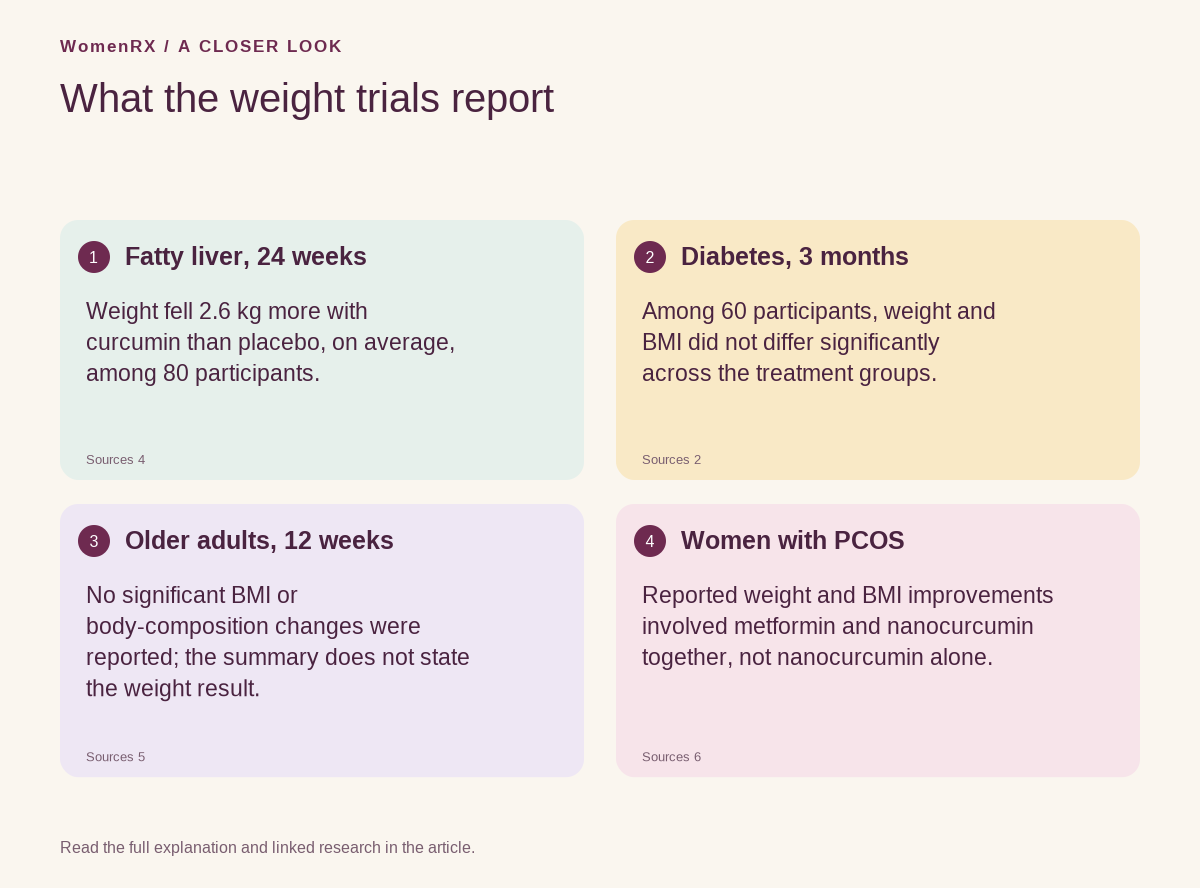
What the weight trials report
Fatty liver, 24 weeks: Weight fell 2.6 kg more with curcumin than placebo, on average, among 80 participants.4
Diabetes, 3 months: Among 60 participants, weight and BMI did not differ significantly across the treatment groups.2
Older adults, 12 weeks: No significant BMI or body-composition changes were reported; the summary does not state the weight result.5
Women with PCOS: Reported weight and BMI improvements involved metformin and nanocurcumin together, not nanocurcumin alone.6
Read the figure as text
The outcome and the group studied change what each curcumin result can tell you.- Fatty liver, 24 weeks: Weight fell 2.6 kg more with curcumin than placebo, on average, among 80 participants.4
- Diabetes, 3 months: Among 60 participants, weight and BMI did not differ significantly across the treatment groups.2
- Older adults, 12 weeks: No significant BMI or body-composition changes were reported; the summary does not state the weight result.5
- Women with PCOS: Reported weight and BMI improvements involved metformin and nanocurcumin together, not nanocurcumin alone.6
More questions, answered
Does using turmeric in food have the same weight evidence?
No. These weight-related trials tested curcumin supplements or extracts, not turmeric used as a seasoning. Their findings don’t establish a weight effect from adding turmeric to meals. 2 3 4 5
Sources you can check
- Body Weight: MedlinePlusAccessed 2026-09-25Return to first citation
- Effect of adding fenofibrate versus curcumin to glimepiride in patients with type 2 diabetes: a randomized controlled trial.Nada EM, El-Gharbawy NM, Abbas H, Werida RH. · BMC pharmacology & toxicology · 2025Return to first citation
- Curcumin extract improves beta cell functions in obese patients with type 2 diabetes: a randomized controlled trial.Yaikwawong M, Jansarikit L, Jirawatnotai S, Chuengsamarn S. · Nutrition journal · 2024Return to first citation
- Curcumin supplementation alleviates hepatic fat content associated with modulation of gut microbiota-dependent bile acid metabolism in patients with nonalcoholic simple fatty liver disease: a randomized controlled trial.He Y, Chen X, Li Y, Liang Y, Hong T, Yang J, Cao Z, Mai H, Yao J, Zhang T, Wu K, Zou J, Feng D. · The American journal of clinical nutrition · 2024Return to first citation
- Twelve-Week Curcumin Supplementation Improves Glucose Homeostasis and Gut Health in Prediabetic Older Adults: A Pilot, Double-Blind, Placebo-Controlled Trial.Lamichhane G, Godsey TJ, Liu J, Franks R, Zhang G, Emerson SR, Kim Y. · Nutrients · 2025Return to first citation
- Effects of metformin and curcumin in women with polycystic ovary syndrome: A factorial clinical trial.Feghhi F, Ghaznavi H, Sheervalilou R, Razavi M, Sepidarkish M. · Phytomedicine : international journal of phytotherapy and phytopharmacology · 2024Return to first citation
- Curcumin on Human Health: A Comprehensive Systematic Review and Meta-Analysis of 103 Randomized Controlled Trials.Jafari A, Abbastabar M, Alaghi A, Heshmati J, Crowe FL, Sepidarkish M. · Phytotherapy research : PTR · 2024Return to first citation