Turmeric and Curcumin: What Matters More Than Timing
For a curcumin supplement, the reason you’re taking it and the product’s formulation matter more than the hour on the clock.
There’s no established best time of day to take turmeric or curcumin for better results. If you’re considering a supplement for knee osteoarthritis, some trials suggest improvements in pain and function, but the best formulation and frequency remain unclear. Turmeric used in food isn’t the same as a concentrated extract, and greater absorption doesn’t prove greater symptom relief.89
Start with the reason you’re taking it
Turmeric in a meal and curcumin in a capsule are different choices. Turmeric is a spice that contains curcuminoids, including curcumin. Supplements may contain concentrated extracts, sometimes combined with ingredients or delivery systems designed to increase absorption. Results from a trial of one supplement can’t automatically be applied to a spoonful of spice or to another brand’s formula.568
So before asking whether morning or evening is best, ask what result you’re hoping for. Knee osteoarthritis is one condition with human trial evidence. For many other proposed uses, the evidence is not strong enough to establish a benefit.89
For knee pain, the signal is promising but not settled
Knee osteoarthritis can make stairs, walking, and getting up after sitting painful or stiff. A systematic review of 10 randomized trials found that participants taking turmeric or curcumin preparations improved from where they started on pain and function measures. Its authors saw a possible benefit compared with placebo, but could not identify an optimal dose, frequency, or formulation. Three of the trials compared turmeric preparations with nonsteroidal anti-inflammatory drugs (NSAIDs) and found no statistically significant difference in outcome scores. That small comparison does not establish that a supplement is interchangeable with an NSAID.38
Another review identified 17 osteoarthritis trials and reported improvements on commonly used pain and symptom scales across varied curcumin formulations. The National Center for Complementary and Integrative Health describes the initial knee osteoarthritis findings as positive, while calling for higher-quality evidence. These are studies of people with osteoarthritis, not proof of a distinct effect in women; the knee-focused review did not report a women-specific result in the material described.789
If joint symptoms are persistent, establishing that they’re osteoarthritis matters more than choosing a supplement time. Regular exercise, including muscle-strengthening activity, is a mainstay of osteoarthritis care; pain-relief options can be considered alongside it.24
Does a more absorbable formula work better?
Curcumin has low natural bioavailability, which is why products may pair it with piperine from black pepper or use approaches such as phospholipid complexes. Those changes are intended to increase how much is absorbed. Absorption is one step on the way to a possible effect, though, not a measure of how much better your knee will feel.69
The knee trials used differing preparations, making it hard to separate a formulation’s effect from other differences between studies. A review noted that some higher-bioavailability compounds tended to show more positive results, but could not settle which preparation or frequency works best. A label that advertises higher absorption is therefore not, by itself, evidence of better clinical results.789
The same limitation applies to timing. The clinical review could not determine the best frequency, and this evidence does not establish a morning-versus-evening advantage. Rather than rearranging your day around a claimed ‘ideal’ hour, look at whether the specific product has been studied for the symptom you want to address.8
Check the concentrated product, not just the spice
Ordinary turmeric in food has a different safety context from a concentrated supplement. Turmeric is recognized as safe as a food ingredient, but oral turmeric products can cause stomach upset, reflux, nausea, diarrhea, or constipation. Liver injury has been reported in people using some enhanced-bioavailability curcumin products. If you develop dark urine or yellowing of the skin or eyes while using one, stop the product and seek medical advice promptly; fatigue, nausea, and poor appetite can also be warning signs.59
If you take warfarin or an antiplatelet medicine, check before adding a turmeric supplement: LactMed notes a possible increased bleeding risk with these medicines. Don’t assume a product with piperine is equivalent to one without it, either. Supplements can contain multiple ingredients, and testing of one product may not apply to another.5
Gallstones deserve a separate distinction. They can cause abdominal pain when a stone blocks a bile duct, and complications can include jaundice. Those symptoms warrant assessment whether or not you use supplements. Gallstone guidance alone does not establish that turmeric or curcumin triggers gallbladder attacks or that people with gallstones need a turmeric-specific restriction.1
Pregnancy and breastfeeding are different questions
Turmeric’s standing as a food ingredient should not be stretched into a safety claim for concentrated supplements during pregnancy. The cited food-safety information does not establish pregnancy safety for extracts or enhanced-absorption products.5
During breastfeeding, LactMed reports no data on whether turmeric components pass into breast milk; a small study found no adverse effects in exposed infants. It also says there’s no scientific evidence supporting turmeric as a way to increase milk production. Those findings don’t make every concentrated curcumin product, particularly one with additional ingredients, equivalent to turmeric used in cooking.5
The practical distinction is simple: choose based on the symptom and evidence for the specific preparation, not a promise about the perfect time to take it. For knee osteoarthritis, there’s a possible benefit worth weighing against uncertain formulation advantages and relevant safety concerns. For turmeric in dinner, you don’t need to treat the clock like part of a clinical trial.589
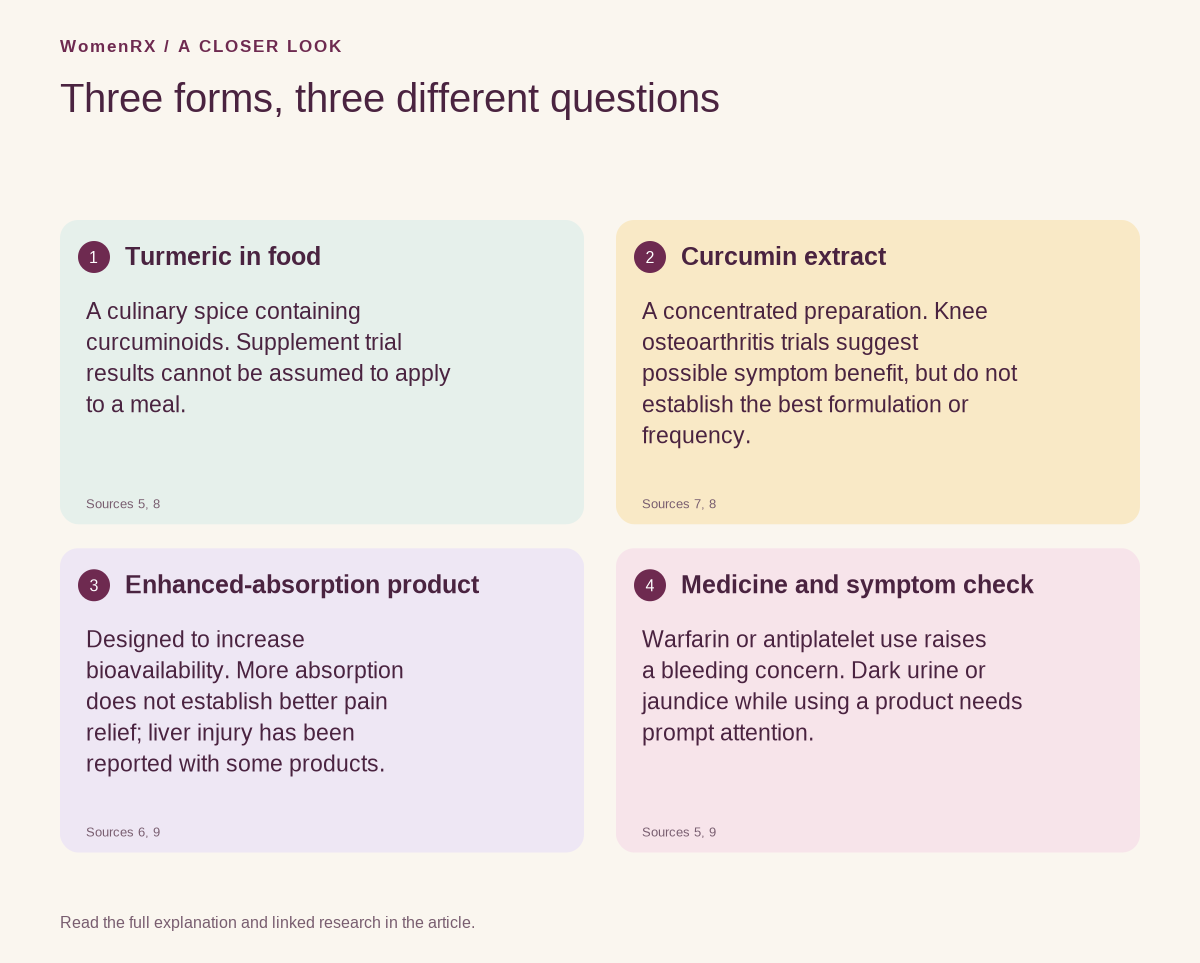
Three forms, three different questions
Turmeric in food: A culinary spice containing curcuminoids. Supplement trial results cannot be assumed to apply to a meal.58
Curcumin extract: A concentrated preparation. Knee osteoarthritis trials suggest possible symptom benefit, but do not establish the best formulation or frequency.78
Enhanced-absorption product: Designed to increase bioavailability. More absorption does not establish better pain relief; liver injury has been reported with some products.69
Medicine and symptom check: Warfarin or antiplatelet use raises a bleeding concern. Dark urine or jaundice while using a product needs prompt attention.59
Read the figure as text
The form tells you what evidence can reasonably be applied to your choice; it does not tell you the best hour to use it.- Turmeric in food: A culinary spice containing curcuminoids. Supplement trial results cannot be assumed to apply to a meal.58
- Curcumin extract: A concentrated preparation. Knee osteoarthritis trials suggest possible symptom benefit, but do not establish the best formulation or frequency.78
- Enhanced-absorption product: Designed to increase bioavailability. More absorption does not establish better pain relief; liver injury has been reported with some products.69
- Medicine and symptom check: Warfarin or antiplatelet use raises a bleeding concern. Dark urine or jaundice while using a product needs prompt attention.59
More questions, answered
Is curcumin proven to work better than turmeric spice for knee pain?
No direct rule like that follows from the knee osteoarthritis reviews. Trials used varied therapeutic preparations, and their results do not tell us that culinary turmeric will have the same effect or establish which supplement formulation works best.8
Sources you can check
- Gallstones - NHSAccessed 2026-09-25Return to first citation
- Osteoarthritis - NHSAccessed 2026-09-25Return to first citation
- Osteoarthritis - Symptoms - NHSAccessed 2026-09-25Return to first citation
- Osteoarthritis - Treatment and support - NHSAccessed 2026-09-25Return to first citation
- Turmeric2006Return to first citation
- Dietary Bioactive Compounds and Their Role in Allergy Prevention: A Comprehensive Review.Zafrilla P, Ballester P, Victoria-Montesinos D, Cerdá B, Marhuenda J, Arcusa R, García-Muñoz AM. · Nutrients · 2025Return to first citation
- A Systematic Review of the Clinical Use of Curcumin for the Treatment of Osteoarthritis.Shokri-Mashhadi N, Bagherniya M, Askari G, Sathyapalan T, Sahebkar A. · Advances in experimental medicine and biology · 2021Return to first citation
- Therapeutic effects of turmeric or curcumin extract on pain and function for individuals with knee osteoarthritis: a systematic review.Paultre K, Cade W, Hernandez D, Reynolds J, Greif D, Best TM. · BMJ open sport & exercise medicine · 2021Return to first citation
- Turmeric: Usefulness and Safety | NCCIHAccessed 2026-09-25Return to first citation