How to Compare Turmeric and Curcumin Supplements
The label’s exact preparation matters because turmeric powder, curcumin extracts, and enhanced-form products aren’t interchangeable in research.
Start by checking whether a product is turmeric powder, a turmeric extract, or a named curcumin preparation, then compare that description with the product used in the study you care about. Research has tested varied formulations, and results don’t show that an added absorption ingredient or a higher-sounding label claim leads to better outcomes. A product label is a way to assess what’s disclosed, not proof of benefit. 4 6
First, identify what’s in the capsule
“Turmeric” and “curcumin” aren’t precise substitutes on a label. Turmeric (Curcuma longa) is the plant; curcumin is one of its compounds. Products may be described as turmeric powder, turmeric extract, curcuminoids, or a particular curcumin preparation. Those descriptions tell you something about the ingredient, but they don’t establish that two products provide the same preparation or have the same effects. 4 6
That distinction matters when you compare a label with research. A 2025 pilot trial studied a turmeric capsule containing curcumin in people with hand osteoarthritis. A separate pilot trial in postmenopausal women with aromatase-inhibitor-related joint symptoms tested nanoemulsion curcumin. Those are different products studied in different circumstances; neither trial establishes that ordinary turmeric powder works the same way. 4 5
Use the study as a comparison, not a shopping claim
For the condition or outcome you’re considering, look for the study’s actual product description and ask:
- What form was tested? Was it turmeric, an extract, curcumin, or a named formulation?
- What did the study report? Check the amount and how it was described. A number on one product’s label isn’t automatically comparable with a number from a differently prepared product.
- Was it a single ingredient? In a 2026 knee-osteoarthritis trial, curcumin and piperine were part of a five-ingredient combination. The combination didn’t reduce pain more than placebo at 12 weeks, so that result can’t tell you whether curcumin alone, or a different product, would have the same result. 3
- Who took part, and what was measured? The hand-osteoarthritis trial was very small. In its curcumin group, some scores improved from baseline, but the abstract does not establish a clear benefit over placebo. The women-only nanoemulsion pilot found no significant difference between treatment and placebo on its reported symptom measures. 4 5
These examples show why “clinically studied” is incomplete on its own. The preparation, comparison group, participants, and outcome all matter. A 2022 review pooled trials across several kinds of arthritis and varied curcumin and turmeric preparations; it described the evidence as limited by the low quality and small quantity of trials. 6
Check the women’s evidence for your situation
A study that includes women doesn’t necessarily tell you whether the result applies to women specifically. For example, the 2026 combination trial reported that 57% of participants were female, but its abstract did not report a women-only result. By contrast, the nanoemulsion pilot specifically enrolled postmenopausal women experiencing joint symptoms while taking aromatase inhibitors for breast cancer. In that small trial, symptom measures did not differ significantly between curcumin and placebo. 3 5
The life stage and reason for symptoms matter, too. Evidence in postmenopausal women with treatment-related joint symptoms does not establish benefit or safety during pregnancy or breastfeeding, or for a different type of joint pain. The studies summarized here don’t establish safety in pregnancy or breastfeeding. If either applies to you, ask your obstetric clinician or pharmacist about the specific product before using it.
Read testing claims for what they actually say
A testing statement is more useful when you can tell who tested the product, whether the result applies to the specific batch, and what was tested. Record those details separately from claims about the ingredient’s benefits. The clinical trials above do not establish which testing seals, laboratories, or testing standards are reliable, and a testing claim by itself does not show that a product will help your symptoms.
A practical comparison can fit on one note: ingredient form; named preparation; amount as labeled; added ingredients; testing details; and the closest matching human study. If a label doesn’t disclose something, mark it “not stated” rather than assuming it matches the research.
Keep the product in perspective
Even a close label match doesn’t guarantee the same result outside a trial. For knee or hand osteoarthritis, the evidence varies by product and study, and the available findings don’t support ranking brands. Exercise and other established osteoarthritis care remain separate considerations; a supplement label shouldn’t substitute for an assessment of persistent joint symptoms. 1 2 6
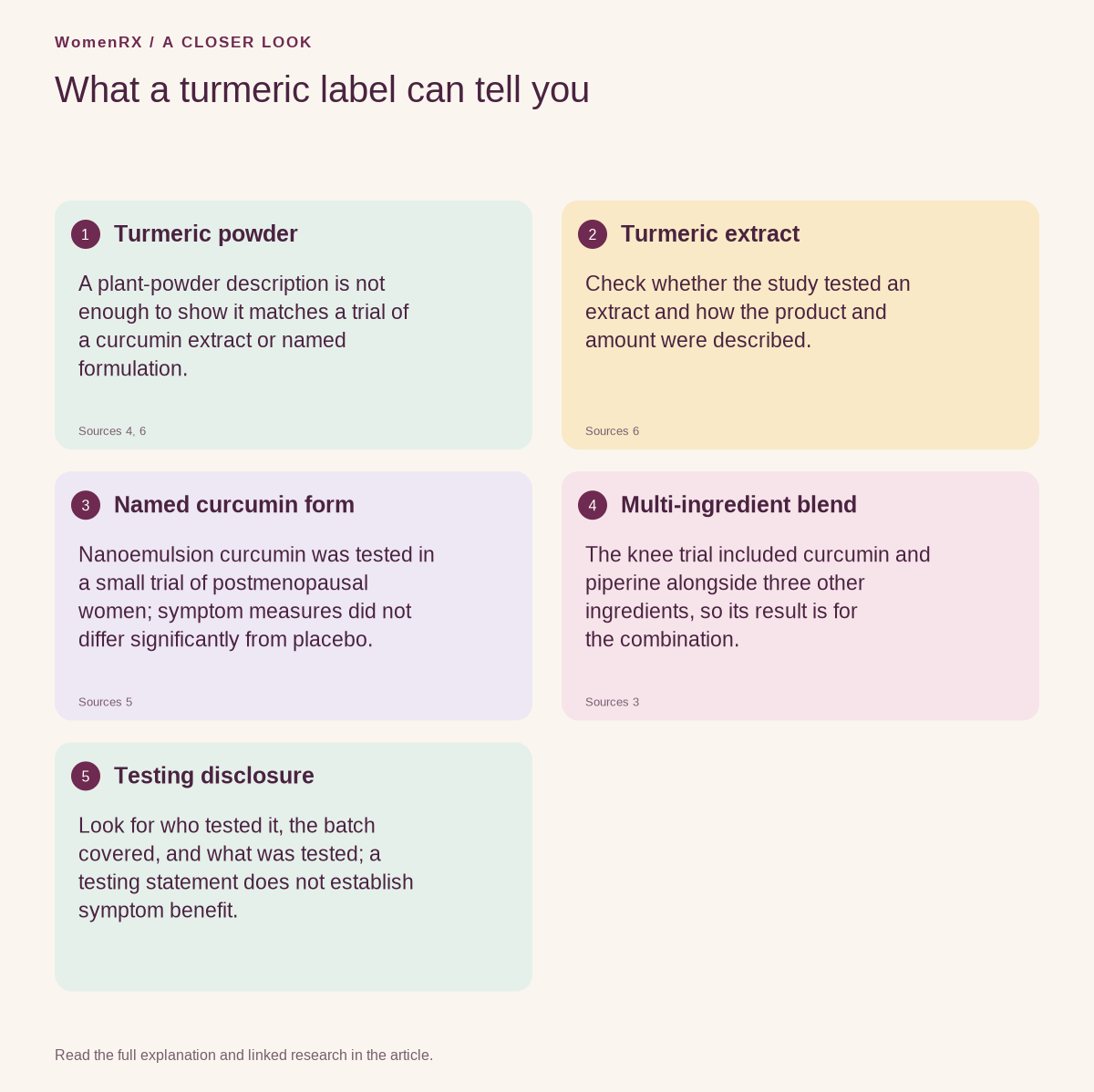
What a turmeric label can tell you
Turmeric powder: A plant-powder description is not enough to show it matches a trial of a curcumin extract or named formulation.46
Turmeric extract: Check whether the study tested an extract and how the product and amount were described.6
Named curcumin form: Nanoemulsion curcumin was tested in a small trial of postmenopausal women; symptom measures did not differ significantly from placebo.5
Multi-ingredient blend: The knee trial included curcumin and piperine alongside three other ingredients, so its result is for the combination.3
Testing disclosure: Look for who tested it, the batch covered, and what was tested; a testing statement does not establish symptom benefit.
Read the figure as text
Compare the product description with what a human study actually tested; similar ingredient words do not establish an equivalent preparation or outcome.- Turmeric powder: A plant-powder description is not enough to show it matches a trial of a curcumin extract or named formulation.46
- Turmeric extract: Check whether the study tested an extract and how the product and amount were described.6
- Named curcumin form: Nanoemulsion curcumin was tested in a small trial of postmenopausal women; symptom measures did not differ significantly from placebo.5
- Multi-ingredient blend: The knee trial included curcumin and piperine alongside three other ingredients, so its result is for the combination.3
- Testing disclosure: Look for who tested it, the batch covered, and what was tested; a testing statement does not establish symptom benefit.
More questions, answered
Does a product with an absorption ingredient work better?
Not necessarily. A formulation designed to change how curcumin is delivered is still a different preparation, and an absorption claim doesn’t prove better symptom relief. In a pilot trial of nanoemulsion curcumin in postmenopausal women with aromatase-inhibitor-related joint symptoms, symptom measures did not differ significantly from placebo. 5
Can I compare turmeric capsules with a curcumin study?
Only cautiously. Check whether the study used turmeric, an extract, curcumin, or a specific formulation, and whether it studied the same condition and people. The arthritis trials used varied preparations, so a shared ingredient name alone doesn’t make products equivalent. 4 6
Sources you can check
- Osteoarthritis - NHSAccessed 2026-09-25Return to first citation
- Osteoarthritis - Treatment and support - NHSAccessed 2026-09-25Return to first citation
- Effect of an oral complementary medicine combination for symptomatic knee osteoarthritis: A double-blind, randomized, placebo-controlled trial.Yuan S, Liu X, Bracken K, Christensen R, Deveza LA, Collins S, Harnett JE, McLachlan AJ, Robbins S, Venkatesha V, Bowden JL, Hunter DJ. · Osteoarthritis and cartilage · 2026Return to first citation
- Efficacy and safety of curcumin in patients with hand osteoarthritis: a pilot double-blinded randomised controlled trial.Tuntiyatorn P, Lerspongpaibool C, Kanchanathepsak T, Watcharananan I, Tawonsawatruk T. · BMC complementary medicine and therapies · 2025Return to first citation
- Randomized placebo-controlled, double-blind clinical trial of nanoemulsion curcumin in women with aromatase inhibitor-induced arthropathy: an Alliance/NCORP pilot trial.Lustberg M, Fan-Havard P, Wong FL, Hill K, Phelps MA, Herrera KW, Tsai NC, Synold T, Feng Y, Kalu C, Sedrak MS, Yee LD. · Breast cancer research and treatment · 2024Return to first citation
- Efficacy and Safety of Curcumin and Curcuma longa Extract in the Treatment of Arthritis: A Systematic Review and Meta-Analysis of Randomized Controlled Trial.Zeng L, Yang T, Yang K, Yu G, Li J, Xiang W, Chen H. · Frontiers in immunology · 2022Return to first citation