Does Turmeric Need to Be Taken With Food?
An empty-stomach absorption study isn’t an instruction to take every turmeric supplement before breakfast.
No universal food rule applies to turmeric or curcumin supplements. Studies that measured absorption while participants fasted compared particular formulations, not the same product with and without a meal. If your label specifies timing, follow it. If it doesn’t, you don’t need to choose an empty stomach for absorption; if the product upsets your stomach, trying it with a meal is reasonable, though food hasn’t been shown to prevent that discomfort.124
What an empty-stomach study actually tells you
Curcumin is one of the compounds in turmeric. Supplement makers package it in different ways, including concentrated extracts and formulations designed to increase absorption. Those differences matter more to this question than a blanket rule about meals.14
In one study, 24 healthy adults took single doses of either a specially formulated curcumin product or a concentrated turmeric extract after fasting. Researchers found higher blood levels of curcuminoids with the formulated product. Because every treatment was taken while fasting, the study can compare those products under that condition. It cannot tell you whether either one would have worked better with food.1
Another absorption study compared three formulations in healthy adult men, again with all products taken while fasting. The products produced different blood levels, but there was no meal comparison. It also did not study women.2 In other words, “tested on an empty stomach” doesn’t mean “must be taken on an empty stomach.”
You may also see a product described as phytosomal, phospholipid, or enhanced absorption. Those words describe formulation approaches, not a shared meal schedule. For example, an eight-week trial had participants take one curcumin phytosome product after dinner, but it did not test after-dinner dosing against fasting dosing.3 Higher absorption, when demonstrated, is not by itself proof of a greater health benefit. More research is needed to understand how curcumin bioavailability affects its benefits.4
A practical choice when the label is unclear
Start with the directions for your product rather than borrowing instructions from a study of another one. If the label says to take it with food, use that direction. If it specifies an empty stomach and taking it that way repeatedly makes you feel unwell, you don’t have to keep pushing through the discomfort to match an absorption study. Ask a pharmacist whether that direction matters for the particular formulation, or stop using the product.
If the label gives no food instruction, fasting-study results alone give you no reason to skip a meal. For example, if a capsule makes you queasy before breakfast, you could try taking it alongside breakfast instead. That’s a practical way to see whether the timing feels better for you, not a proven method for preventing side effects or increasing absorption. Turmeric taken by mouth can cause nausea, reflux, stomach upset, diarrhea, or constipation.4 If discomfort keeps returning, changing the timing may not solve it; consider stopping the supplement rather than treating a persistent reaction as a scheduling problem.
This choice doesn’t require adding fat to a meal, either. The human comparisons above did not establish that a fatty meal is necessary for the products they studied, let alone every turmeric supplement.12
When the question is bigger than meal timing
A little stomach upset and signs of possible liver trouble are different situations. Liver damage has been reported in some people using curcumin products designed for increased bioavailability. If you develop dark urine or yellowing of the skin or eyes while taking one, stop it and seek medical advice promptly rather than experimenting with meal timing.4
If you’re pregnant, the question isn’t simply whether to take a supplement with breakfast: turmeric supplements may be unsafe during pregnancy. While breastfeeding, little is known about the safety of turmeric amounts greater than those commonly found in food. Absorption studies in healthy adults, including one conducted only in men, don’t answer those questions.42
What the dosing studies can tell you
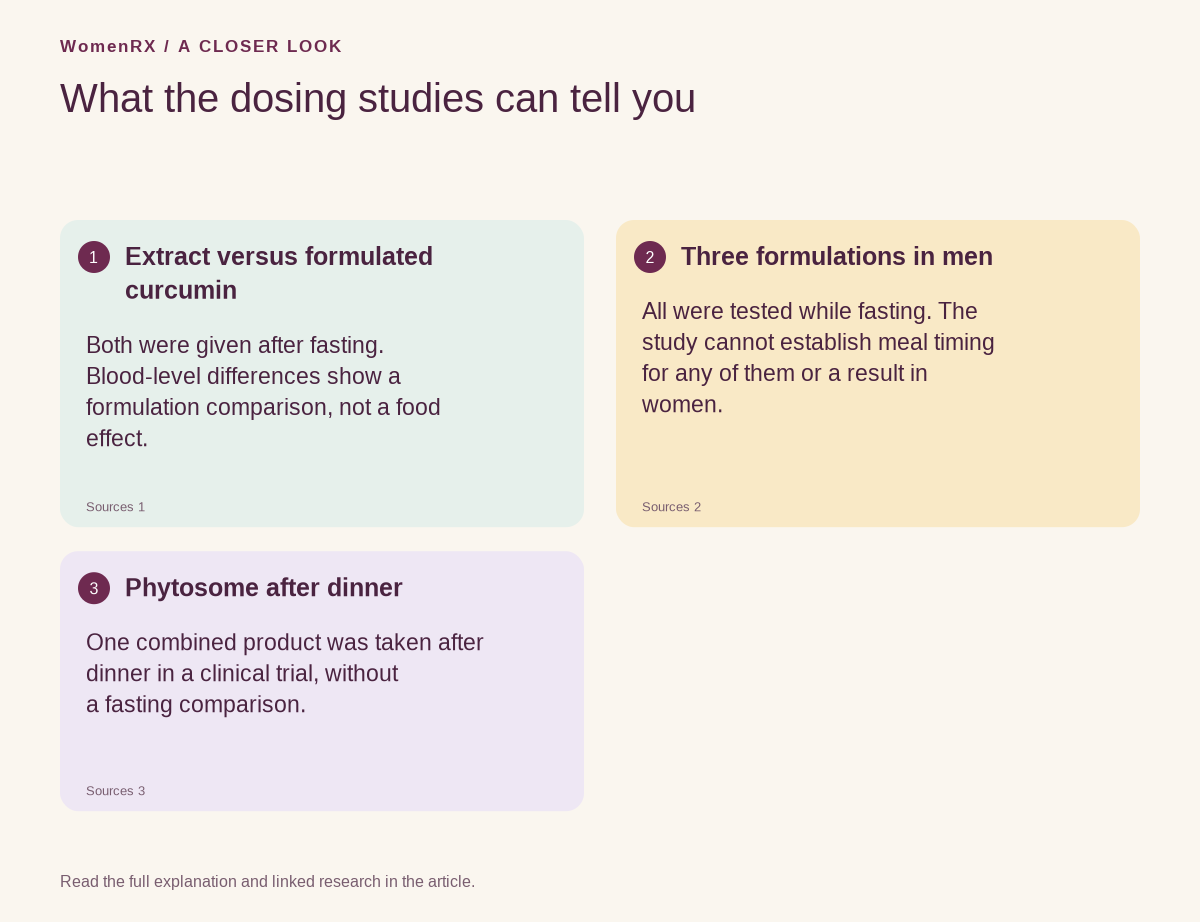
Extract versus formulated curcumin: Both were given after fasting. Blood-level differences show a formulation comparison, not a food effect.1
Three formulations in men: All were tested while fasting. The study cannot establish meal timing for any of them or a result in women.2
Phytosome after dinner: One combined product was taken after dinner in a clinical trial, without a fasting comparison.3
Read the figure as text
These studies used different products and schedules. None compared the same product with a meal versus on an empty stomach.- Extract versus formulated curcumin: Both were given after fasting. Blood-level differences show a formulation comparison, not a food effect.1
- Three formulations in men: All were tested while fasting. The study cannot establish meal timing for any of them or a result in women.2
- Phytosome after dinner: One combined product was taken after dinner in a clinical trial, without a fasting comparison.3
Sources you can check
- Superior Bioavailability of a Novel Curcumin Formulation in Healthy Humans Under Fasting Conditions.Kothaplly S, Alukapally S, Nagula N, Maddela R. · Advances in therapy · 2022Return to first citation
- Comparative Oral Absorption of Curcumin in a Natural Turmeric Matrix with Two Other Curcumin Formulations: An Open-label Parallel-arm Study.Gopi S, Jacob J, Varma K, Jude S, Amalraj A, Arundhathy CA, George R, Sreeraj TR, Divya C, Kunnumakkara AB, Stohs SJ. · Phytotherapy research : PTR · 2017Return to first citation
- Effects of phytosomal curcumin on anthropometric parameters, insulin resistance, cortisolemia and non-alcoholic fatty liver disease indices: a double-blind, placebo-controlled clinical trial.Cicero AFG, Sahebkar A, Fogacci F, Bove M, Giovannini M, Borghi C. · European journal of nutrition · 2020Return to first citation
- Turmeric: Usefulness and Safety | NCCIHAccessed 2026-09-25Return to first citation