Turmeric Supplements: What the Evidence Actually Tests
Curcumin studies use different products and measure different kinds of joint pain, so a result for one preparation may not apply to the bottle you’re considering.
Curcumin has been studied for osteoarthritis pain in several forms, including a nano-curcumin capsule, a curcumin ointment, and an oral turmeric capsule. Small trials and a review suggest possible symptom relief, but the evidence has limits. In a pilot trial among postmenopausal women with aromatase inhibitor-related joint pain, nanoemulsion curcumin did not outperform placebo. These findings don’t establish that turmeric products are interchangeable. 1 3 4 5 6
If you’re comparing turmeric supplements because your knees, hands, or joints hurt, start with the exact outcome and preparation a study tested. “Curcumin helped with arthritis” can sound like one clear result. It isn’t: studies have used different formulations, involved different types of arthritis, and measured different symptoms.
The clearest evidence is about possible symptom relief
A 2022 systematic review and meta-analysis included 29 randomized trials with 2,396 participants across five types of arthritis. It found that curcumin or Curcuma longa extract may improve pain and other symptoms. But the authors cautioned that the trials were limited in quality and number, so the findings need careful interpretation. Results pooled across different arthritis conditions don’t tell you exactly what to expect for one joint or one product. 5
For knee osteoarthritis, one small randomized trial tested 40 mg of nanocurcumin every 12 hours against placebo for six weeks. The researchers reported better scores for pain, stiffness, and physical function in the nanocurcumin group. That result applies to that specific preparation and trial, not automatically to a standard turmeric capsule or another product marketed as “high absorption.” 6
A different trial tested a topical 5% curcumin ointment, not an oral supplement, in 72 older adults with knee osteoarthritis. After six weeks, pain scores were lower in the ointment group than in the Vaseline group. A cream or ointment result isn’t evidence that swallowing a capsule will have the same effect. 1
A 2025 pilot trial in 27 people with hand osteoarthritis tested an oral turmeric capsule containing curcumin against placebo. Pain and hand-function scores improved from baseline in the curcumin group by the third month, but the small study leaves uncertainty about how reliably that result would hold in a larger trial. 3
“More absorbable” doesn’t mean proven better
Curcumin has been studied in forms intended to change how it’s delivered or absorbed, including nanocurcumin and nanoemulsion curcumin. The important distinction is that these are different preparations, not interchangeable labels for one proven effect. The studies summarized here don’t establish that a more absorbable formulation works better than a conventional product, or show which preparation is best for you.
That difference matters when you read a label. Check whether the product is a plain turmeric or curcumin capsule, a named delivery formulation, a topical product, or a combination of ingredients. Then compare that with the preparation and outcome in the study you’re relying on. A trial of a topical ointment, for example, can’t support a claim about an oral capsule.
Combination products need particular care in interpreting results. In a 2026 trial, an oral blend containing curcumin, piperine, and three other ingredients did not improve knee pain more than placebo after 12 weeks. Because it was a combination, the result can’t show what curcumin alone would have done. 2
What a women-specific trial found
A randomized pilot trial studied nanoemulsion curcumin in postmenopausal women with joint pain associated with aromatase inhibitor treatment for breast cancer. Forty-two women were randomized, and 34 completed the three-month study. Pain and function measures did not differ significantly between curcumin and placebo. The study was designed as a pilot, so it doesn’t settle the question for every woman or every kind of joint pain, but it is more directly relevant to this specific group than a mixed-population osteoarthritis study. 4
Other studies in this evidence base don’t provide a clear women-specific answer: the reported results don’t give life-stage or sex-specific findings for the knee and hand osteoarthritis trials. That means a result in older adults or a combined arthritis population shouldn’t be described as proven specifically for women, or assumed to apply during the cycling years, pregnancy, or breastfeeding. 1 3 5 6
Safety: note the preparation and the question
In the small hand-osteoarthritis trial, one participant taking curcumin reported gastrointestinal side effects and withdrew. Gastrointestinal effects were also commonly reported in both groups in the nanoemulsion trial among women with aromatase inhibitor-related symptoms. These studies offer limited safety information; short, small trials can’t establish safety for every product or situation. 3 4
The arthritis research described here doesn’t answer whether turmeric or curcumin supplements are appropriate during pregnancy or breastfeeding. If either applies to you, get individual guidance before using a supplement rather than relying on results from adult arthritis trials. If you take medication or have a specific health concern, ask about the exact product and its full ingredient list; these studies don’t establish which medication interactions to expect.
A useful way to compare a product with a study
Before you decide, match three things: the condition studied, the preparation tested, and the outcome measured. A trial might assess knee pain after six weeks, while another measures hand function after three months. Those results answer different questions. If the product label doesn’t make clear how its formulation matches the one studied, the trial may not tell you much about that product.
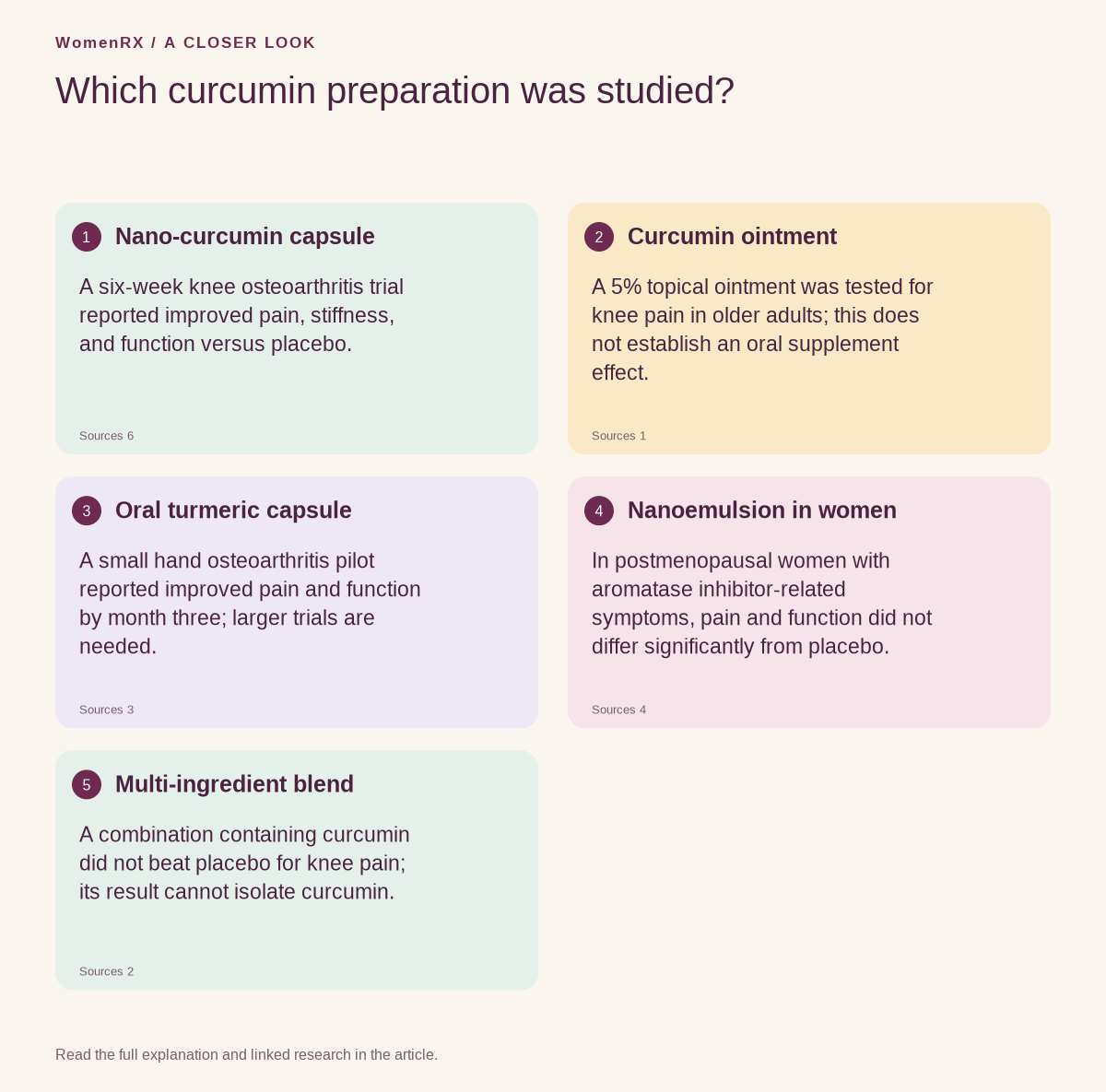
Which curcumin preparation was studied?
Nano-curcumin capsule: A six-week knee osteoarthritis trial reported improved pain, stiffness, and function versus placebo.6
Curcumin ointment: A 5% topical ointment was tested for knee pain in older adults; this does not establish an oral supplement effect.1
Oral turmeric capsule: A small hand osteoarthritis pilot reported improved pain and function by month three; larger trials are needed.3
Nanoemulsion in women: In postmenopausal women with aromatase inhibitor-related symptoms, pain and function did not differ significantly from placebo.4
Multi-ingredient blend: A combination containing curcumin did not beat placebo for knee pain; its result cannot isolate curcumin.2
Read the figure as text
These studies tested distinct preparations and outcomes. Match the form and condition before applying a result to a product.- Nano-curcumin capsule: A six-week knee osteoarthritis trial reported improved pain, stiffness, and function versus placebo.6
- Curcumin ointment: A 5% topical ointment was tested for knee pain in older adults; this does not establish an oral supplement effect.1
- Oral turmeric capsule: A small hand osteoarthritis pilot reported improved pain and function by month three; larger trials are needed.3
- Nanoemulsion in women: In postmenopausal women with aromatase inhibitor-related symptoms, pain and function did not differ significantly from placebo.4
- Multi-ingredient blend: A combination containing curcumin did not beat placebo for knee pain; its result cannot isolate curcumin.2
More questions, answered
Does a turmeric study for osteoarthritis apply to joint pain from cancer treatment?
Not necessarily. A pilot trial specifically tested nanoemulsion curcumin for aromatase inhibitor-related joint symptoms in postmenopausal women and found no significant difference from placebo in pain and function measures. Osteoarthritis studies address a different condition. 4 5
Do these studies show that turmeric supplements are safe in pregnancy or while breastfeeding?
No. The arthritis studies discussed here don’t answer that question. Their findings in adults with arthritis shouldn’t be treated as evidence of safety during pregnancy or breastfeeding; seek individual guidance about the specific product.
Sources you can check
- The effect of curcumin ointment on knee pain in older adults with osteoarthritis: a randomized placebo trial.Jamali N, Adib-Hajbaghery M, Soleimani A. · BMC complementary medicine and therapies · 2020Return to first citation
- Effect of an oral complementary medicine combination for symptomatic knee osteoarthritis: A double-blind, randomized, placebo-controlled trial.Yuan S, Liu X, Bracken K, Christensen R, Deveza LA, Collins S, Harnett JE, McLachlan AJ, Robbins S, Venkatesha V, Bowden JL, Hunter DJ. · Osteoarthritis and cartilage · 2026Return to first citation
- Efficacy and safety of curcumin in patients with hand osteoarthritis: a pilot double-blinded randomised controlled trial.Tuntiyatorn P, Lerspongpaibool C, Kanchanathepsak T, Watcharananan I, Tawonsawatruk T. · BMC complementary medicine and therapies · 2025Return to first citation
- Randomized placebo-controlled, double-blind clinical trial of nanoemulsion curcumin in women with aromatase inhibitor-induced arthropathy: an Alliance/NCORP pilot trial.Lustberg M, Fan-Havard P, Wong FL, Hill K, Phelps MA, Herrera KW, Tsai NC, Synold T, Feng Y, Kalu C, Sedrak MS, Yee LD. · Breast cancer research and treatment · 2024Return to first citation
- Efficacy and Safety of Curcumin and Curcuma longa Extract in the Treatment of Arthritis: A Systematic Review and Meta-Analysis of Randomized Controlled Trial.Zeng L, Yang T, Yang K, Yu G, Li J, Xiang W, Chen H. · Frontiers in immunology · 2022Return to first citation
- The Effect of Nanocurcumin in Improvement of Knee Osteoarthritis: A Randomized Clinical Trial.Hashemzadeh K, Davoudian N, Jaafari MR, Mirfeizi Z. · Current rheumatology reviews · 2020Return to first citation