Curcumin-Piperine Supplements: What Short Trials Say About Safety
Short trials offer some reassurance about curcumin-piperine supplements, but they don’t establish that taking them for months or years is safe for everyone.
In a review of 20 adult trials of curcumin taken with piperine, study doses ranged from 500 to 1,500 mg of curcumin and 5 to 15 mg of piperine per day, for one to 12 weeks. Researchers reported no significant adverse effects, but those trial ranges aren’t long-term recommendations. Before continuing, check your product’s amounts and formulation, symptoms, health conditions, and medicines. 4
Start with what the safety evidence actually covers
The most relevant trial review summarized 20 randomized studies of adults taking curcumin with piperine. Across the studies, curcumin doses ranged from 500 to 1,500 mg per day and piperine doses from 5 to 15 mg per day. The studies lasted one to 12 weeks, and the review reported no significant adverse effects. These are the doses used in those short trials, not established recommendations for long-term use. A separate review focused on kidney disease notes that standardized dosing guidance and long-term safety data are lacking for that population. 4 1
These were studies of measured curcumin supplements, often paired with piperine, not a direct comparison of supplements with turmeric used in cooking. So trial findings shouldn’t be treated as proof that a supplement is as safe as food use, or that the two exposures are equivalent.
Read the whole formulation, not just “turmeric”
Check the label for the amount of curcumin or curcuminoids, whether piperine or black-pepper extract is included, and any other delivery or absorption-enhancing ingredients. A product labeled “turmeric” may not tell you the same thing as a stated amount of curcumin.
This matters because formulations can change exposure. In a randomized, single-dose study of 14 healthy adults, researchers found different curcumin bioavailability across the tested formulations. The study measured blood levels over eight hours; it did not test long-term safety or show that one product is safer for ongoing use. 2
Piperine is added to improve curcumin absorption, but changing how a substance is absorbed or metabolized can also matter when medicines are involved. A kidney-disease review described potential interactions involving medicines including losartan, rosuvastatin, insulin, and cilostazol, while noting the limited clinical evidence and formulation differences. Those mentions are a reason to check your exact product and medication list, not proof that every person taking one of those medicines will have a harmful interaction. 1 2
Match the evidence to your situation
A trial result applies most directly to the people, product, and duration actually studied. The curcumin-piperine review covered different adult health conditions and reported varying amounts of curcumin and piperine. Its dose ranges describe short trials, not a settled dose for ongoing use, and it doesn’t settle the safety of every brand or formulation. 4
If you have kidney disease or take several medicines, make the product label part of a medication review. The kidney-focused review specifically raised concerns about possible effects on drug-metabolizing enzymes and transporters, and said formulation differences and limited high-quality trials complicate safety decisions. It also identified a lack of standardized dosing guidance and long-term safety data in kidney disease. 1
Pregnancy and breastfeeding are separate evidence questions. Short-term findings from adult supplement trials don’t establish safety during either stage. Don’t use the absence of a reported problem in those trials as reassurance for ongoing use.
A practical review before continuing
Write down the brand and full ingredient list, the curcumin or curcuminoid amount per serving and how much you actually take, the piperine amount if stated, and how long you’ve taken it. Add any symptoms, prescription medicines, and other supplements. Bring that specific list to a pharmacist or the clinician who manages your medicines, especially if you have a chronic condition or are pregnant or breastfeeding.
If you’ve noticed a new or worsening symptom, include when it began and whether it changed after starting the product. A review of supplements found gastrointestinal irritation among potential curcumin adverse effects, but that broad review does not establish how often it occurs or predict your individual risk. 3
The useful distinction is not simply “turmeric or no turmeric.” It’s whether the product’s concentration and formulation, duration of use, health context, and medicine list match what limited short-term studies can tell you.
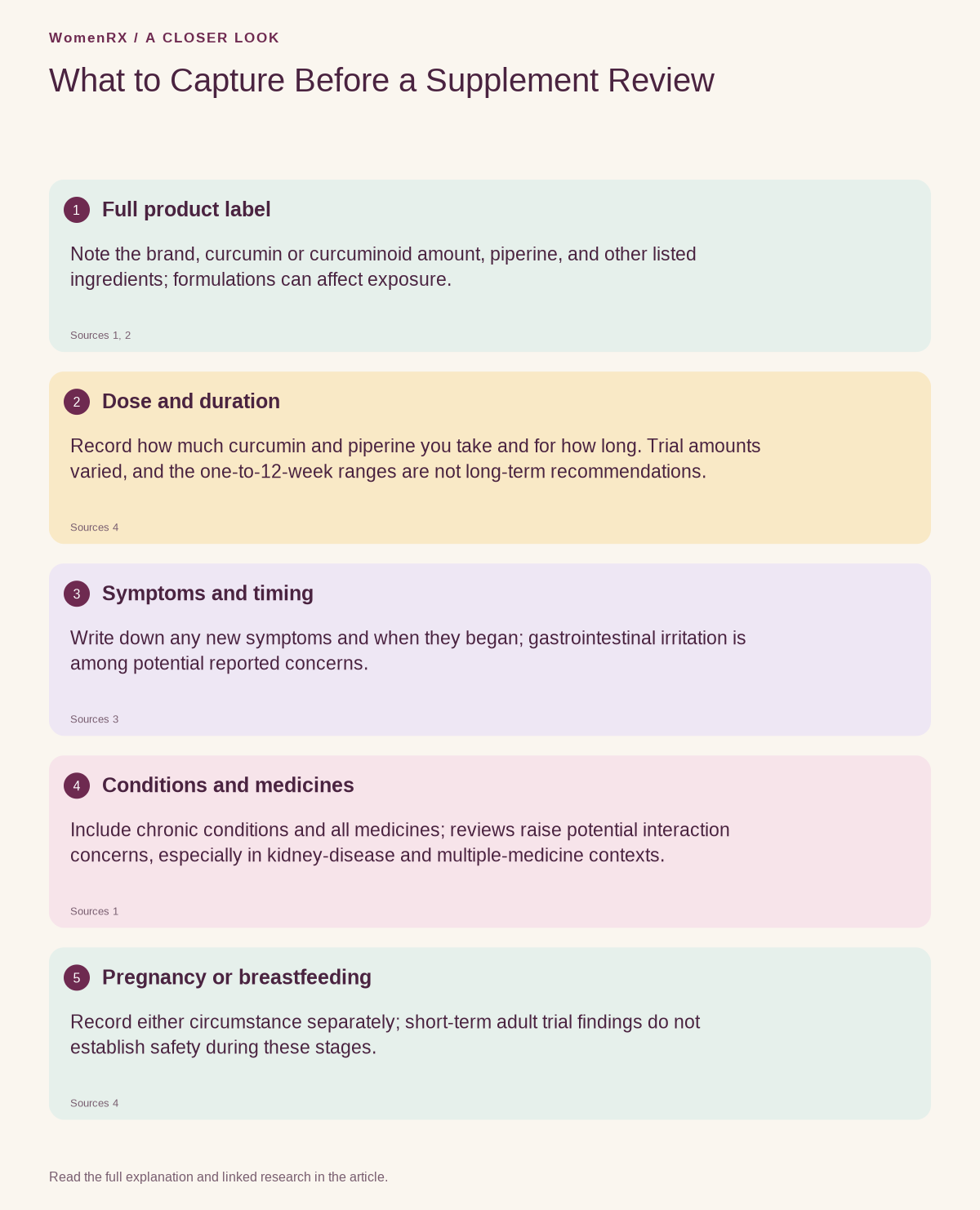
What to Capture Before a Supplement Review
Full product label: Note the brand, curcumin or curcuminoid amount, piperine, and other listed ingredients; formulations can affect exposure.12
Dose and duration: Record how much curcumin and piperine you take and for how long. Trial amounts varied, and the one-to-12-week ranges are not long-term recommendations.4
Symptoms and timing: Write down any new symptoms and when they began; gastrointestinal irritation is among potential reported concerns.3
Conditions and medicines: Include chronic conditions and all medicines; reviews raise potential interaction concerns, especially in kidney-disease and multiple-medicine contexts.1
Pregnancy or breastfeeding: Record either circumstance separately; short-term adult trial findings do not establish safety during these stages.4
Read the figure as text
Record the details that help distinguish your product and situation from the short-term curcumin-piperine evidence.- Full product label: Note the brand, curcumin or curcuminoid amount, piperine, and other listed ingredients; formulations can affect exposure.12
- Dose and duration: Record how much curcumin and piperine you take and for how long. Trial amounts varied, and the one-to-12-week ranges are not long-term recommendations.4
- Symptoms and timing: Write down any new symptoms and when they began; gastrointestinal irritation is among potential reported concerns.3
- Conditions and medicines: Include chronic conditions and all medicines; reviews raise potential interaction concerns, especially in kidney-disease and multiple-medicine contexts.1
- Pregnancy or breastfeeding: Record either circumstance separately; short-term adult trial findings do not establish safety during these stages.4
More questions, answered
Does “no significant adverse effects” mean the supplement is proven safe?
No. It describes what the reviewed trials reported during their one-to-12-week study periods. It doesn’t rule out uncommon effects or establish safety with longer use. 4
Is a supplement with piperine interchangeable with one without it?
Not necessarily. Piperine is used to increase curcumin absorption, and formulation can affect exposure. That difference also makes the exact label relevant when reviewing medicines. 1 2
Sources you can check
- Curcumin in the Treatment of Kidney Disease: A Systematic Review with a Focus on Drug Interactions.Ofori-Attah E, Aning A, Simón L. · Antioxidants (Basel, Switzerland) · 2025Return to first citation
- An Open Label, Randomized, Comparative Bioavailability Study of BioTurm™ Extract Versus Curcuma longa Extract With Piperine in Healthy Adult Volunteers.Malhotra VK, Deshpande AC, Tamoli S, Soman GS, Sabnis Shinde R, Soman AD. · Cureus · 2025Return to first citation
- The double-edged sword of nutraceuticals: comprehensive review of protective agents and their hidden risks.Ashrafpour S, Ashrafpour M. · Frontiers in nutrition · 2025Return to first citation
- Curcumin-piperine supplementation modulates inflammation, oxidative stress, and cardiometabolic risk: a systematic review of randomized controlled trials.Pan C, Wang S, Yang Y, Hu J, Pan Y. · Frontiers in nutrition · 2026Return to first citation