Turmeric Supplements: What to Check Before You Take One
Turmeric in food and concentrated curcumin products aren’t interchangeable, and one reported concern involves high-dose turmeric with immunosuppressive medicines.
Check the exact product, not just the word “turmeric”: preparations and formulations can differ, and enhanced-absorption products raise separate safety questions. A systematic review reported kidney toxicity with high-dose turmeric used alongside immunosuppressive medicines, so that combination needs particular caution. Findings about one product or combination don’t establish the interaction risk of every formula. 4 5
Start with the form, not the front label
Turmeric used as a spice and a concentrated turmeric or curcumin supplement are different preparations. Extracts, standardized products and formulas with added ingredients shouldn’t be treated as interchangeable just because they share a name. Product composition can vary, and enhanced-bioavailability formulas bring their own pharmacokinetic and liver-safety questions. 5
That distinction matters when you check a label. Look for the amount and form of turmeric or curcumin, whether the product is an extract or a blend, and any added ingredients such as piperine. Piperine is used to enhance bioavailability, but an ingredient that changes absorption can also complicate a medicine safety review. Products and formulations differ, so evidence about one combination doesn’t establish the interaction risk of every combination. 5 6
A label can identify what is in the bottle, but it can’t prove the product is safe for you or that results from one tested formula apply to another. In a review of 10 clinical trials of turmeric or curcumin for knee osteoarthritis, no significant adverse events were reported in the turmeric groups. The review also said that optimal formulation and other treatment details remained unclear. Those findings offer some reassurance about the studied trials, not a guarantee for long-term use or every supplement. 3
One medication combination deserves extra attention
A 2026 systematic review covering people on dialysis or using immunosuppressive medicines reported kidney toxicity when high doses of turmeric were used with immunosuppressive drugs. The review included randomized trials and case reports, and its authors called for larger, higher-quality studies. This is a specific warning, not evidence that turmeric interacts with every medicine or that every dose carries the same risk. If you take an immunosuppressant, don’t start a turmeric or curcumin supplement without having the exact product reviewed with your care team. 4
Other interaction claims need care, too. Curcumin can affect drug transport in broiler chickens, but that animal finding doesn’t establish a human interaction or show what happens with a particular supplement and medicine in people. 7 A broad review discusses possible interactions, but products and formulations differ, so evidence about one combination doesn’t establish the risk of every combination. Don’t use a general interaction list as a substitute for checking your exact formula and medicines. 5 6
Pregnancy and breastfeeding call for product-specific caution
If you’re pregnant, treat a turmeric or curcumin supplement as an herb or supplement, not as an ordinary food ingredient. MedlinePlus advises checking with a provider before taking herbs or supplements during pregnancy because some can harm a developing fetus. That guidance does not establish a turmeric-specific risk; it does support checking the exact product rather than assuming a concentrated supplement is equivalent to seasoning in food. 2
MedlinePlus’s breastfeeding guidance is general: it says some medicines can pass into breast milk and advises checking when there are concerns, but it doesn’t discuss turmeric supplements specifically. Bring the product label to the person supporting your care so the ingredients can be considered individually. 1
A useful product check
Before using a supplement, write down or photograph the full label, including the serving amount, extract or formulation, and added ingredients. Match it against your current medicines and health conditions with a pharmacist or prescriber, especially if you take an immunosuppressive medicine or are pregnant or breastfeeding. This is a product-specific check, not a reason to stop a prescribed medicine. During pregnancy, MedlinePlus specifically advises talking with a provider before starting or stopping a medicine. 2 4
If the label doesn’t say clearly what the product contains, or if someone is recommending it to treat a disease, don’t assume another turmeric product has the same evidence or safety profile. Studies have examined particular products and contexts, including turmeric or curcumin for knee osteoarthritis and curcumin used with mesalamine for ulcerative colitis. Evidence about those uses shouldn’t be assumed to apply to another product or condition, or to mean a supplement can replace established treatment. 3 5
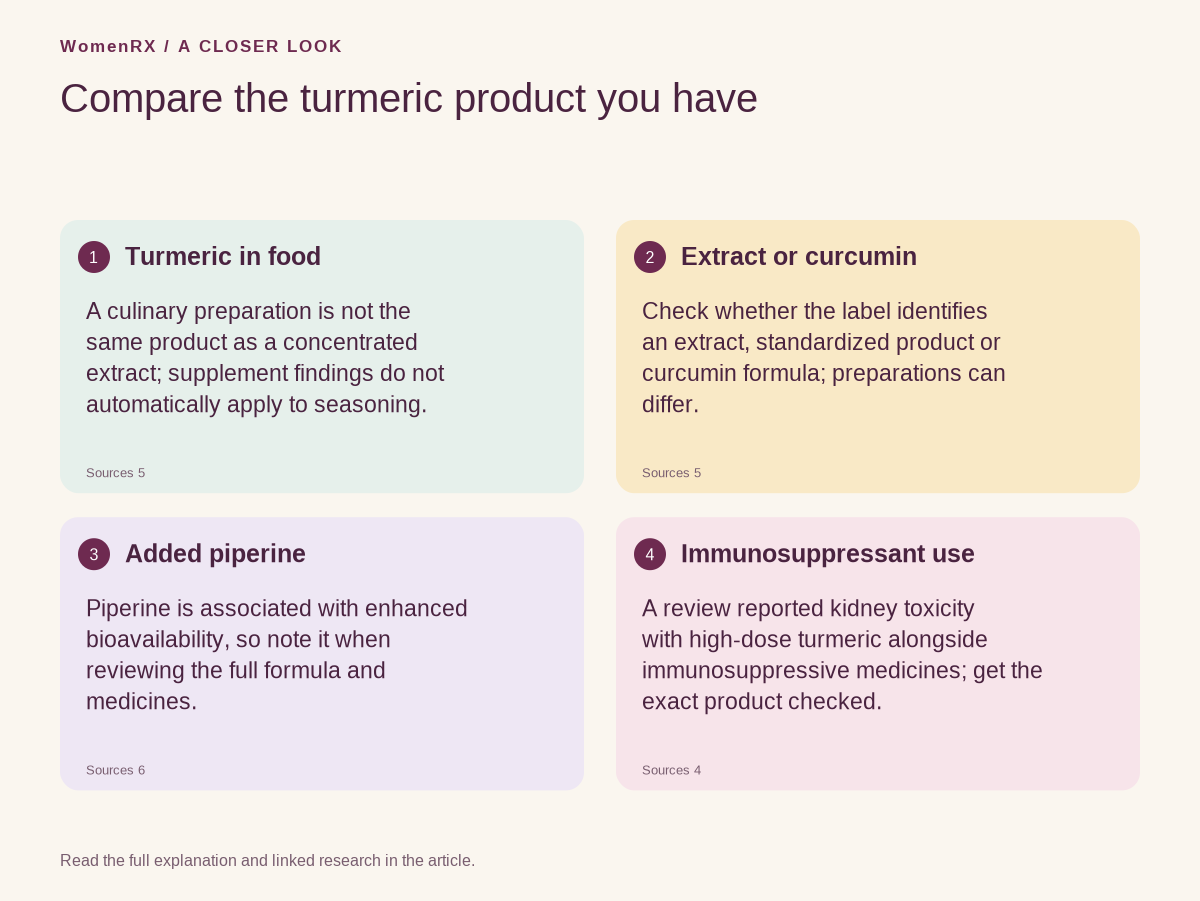
Compare the turmeric product you have
Turmeric in food: A culinary preparation is not the same product as a concentrated extract; supplement findings do not automatically apply to seasoning.5
Extract or curcumin: Check whether the label identifies an extract, standardized product or curcumin formula; preparations can differ.5
Added piperine: Piperine is associated with enhanced bioavailability, so note it when reviewing the full formula and medicines.6
Immunosuppressant use: A review reported kidney toxicity with high-dose turmeric alongside immunosuppressive medicines; get the exact product checked.4
Read the figure as text
The name turmeric can describe different preparations. Check what the product is before applying evidence or safety advice from another form.- Turmeric in food: A culinary preparation is not the same product as a concentrated extract; supplement findings do not automatically apply to seasoning.5
- Extract or curcumin: Check whether the label identifies an extract, standardized product or curcumin formula; preparations can differ.5
- Added piperine: Piperine is associated with enhanced bioavailability, so note it when reviewing the full formula and medicines.6
- Immunosuppressant use: A review reported kidney toxicity with high-dose turmeric alongside immunosuppressive medicines; get the exact product checked.4
More questions, answered
Does a turmeric supplement have the same safety profile as turmeric in food?
Not necessarily. Food seasoning, extracts and enhanced-absorption formulas are different preparations, and evidence about one shouldn’t automatically be applied to another. 5
Which medicine combination is specifically flagged?
A 2026 systematic review reported kidney toxicity with high-dose turmeric used alongside immunosuppressive medicines. It doesn’t establish that all turmeric products interact with all medicines, but this combination warrants a product-specific safety check. 4
Sources you can check
- Breastfeeding | Benefits of Breastfeeding | MedlinePlusAccessed 2026-09-25Return to first citation
- Pregnancy and Medicines | MedlinePlusAccessed 2026-09-25Return to first citation
- Therapeutic effects of turmeric or curcumin extract on pain and function for individuals with knee osteoarthritis: a systematic review.Paultre K, Cade W, Hernandez D, Reynolds J, Greif D, Best TM. · BMJ open sport & exercise medicine · 2021Return to first citation
- Effects of turmeric and curcumin in patients on dialysis or using immunosuppressive agents: a systematic review.Rajabian F, Khajavi Rad A, Ghorban Sabbagh M, Hosseinzadeh H. · Naunyn-Schmiedeberg's archives of pharmacology · 2026Return to first citation
- Defined Natural Products as Adjunctive Therapies: Evidence-Gated Polypharmacology Across Molecular Targets, Human Exposure, Clinical Signals, and Safety Boundaries.Seo Y, Woo J. · International journal of molecular sciences · 2026Return to first citation
- The double-edged sword of nutraceuticals: comprehensive review of protective agents and their hidden risks.Ashrafpour S, Ashrafpour M. · Frontiers in nutrition · 2025Return to first citation
- Inhibitor of P-glycoprotein-mediated drug transport by curcumin in broiler chickens.Li M, Abdurexit M, Xu Z, Gao Y, Zhang Y. · American journal of veterinary research · 2024Return to first citation