Turmeric or Curcumin: What Trial Timelines Can Tell You
Curcumin studies have measured outcomes after weeks, but they don’t establish a universal wait time for relief.
There isn’t an established number of days or weeks when turmeric or curcumin should start helping. One small trial in women with rheumatoid arthritis reported better joint outcomes after eight weeks. A 16-week trial of nanocurcumin for diabetic nerve pain found no significant benefit over placebo, although its authors cite an earlier trial in the same condition that reported improvement. None establishes an onset time for a retail product. 3 4
The short version: trial length isn’t an onset clock
If you’re trying turmeric or curcumin for pain, the evidence doesn’t tell you to expect relief by a particular day. The human trials discussed here measured outcomes at the end of treatment periods. They don’t show exactly when any change began, whether an early change lasted, or how quickly a different product might work. 3 4
That distinction matters. An eight-week study means researchers assessed participants after eight weeks; it doesn’t mean eight weeks is a proven waiting period or that everyone who might benefit will feel better by then.
Two selected pain trials, not one timeline
One randomized, double-blind, placebo-controlled trial studied 48 women with rheumatoid arthritis. Participants received curcumin or placebo for eight weeks. At the end, the curcumin group had lower tender and swollen joint counts, pain ratings, and disease activity scores than the placebo group. The study also reported changes in some blood measures. This is a result in women, but it comes from one relatively small trial and doesn’t establish when during those eight weeks any change occurred. 3
A separate randomized, double-blind, placebo-controlled trial studied nanocurcumin for diabetic peripheral neuropathy in people with type 2 diabetes. After 16 weeks, researchers found no significant differences from placebo in pain ratings or the reported neuropathy measures. The report doesn’t give a women-only result, so it can’t tell you whether the findings differed for women. 4
These are two selected trials, not a complete account of curcumin research for either condition. The 16-week study’s authors also cite an earlier eight-week nanocurcumin trial in diabetic neuropathy that reported improvement on a neuropathy severity measure. Findings may therefore differ even within the same condition. The rheumatoid arthritis and 16-week neuropathy trials also tested different products and outcomes, so their durations can’t be compared as competing estimates of when curcumin starts working. 3 4
Turmeric, curcumin, and formulated extracts aren’t interchangeable
Turmeric is the rhizome used as a spice. It contains several kinds of compounds, including curcuminoids, a group that includes curcumin, and aromatic compounds called turmerones. A curcumin supplement or a specially formulated product is not the same thing as using turmeric in food. 2
The clinical trials also tested particular products, not turmeric in every form. The rheumatoid arthritis trial studied a curcumin capsule; the 16-week nerve-pain trial studied nanocurcumin. Neither trial directly compared its product with turmeric powder or with other retail formulations. 3 4
So, when a label says “turmeric” or “curcumin,” the name alone doesn’t tell you that the product matches something studied in a trial. Formulation is part of the evidence, not a detail you can safely ignore.
What you can reasonably take from the evidence
Think of the study periods as snapshots of what researchers assessed, not promised deadlines:
- Rheumatoid arthritis: one trial in women assessed a particular curcumin capsule after eight weeks and reported better results than placebo on several joint and disease activity measures. 3
- Diabetic nerve pain: one nanocurcumin trial found no significant benefit over placebo on pain or the reported neuropathy measures after 16 weeks. Its authors cite an earlier eight-week trial that reported improvement on a neuropathy severity measure, so the 16-week finding doesn’t settle the question for this condition. 4
- Turmeric as a broad category: these studies don’t establish a general timeline for turmeric spice, every curcumin extract, or supplements aimed at other types of pain. 2 3 4
For rheumatoid arthritis specifically, clinical guidance says evidence supporting supplements for the condition is limited. Curcumin shouldn’t be treated as a substitute for care aimed at controlling inflammation and slowing joint damage. 1
The practical takeaway is modest but useful: if you’re comparing a supplement with research, check whether the ingredient and formulation resemble the one studied, and whether the trial addressed your particular condition. A trial’s final assessment point can help you understand what researchers measured; it can’t tell you when you personally should feel a change.
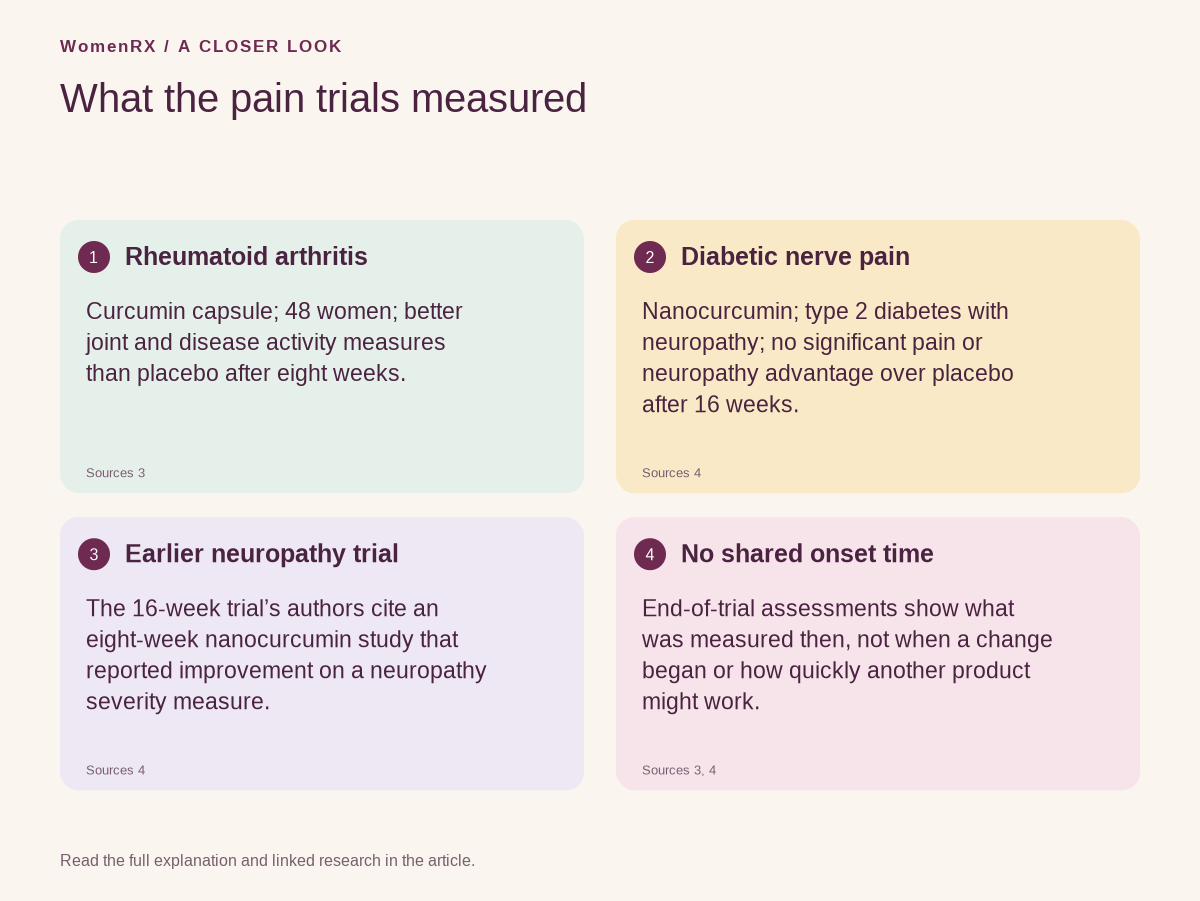
What the pain trials measured
Rheumatoid arthritis: Curcumin capsule; 48 women; better joint and disease activity measures than placebo after eight weeks.3
Diabetic nerve pain: Nanocurcumin; type 2 diabetes with neuropathy; no significant pain or neuropathy advantage over placebo after 16 weeks.4
Earlier neuropathy trial: The 16-week trial’s authors cite an eight-week nanocurcumin study that reported improvement on a neuropathy severity measure.4
No shared onset time: End-of-trial assessments show what was measured then, not when a change began or how quickly another product might work.34
Read the figure as text
These selected studies assessed different curcumin formulations for different conditions. Their final assessment points are not interchangeable estimates of when relief begins.- Rheumatoid arthritis: Curcumin capsule; 48 women; better joint and disease activity measures than placebo after eight weeks.3
- Diabetic nerve pain: Nanocurcumin; type 2 diabetes with neuropathy; no significant pain or neuropathy advantage over placebo after 16 weeks.4
- Earlier neuropathy trial: The 16-week trial’s authors cite an eight-week nanocurcumin study that reported improvement on a neuropathy severity measure.4
- No shared onset time: End-of-trial assessments show what was measured then, not when a change began or how quickly another product might work.34
More questions, answered
Does turmeric in food have the same evidence as curcumin capsules?
No. Turmeric contains multiple compounds, while the rheumatoid arthritis trial tested a curcumin capsule and the 16-week nerve-pain trial tested nanocurcumin. Those results don’t establish the same effects or timing for turmeric used as a spice. 2 3 4
Does a 16-week trial mean curcumin needs 16 weeks to work?
No. That trial measured outcomes after 16 weeks and found no significant advantage over placebo for the tested nanocurcumin and diabetic nerve pain. It did not establish a general waiting period for other products or conditions. 4
Sources you can check
- Rheumatoid arthritis - Treatment - NHSAccessed 2026-09-25Return to first citation
- Turmeric (curcuma longa) rhizome essential oil: analytical profile of authenticated and commercial samples, safety and pharmacology review.Saavedra DI, Carter DT, Dawson JT, Shah SA, Stevens N, Poudel A, Satyal P, Bascoul C. · Pharmaceutical biology · 2026Return to first citation
- The efficacy of curcumin supplementation on serum total antioxidant capacity, malondialdehyde, and disease activity in women with rheumatoid arthritis: A randomized, double-blind, placebo-controlled clinical trial.Pourhabibi-Zarandi F, Rafraf M, Zayeni H, Asghari-Jafarabadi M, Ebrahimi AA. · Phytotherapy research : PTR · 2024Return to first citation
- The effectiveness and safety of nanocurcumin supplementation for diabetic peripheral neuropathy in patients with type 2 diabetes: a randomized double-blind clinical trial.Mansour A, Rahimi HR, Gerami H, Khorasanian AS, Esmaeili AH, Amrollahi Bioky A, Mohajeri-Tehrani MR, Fateh HR, Sajjadi-Jazi SM. · Nutrition journal · 2025Return to first citation