Alpha-Lipoic Acid: What Study Timelines Can Tell You
Studies have checked alpha-lipoic acid’s effects on diabetic nerve symptoms over weeks and months, but those check-ins don’t promise a personal response by a certain date.
For diabetic peripheral neuropathy, studies have measured alpha-lipoic acid over weeks to months, but those checkpoints aren’t proof that you should feel better by then. A Cochrane review found probably little or no effect on neuropathy symptoms at six months compared with placebo. Shorter studies also don’t establish a dependable onset time. 3 1 2
A study check-in isn’t a personal deadline
If you’re taking alpha-lipoic acid (also called thioctic acid) for diabetic nerve symptoms, clinical studies don’t identify a dependable personal time to benefit. Researchers choose study check-in dates to measure changes. That schedule doesn’t show that a benefit begins at that point, or that it will happen for every person.
The evidence also depends on what researchers measure. Pain or tingling scores capture symptoms; nerve tests and examination scores assess different aspects of neuropathy. A change in one measure doesn’t necessarily mean the underlying nerve damage has improved.
What the diabetic-neuropathy studies measured
A 2024 Cochrane review included three placebo-controlled trials, with 816 adults overall. Treatment lasted from six to 48 months, but the main six-month symptom comparison came from one study of 330 participants. On the Total Symptom Score, where a lower score is better, alpha-lipoic acid’s average difference from placebo was −0.16 points (95% confidence interval −0.83 to 0.51). The review concluded it probably made little or no difference to symptoms at six months. All three studies had a high risk of bias from participants dropping out. 3
That finding is about diabetic peripheral neuropathy, not every reason someone might consider the supplement. It also doesn’t translate into a rule that an individual should wait six months: the review’s six-month point was a study outcome, not a proven time-to-benefit threshold. The review found that evidence about nerve impairment was less certain, and its included trials did not report quality of life or neuropathy complications. 3
Other studies show why a calendar alone can mislead. In a six-month prospective observational study comparing alpha-lipoic acid with pregabalin and carbamazepine, symptoms were assessed monthly and nerve-conduction testing was done at the start, three months, and six months. Symptoms improved in the treatment groups, but improvement was faster and greater with pregabalin; nerve-conduction velocity did not improve in any group. Because this wasn’t a randomized placebo comparison, it cannot establish a precise onset time for alpha-lipoic acid. 1
A separate 12-week randomized trial in people with type 2 diabetes measured pain in groups receiving alpha-lipoic acid, pregabalin, or both. Its reported main comparison was pregabalin alone versus the combination, so its 12-week endpoint is not proof that alpha-lipoic acid alone works by week 12. 2
The concern matters as much as the timeline
The timelines above concern diabetic peripheral neuropathy. They don’t establish whether alpha-lipoic acid works, or how long it might take, for an unrelated concern. A timeline from one condition shouldn’t be borrowed for another.
Even within diabetic neuropathy, studies ask different questions: whether pain changes, whether symptoms change on a score, or whether nerve impairment changes. For example, a person might report a symptom difference without a measurable change on a nerve-conduction test. These studies don’t provide a single assessment that predicts an individual response.
What’s known about women and pregnancy
One observational study reported that 52 of its 96 participants who completed follow-up were women, but it did not report whether effects differed by sex. Another small study included 13 women among 20 participants; its results don’t establish a women-specific response timeline. 1 4
These findings also don’t establish effectiveness or safety during pregnancy or breastfeeding. If either applies to you, bring that uncertainty into a conversation with your clinician before deciding whether to use the supplement.
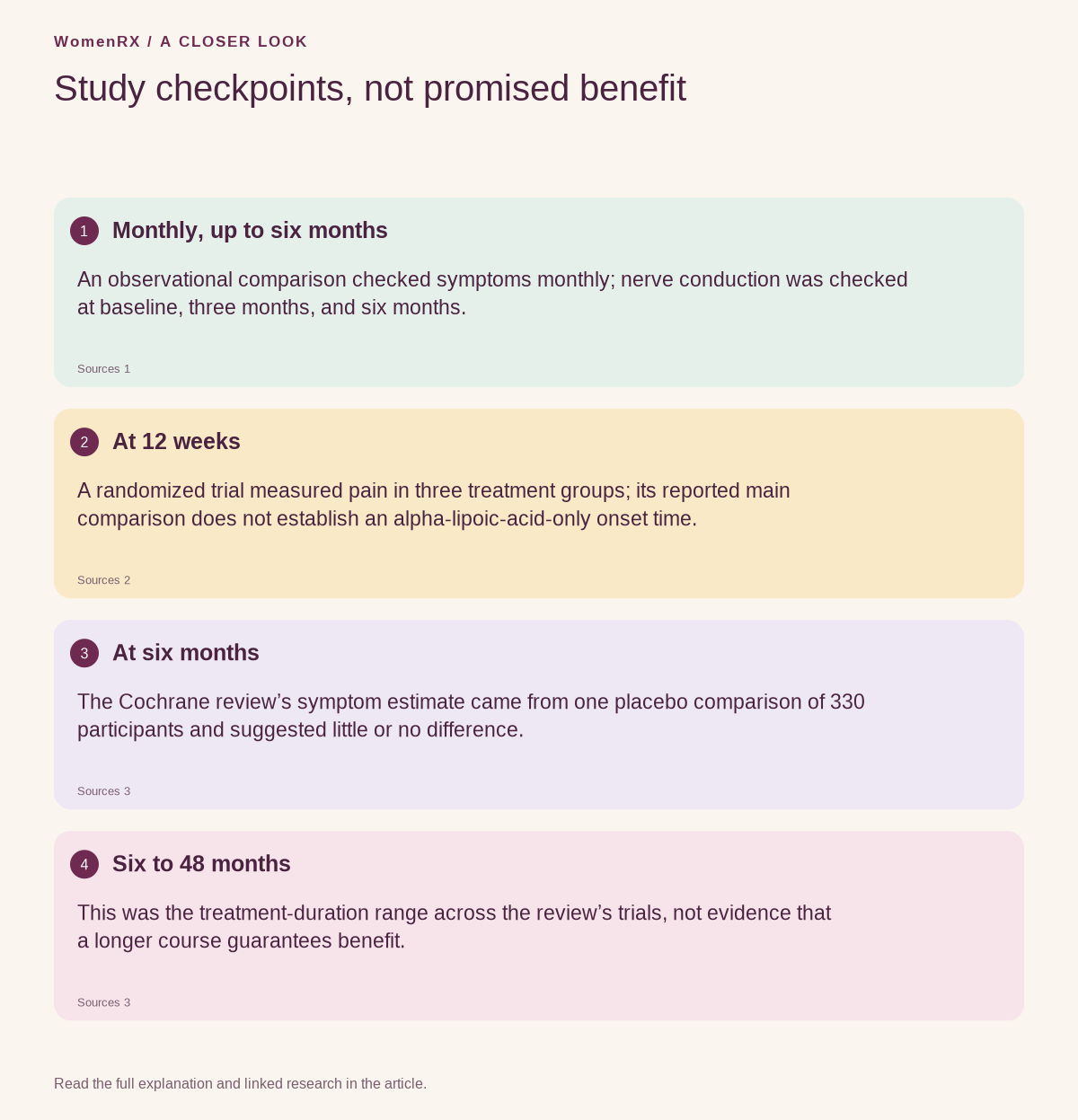
Study checkpoints, not promised benefit
Monthly, up to six months: An observational comparison checked symptoms monthly; nerve conduction was checked at baseline, three months, and six months.1
At 12 weeks: A randomized trial measured pain in three treatment groups; its reported main comparison does not establish an alpha-lipoic-acid-only onset time.2
At six months: The Cochrane review’s symptom estimate came from one placebo comparison of 330 participants and suggested little or no difference.3
Six to 48 months: This was the treatment-duration range across the review’s trials, not evidence that a longer course guarantees benefit.3
Read the figure as text
These are the periods researchers used to assess diabetic-neuropathy outcomes. They are not a schedule for when an individual should feel a change.- Monthly, up to six months: An observational comparison checked symptoms monthly; nerve conduction was checked at baseline, three months, and six months.1
- At 12 weeks: A randomized trial measured pain in three treatment groups; its reported main comparison does not establish an alpha-lipoic-acid-only onset time.2
- At six months: The Cochrane review’s symptom estimate came from one placebo comparison of 330 participants and suggested little or no difference.3
- Six to 48 months: This was the treatment-duration range across the review’s trials, not evidence that a longer course guarantees benefit.3
Sources you can check
- A study of the use of carbamazepine, pregabalin and alpha lipoic acid in patients of diabetic neuropathy.Patel N, Mishra V, Patel P, Dikshit RK. · Journal of diabetes and metabolic disorders · 2014Return to first citation
- Efficacy and Safety of Pregabalin and Alpha-Lipoic Acid Combination in Patients With Painful Diabetic Peripheral Neuropathy: A Randomized, Open-Label, Non-Inferiority, Phase IV Clinical Trial and Subgroup Analysis (OPTIMUM Study).Oh TJ, Kim SS, Lee SH, Kwon HS, Kim ES, Rhee EJ, Yoo HJ, Jang HN, Lee WJ, Kim ES, Kim SY, Koh G, Hong EG, Park TS, Won JC. · Diabetes, obesity & metabolism · 2026Return to first citation
- Alpha-lipoic acid for diabetic peripheral neuropathy.Baicus C, Purcarea A, von Elm E, Delcea C, Furtunescu FL. · The Cochrane database of systematic reviews · 2024Return to first citation
- Alpha lipoic acid and glycaemic control in diabetic neuropathies at type 2 diabetes treatment.Ibrahimpasic K. · Medical archives (Sarajevo, Bosnia and Herzegovina) · 2013Return to first citation