Can You Take Alpha-Lipoic Acid Long Term?
Alpha-lipoic acid has been studied for months and, in some diabetic-neuropathy trials, longer, but study duration alone cannot tell you whether ongoing use is right for you.
There’s no proven safe duration for taking alpha-lipoic acid (ALA) for general wellness. A review of diabetic-neuropathy trials included treatments lasting from three to 208 weeks, but that range does not establish the safety of taking your particular product indefinitely. 4 If you use insulin or other glucose-lowering medicine, discuss ALA with your prescriber or pharmacist before adding it; the studies don’t settle how it might affect your glucose-management plan. 1 3
Study duration is not a safety guarantee
Alpha-lipoic acid, also called thioctic acid, has been studied mainly for particular health conditions, especially diabetic peripheral neuropathy. One review of randomized trials included oral, intravenous and sequential treatment lasting from three to 208 weeks. That longest duration is useful to know, but it isn’t a tested safety limit or proof that an over-the-counter oral product is safe to take for years. The review combined different routes and study designs to assess neuropathy outcomes, not to define a safe duration for general use. 4
Two other studies show why the details matter. A six-month randomized trial in people with mild to moderate carpal tunnel syndrome tested ALA with B vitamins. A 12-month randomized trial in people with fatty liver disease tested ALA with ursodeoxycholic acid. Neither can isolate the effects of ALA alone over those periods. 2 6
So start with your reason for taking it. Research on symptoms of diabetic neuropathy doesn’t establish a benefit for general wellness. Nor does it show that ALA can replace prescribed diabetes treatment or neuropathy pain treatment. A review focused on diabetic neuropathy found reasons to study ALA further but specifically called for more research on long-term effectiveness in US patients. 5
What side effects have studies reported?
In the six-month carpal tunnel trial, the ALA-and-B-vitamin combination was generally well tolerated. Reported side effects included mild abdominal discomfort and diarrhea, which resolved after the treatment was stopped. Because several ingredients were given together, the trial cannot tell which one caused a symptom. The 12-month fatty-liver trial also reported that its ALA-and-ursodeoxycholic-acid combination was well tolerated, but that finding belongs to the combination and the people studied. 2 6
A small review of ALA added to antipsychotic treatment found no significant difference from placebo in adverse events or treatment discontinuation. It included eight studies and 165 people with schizophrenia; the authors cautioned that the safety findings were imprecise. A result like this is reassuring within its limits, not a way to rule out uncommon effects during longer use. 1
If you manage diabetes, check the glucose question first
If you take insulin or another glucose-lowering medicine, the practical question is whether adding ALA could change what you need to watch for. The research described above does not establish a specific interaction or show that ALA reliably lowers blood glucose. A small review in people with schizophrenia found no significant effect on HbA1c, a measure of longer-term glucose levels. In a six-month observational study of diabetic neuropathy, glucose measures improved across treatment groups, including the ALA group, but the study cannot show that ALA caused those changes or altered the effects of diabetes medicines. 1 3
Bring the product label to your prescriber or pharmacist and ask whether taking it calls for any change to your existing glucose-monitoring plan. That’s more useful than assuming ALA has no effect, or changing prescribed treatment on your own. The studies also do not establish a routine lab-testing schedule specifically for ALA use. 1 3
Pregnancy, breastfeeding, and your next decision
These studies do not establish the safety of ALA supplements during pregnancy or breastfeeding. That is an unanswered question, not evidence that ALA is harmful. If either applies to you, discuss the supplement and your reason for taking it with your maternity or primary care clinician before starting or continuing it.
For anyone considering ongoing use, make the decision specific: What am I taking it for? Is there evidence for that purpose? What product am I using, and have I noticed any unwanted effects? A study’s follow-up period answers how long its participants were observed. It does not, by itself, tell you how long you should take ALA.
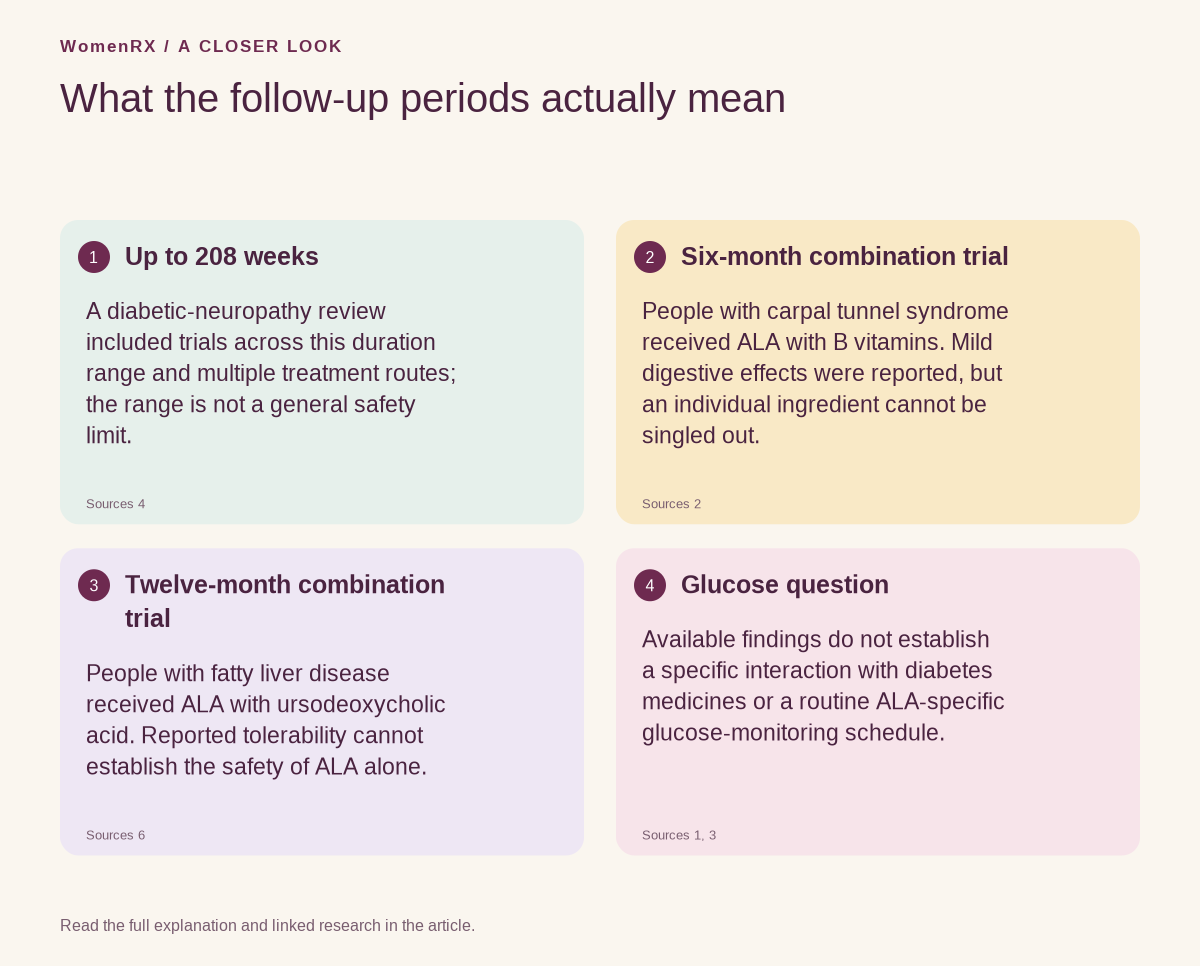
What the follow-up periods actually mean
Up to 208 weeks: A diabetic-neuropathy review included trials across this duration range and multiple treatment routes; the range is not a general safety limit.4
Six-month combination trial: People with carpal tunnel syndrome received ALA with B vitamins. Mild digestive effects were reported, but an individual ingredient cannot be singled out.2
Twelve-month combination trial: People with fatty liver disease received ALA with ursodeoxycholic acid. Reported tolerability cannot establish the safety of ALA alone.6
Glucose question: Available findings do not establish a specific interaction with diabetes medicines or a routine ALA-specific glucose-monitoring schedule.13
Read the figure as text
The longest number is not automatically the most useful answer: each study tested ALA in a particular setting.- Up to 208 weeks: A diabetic-neuropathy review included trials across this duration range and multiple treatment routes; the range is not a general safety limit.4
- Six-month combination trial: People with carpal tunnel syndrome received ALA with B vitamins. Mild digestive effects were reported, but an individual ingredient cannot be singled out.2
- Twelve-month combination trial: People with fatty liver disease received ALA with ursodeoxycholic acid. Reported tolerability cannot establish the safety of ALA alone.6
- Glucose question: Available findings do not establish a specific interaction with diabetes medicines or a routine ALA-specific glucose-monitoring schedule.13
More questions, answered
Did any trial follow people taking ALA for years?
A review of randomized diabetic-neuropathy trials included treatment durations up to 208 weeks. That describes the range across included trials, not a proven safe duration for ALA supplements generally. 4
Sources you can check
- Efficacy and Safety of Alpha-Lipoic Acid as an Adjunctive Therapy in Schizophrenia: A Systematic Review and Meta-Analysis.Tudella GCN, Pereira MAOM, Klostermann AU, Gonzalez JVP, Gonçalves OR, Donato KO, Nantes LAO, da Silva AMP, Forte ARCC, Patrocínio MLV, de Queiroz Oliveira T, Vasconcelos SMM. · Journal of clinical psychopharmacology · 2026Return to first citation
- Evaluating the efficacy and tolerability of the oral combination of alpha lipoic acid and vitamin B complex preparation in carpal tunnel syndrome: a single center, randomized, double-blind, placebo-controlled trial.Zainal NA, Abdul Rashid AM, A Rauf AL, Yusof Khan AHK, Wan Sulaiman WA, Basri H. · BMC neurology · 2025Return to first citation
- A study of the use of carbamazepine, pregabalin and alpha lipoic acid in patients of diabetic neuropathy.Patel N, Mishra V, Patel P, Dikshit RK. · Journal of diabetes and metabolic disorders · 2014Return to first citation
- Oral, intravenous, or sequential alpha-lipoic acid for diabetic peripheral neuropathy? A Bayesian network meta-analysis of randomized controlled trials.Shen J, Zheng Y, Yu M, Wang X. · Frontiers in neurology · 2026Return to first citation
- A Case for Alpha-Lipoic Acid as an Alternative Treatment for Diabetic Polyneuropathy.Nguyen N, Takemoto JK. · Journal of pharmacy & pharmaceutical sciences : a publication of the Canadian Society for Pharmaceutical Sciences, Societe canadienne des sciences pharmaceutiques · 2018Return to first citation
- Impact of combined therapy with alpha-lipoic and ursodeoxycolic acid on nonalcoholic fatty liver disease: double-blind, randomized clinical trial of efficacy and safety.Gianturco V, Troisi G, Bellomo A, Bernardini S, D'Ottavio E, Formosa V, Iacono CL, Verrusio W, Marigliano B, Marigliano V. · Hepatology international · 2013Return to first citation