Turmeric Supplements: How to Read the Dose and Risks
A study dose is tied to its product and participants, so it’s a starting point for questions, not a personal dosing guide.
Turmeric in food and concentrated curcumin supplements aren’t interchangeable: most trials in a metabolic-health review studied standardized supplements or enhanced formulations rather than culinary turmeric. One small study in people with cirrhosis used 500 mg of curcumin twice daily for 12 weeks, but that result doesn’t establish a general dose or show that it’s appropriate for someone with cirrhosis. Check the exact product, intended outcome, medicines, health conditions, and pregnancy or breastfeeding context. 1 5
Start with what the product actually contains
Turmeric is the spice; curcumin is one of its main curcuminoids. A capsule labeled “turmeric” may not be equivalent to a product labeled “curcumin,” and two curcumin products may use different delivery formulations. 3 That matters because most metabolic-health trials in a large review studied standardized turmeric or curcumin supplements, including enhanced formulations, rather than turmeric used in everyday cooking. 5
So first check the label: Is it turmeric powder, a curcumin extract, or a specialized formulation? Does it list added ingredients such as BioPerine? One interaction study used curcumin alongside BioPerine, but it couldn’t isolate BioPerine’s contribution. 4 Note the ingredients so a pharmacist or clinician can review the full product alongside your medicines. A higher amount on the label doesn’t necessarily mean a more useful product: formulations can change blood exposure, but that isn’t proof of greater health benefit. 2
A study dose belongs to that study
There isn’t one study dose that applies across products and purposes. For example, a 12-week randomized trial in 58 people with cirrhosis compared 500 mg of curcumin twice daily with placebo for bodily and joint pain. The review’s study table lists 30 women among the participants, but it doesn’t report whether results differed by sex. The study’s population, outcome, duration, and product all limit what you can take from its dose. 1
That dose is not a recommendation for pain, a metabolic condition, or general wellness. A systematic review of 104 randomized trials in adults with metabolic syndrome or related conditions found varied results across formulations, doses, durations, and health conditions. It also found that the trials mostly studied supplements, not culinary turmeric. Even pooled findings for some blood sugar, lipid, and inflammation markers don’t identify a single dose for an individual or show that every product has the same effect. 5
When comparing a study with a product you’re considering, ask whether the ingredient and formulation match, whether the study measured an outcome you care about, and whether its participants resemble you. If those don’t line up, the study dose may not tell you much about the product in your hand.
Formulation changes exposure, not proven benefit
Curcumin is poorly absorbed in some forms, and formulations can change how much enters the bloodstream. In an exploratory single-dose trial, 18 healthy men received either a nano-liposomal product or free curcumin; the researchers found substantially higher dose-normalized exposure with the nano-liposomal formulation. The study assessed blood levels after one dose, not whether the formulation improved health outcomes or long-term safety. It included no women, so it can’t establish those results for women. 2
This is why milligrams aren’t always an apples-to-apples comparison across labels. A formulation designed to increase absorption may produce different exposure from the same stated amount of a less-absorbed form. Higher exposure alone doesn’t prove greater benefit or make a product safer.
Make medication review product-specific
One human interaction study offers a useful example of why the whole product matters. Healthy volunteers took sepiapterin alone or with curcumin alongside BioPerine. With that combination, exposure to sepiapterin’s metabolite increased modestly; the study authors judged the change not clinically meaningful. Because the study used curcumin alongside BioPerine, it can’t isolate BioPerine’s contribution or attribute the finding to curcumin alone. It also doesn’t establish how other medicines or formulations would behave. 4
If you take prescription medicines, show a pharmacist the exact supplement label, including added ingredients such as BioPerine. That’s more useful than asking about “turmeric” in general, because the study finding applies to one product combination and one medicine-related outcome, not every turmeric supplement or drug.
Pregnancy and breastfeeding need their own answer
The study details discussed here don’t provide pregnancy or breastfeeding outcomes for concentrated supplements. They also don’t provide findings about turmeric used as a food ingredient in those circumstances. These examples therefore can’t answer whether either use is safe or harmful during pregnancy or breastfeeding. 1 2 4 5 If you’re pregnant or breastfeeding, a practical question for your maternity-care clinician or pharmacist is what’s known about the specific concentrated supplement you’re considering, rather than assuming evidence about turmeric in food applies to it.
A practical label check
Before choosing a supplement, write down the outcome you want it for and compare the product with evidence for that same outcome. Check whether it’s turmeric or curcumin, whether it includes BioPerine or a specialized delivery system, and whether the dose and formulation actually match the study you’re considering. Then consider whether the study included people with your health condition and measured an outcome relevant to you. The cirrhosis example doesn’t establish that its study dose is safe for someone with cirrhosis: the review describes moderate-to-high risk of bias across its included studies and says more research is needed to determine safety and optimal dosage. 1 If you take medicines, review the full label with a pharmacist. If the product differs from the study, or the study measured only blood levels rather than a health outcome, treat that as a reason not to assume the study dose applies to you.
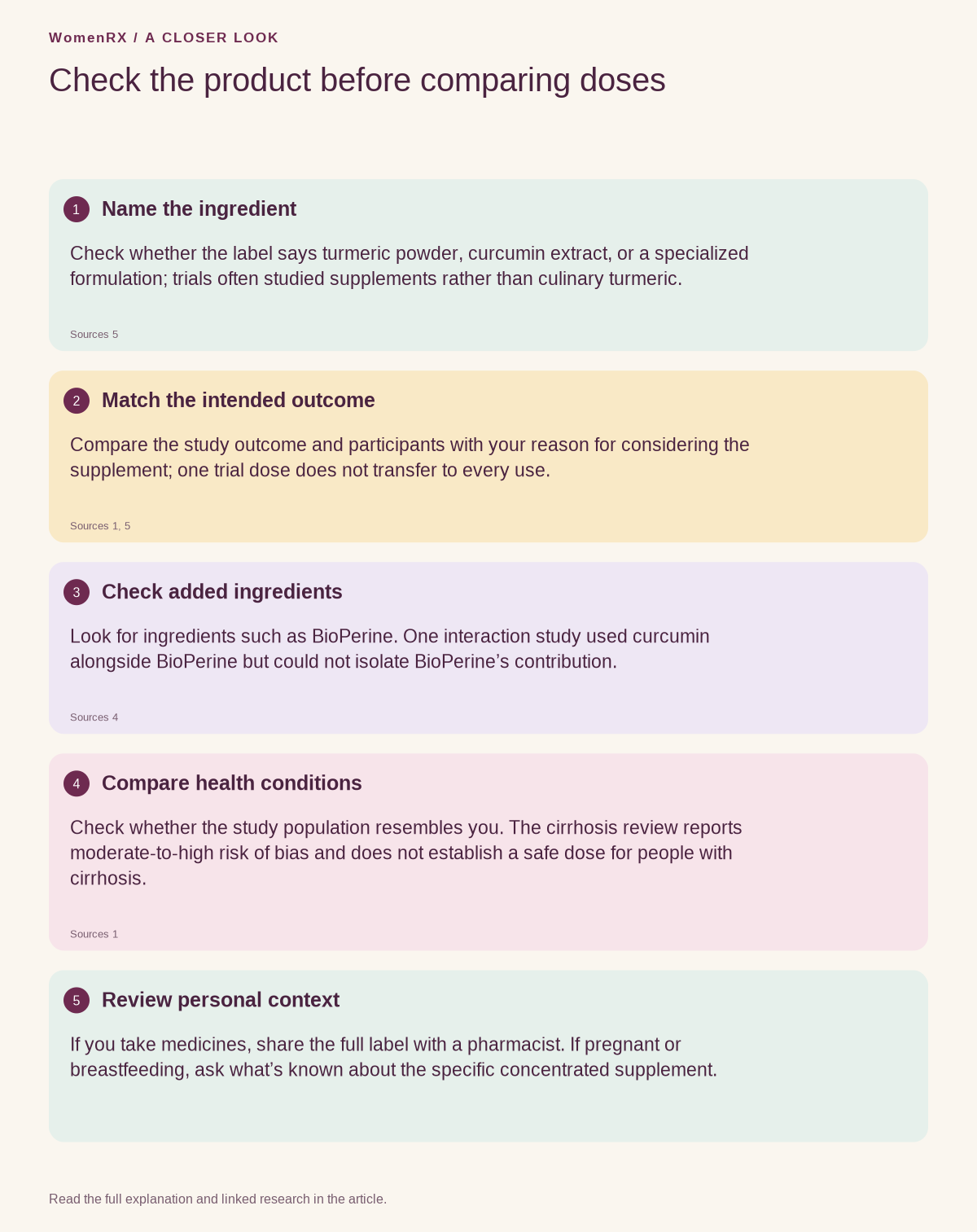
Check the product before comparing doses
Name the ingredient: Check whether the label says turmeric powder, curcumin extract, or a specialized formulation; trials often studied supplements rather than culinary turmeric.5
Match the intended outcome: Compare the study outcome and participants with your reason for considering the supplement; one trial dose does not transfer to every use.15
Check added ingredients: Look for ingredients such as BioPerine. One interaction study used curcumin alongside BioPerine but could not isolate BioPerine’s contribution.4
Compare health conditions: Check whether the study population resembles you. The cirrhosis review reports moderate-to-high risk of bias and does not establish a safe dose for people with cirrhosis.1
Review personal context: If you take medicines, share the full label with a pharmacist. If pregnant or breastfeeding, ask what’s known about the specific concentrated supplement.
Read the figure as text
Use these questions to decide whether a study is relevant to the product and situation you’re considering.- Name the ingredient: Check whether the label says turmeric powder, curcumin extract, or a specialized formulation; trials often studied supplements rather than culinary turmeric.5
- Match the intended outcome: Compare the study outcome and participants with your reason for considering the supplement; one trial dose does not transfer to every use.15
- Check added ingredients: Look for ingredients such as BioPerine. One interaction study used curcumin alongside BioPerine but could not isolate BioPerine’s contribution.4
- Compare health conditions: Check whether the study population resembles you. The cirrhosis review reports moderate-to-high risk of bias and does not establish a safe dose for people with cirrhosis.1
- Review personal context: If you take medicines, share the full label with a pharmacist. If pregnant or breastfeeding, ask what’s known about the specific concentrated supplement.
More questions, answered
Does a higher-absorption formula mean I need less?
Not necessarily. A small single-dose study in healthy men found higher blood exposure from one nano-liposomal product than from free curcumin, but it did not establish a dose for a health benefit or compare long-term safety. 2
Do curcumin studies show the same results for women?
Not consistently from the details reported here. One formulation study enrolled only men, while a cirrhosis trial included women but the review’s reported study table doesn’t give outcomes by sex. Those studies can’t answer whether effects or dosing differ for women. 1 2
Sources you can check
- Non-pharmacological Interventions for Muscle Cramps and Pain in Patients With Cirrhosis: A Systematic Review.Muller R, Dranoff J, Grimshaw AA, Bastian L, Gunderson C. · Cureus · 2024Return to first citation
- Enhanced bioavailability of a novel double-layered nano-liposomal curcumin (BNT-C060): a randomized, double-blind, clinical trial.Kim DS, Kim HK, Ha KC, Jang GH, Park SH, Kim DH, Kim YM, Pyo J, Joo JC, Chae HJ. · Scientific reports · 2026Return to first citation
- A review bridging pharmacokinetics, preclinical data, and human evidence on curcuminoids in cardiovascular disease.Zolnik K, Mogielnicki A, Kalaska B. · Frontiers in pharmacology · 2026Return to first citation
- Clinical Assessment of Breast Cancer Resistance Protein (BCRP)-Mediated Drug-Drug Interactions of Sepiapterin with Curcumin and Rosuvastatin in Healthy Volunteers.Gao L, Kaushik D, Ingalls K, Milner S, Smith N, Kong R. · Drugs in R&D · 2024Return to first citation
- Clinical Potential of Curcuma longa Linn. as Nutraceutical/Dietary Supplement for Metabolic Syndrome: Systematic Review and Meta-Analysis of Randomized Controlled Trials.Kehinde SA, Qaisrani ZN, Pattanayaiying R, Lay BB, Phyo KY, Lin WP, San MM, Awaeloh N, Aunsorn S, Kitkangplu R, Chusri S. · Foods (Basel, Switzerland) · 2025Return to first citation