Does Joint Pain Change After Perimenopause?
Joint aches can occur on both sides of the menopause transition, but studies don’t show a predictable change when perimenopause ends.
Joint pain can happen during perimenopause and after menopause, but these studies don’t establish that it reliably gets better or worse between those stages. One reports each stage group’s most severe symptom, not joint-pain levels across every group. Another analyzes the two stages together. Your pain’s location and pattern may be more useful than your menopause stage when considering what’s causing it. 123
Why the stage comparison is harder than it sounds
Perimenopause and postmenopause are distinct reproductive stages, but being in one or the other doesn’t tell you what will happen to an aching knee, hand, or hip. Lower estrogen levels may contribute to aching joints around menopause. Joint pain can also have other causes, including injury and arthritis. 1
To show whether pain changes between stages, a study would need to report joint pain separately for women in perimenopause and postmenopause. It would also help to follow the same women over time. The studies discussed below give useful snapshots, but neither establishes a typical path for joint pain across the transition. 23
What two studies measured
A study of women with a history of criminal legal system involvement separated participants into premenopause, early perimenopause, late perimenopause, and postmenopause. Joint pain was the most severe reported symptom in the premenopausal and late-perimenopausal groups; hot flashes were the most severe in the postmenopausal group. That does not mean postmenopausal women had less joint pain. The published summary identifies the top symptom in each group but doesn’t give a full comparison of joint-pain levels across all four groups. Only 10 participants were classified as late perimenopausal. 2
A survey of women faculty and staff at three US universities took a different approach. Its analysis of symptoms at work included women in perimenopause and postmenopause together. Joint or muscle pain was associated with lower work-related quality of life in that combined group. The finding shows that pain can matter in daily life, but it cannot tell us which of the two stages has more joint pain. It also measures joint or muscle pain, not joint pain alone. 3
These differences in grouping and symptom reporting matter. A top-symptom ranking is not a measurement of how much joint pain rises or falls. A combined perimenopause-and-postmenopause result cannot be split into two stage-specific results after the fact. So neither study supports a rule that joint pain begins in perimenopause, peaks after menopause, or fades once periods stop. 23
Pay attention to the pain itself
Menopause stage is only one piece of context. Where the pain is, whether a joint is swollen or warm, and what happens after activity or rest may offer more useful clues. For example, pain and swelling after repetitive exercise may fit an injury pattern. Pain that’s worse with walking and stiffness after activity can occur with osteoarthritis. Pain and stiffness on both sides of the body that are worse after being still can occur with rheumatoid arthritis. None of those patterns confirms a diagnosis on its own. 1
If pain keeps coming back, is getting worse, affects sleep or normal activities, or comes with morning stiffness lasting more than 30 minutes, arrange a medical assessment rather than assuming it’s part of menopause. A hot, swollen joint alongside a fever or feeling generally unwell needs urgent assessment. 1
The useful distinction is this: reproductive stage may help explain the context of an ache, but it doesn’t establish its cause or predict its course. You don’t need to wait for a different menopause stage to take persistent or concerning joint pain seriously. 123
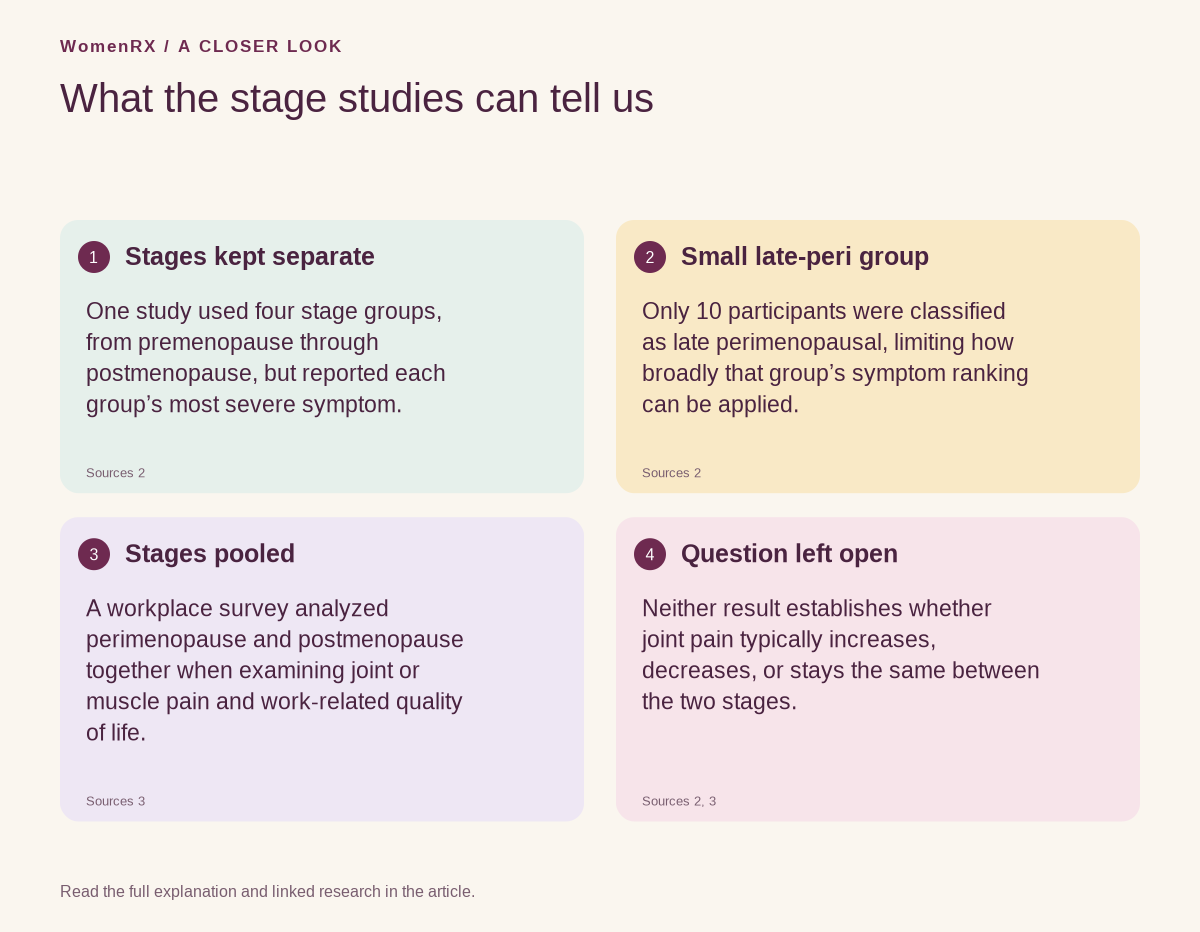
What the stage studies can tell us
Stages kept separate: One study used four stage groups, from premenopause through postmenopause, but reported each group’s most severe symptom.2
Small late-peri group: Only 10 participants were classified as late perimenopausal, limiting how broadly that group’s symptom ranking can be applied.2
Stages pooled: A workplace survey analyzed perimenopause and postmenopause together when examining joint or muscle pain and work-related quality of life.3
Question left open: Neither result establishes whether joint pain typically increases, decreases, or stays the same between the two stages.23
Read the figure as text
How women were grouped and how pain was reported determine which comparisons are possible.- Stages kept separate: One study used four stage groups, from premenopause through postmenopause, but reported each group’s most severe symptom.2
- Small late-peri group: Only 10 participants were classified as late perimenopausal, limiting how broadly that group’s symptom ranking can be applied.2
- Stages pooled: A workplace survey analyzed perimenopause and postmenopause together when examining joint or muscle pain and work-related quality of life.3
- Question left open: Neither result establishes whether joint pain typically increases, decreases, or stays the same between the two stages.23
More questions, answered
Does joint pain mean I’m in perimenopause?
No. Aching joints can occur around menopause, but injury, arthritis, and other conditions can also cause joint pain. The symptom alone cannot identify your reproductive stage. 1
Sources you can check
- Joint pain - NHSAccessed 2026-09-25Return to first citation
- Menopause experience among people with criminal legal system involvement.Leone AM, Emerson A, Brotkin EJ, Patel S, Li X, Geller EJ, Lorvick J, Ramaswamy M, Knittel AK. · Menopause (New York, N.Y.) · 2026Return to first citation
- Occupational quality of life during the menopause transition: a cross-sectional study of women faculty and staff at three universities in the United States.Cherenack EM, Combs S, Genkinger JM, Glass N, Kaltman S, Bates LM, Shen W, Pisano K, Sommer M. · Menopause (New York, N.Y.) · 2026Return to first citation