Joint Pain in Perimenopause: What the Evidence Can and Cannot Say
Joint aches can appear around the menopause transition, but timing alone can’t tell you what’s causing them.
Research suggests muscle and joint pain may be more common during perimenopause than before it, but it doesn’t prove that hormonal changes cause an individual’s aches. Age, activity, previous injury and other joint conditions can also matter. Pain with visible swelling, marked stiffness after rest, worsening symptoms or fever deserves a broader assessment rather than being put down to menopause. 3 1

A real association, not a diagnosis
If new aches began as your periods started changing, the timing may be relevant. A 2026 systematic review of 37 studies involving 93,421 women found a higher risk of muscle and joint pain during perimenopause than before it. The review did not find a significant further increase in musculoskeletal symptoms after the transition. 3
That finding describes a pattern across groups. It can’t establish why one person’s knee, hand or hip hurts, or confirm that menopause is the cause. The review’s authors say the causes and specific diagnoses behind reported symptoms were often poorly described. Much of the research was cross-sectional, relied on self-reported symptoms, and could not fully separate age from menopausal stage. 3
So joint pain during perimenopause isn’t proof of low estrogen or another hormone problem. The review discusses a possible biological connection, but says the relationship remains uncertain; it does not establish that hormone therapy will resolve joint pain. 3
The pattern can offer clues
Aches can have many explanations, and a symptom pattern may help guide an assessment without proving a diagnosis. For example, discomfort after intense or repetitive activity can fit a strain; pain that’s worse with walking and stiffness after activity can occur with osteoarthritis. A warm, tender swelling may have other causes, while sudden, very painful swelling in a toe can occur with gout. 1
Stiffness matters, too. Pain and stiffness on both sides of the body that feel worse after you’ve been still, such as when you wake up, are among the patterns associated with rheumatoid arthritis. That doesn’t mean morning stiffness automatically indicates arthritis, but persistent or limiting symptoms are worth discussing rather than assuming they’re part of perimenopause. 1
Age and physical demands can overlap with the transition. A change in activity, repetitive movements or a past injury may also be relevant; pain after intense or repetitive exercise is one pattern associated with a sprain or strain. 1 3
What to notice, and when to seek care
For an initial assessment, it can help to describe which joints hurt, whether one or both sides are affected, when the pain occurs, what activities make it worse, and whether you see swelling or feel stiffness after rest. Also mention a recent injury or change in activity. These details help make the symptom more specific than simply saying “I ache.” 2
Arrange an evaluation if pain is interfering with normal activities or sleep, is getting worse, or keeps returning. A joint that is hot and swollen along with a fever or feeling generally unwell needs urgent medical evaluation, because that combination can signal a more serious problem, including joint infection. Severe pain after an injury, inability to put weight on the joint, or a joint that looks out of place also calls for urgent assessment. 1
The useful middle ground is to take the timing seriously without treating it as the answer. Perimenopause may be part of the picture, but the joint’s symptoms, your history and how the pain affects you help determine what else should be considered.
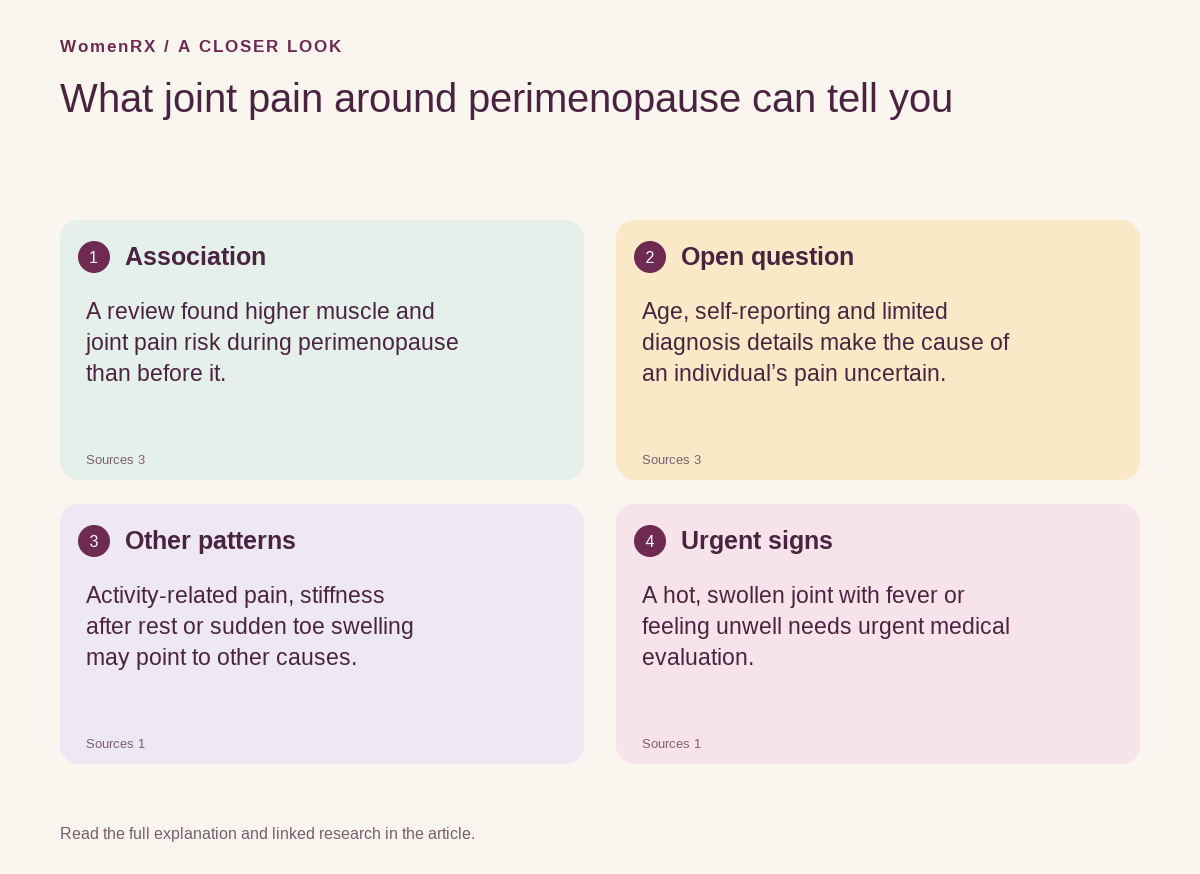
What joint pain around perimenopause can tell you
Association: A review found higher muscle and joint pain risk during perimenopause than before it.3
Open question: Age, self-reporting and limited diagnosis details make the cause of an individual’s pain uncertain.3
Other patterns: Activity-related pain, stiffness after rest or sudden toe swelling may point to other causes.1
Urgent signs: A hot, swollen joint with fever or feeling unwell needs urgent medical evaluation.1
Read the figure as text
The evidence supports a possible transition-related pattern, but the pain’s features still matter.- Association: A review found higher muscle and joint pain risk during perimenopause than before it.3
- Open question: Age, self-reporting and limited diagnosis details make the cause of an individual’s pain uncertain.3
- Other patterns: Activity-related pain, stiffness after rest or sudden toe swelling may point to other causes.1
- Urgent signs: A hot, swollen joint with fever or feeling unwell needs urgent medical evaluation.1
Sources you can check
- Joint pain - NHSAccessed 2026-09-25Return to first citation
- Pain | MedlinePlusAccessed 2026-09-25Return to first citation
- Musculoskeletal Manifestations of Perimenopause: A Systematic Review and Meta-Analysis of 93,021 Women.Kruse C, McKechnie T, Dworsky-Fried J, Sardar A, Hacker G, Rattansi S, Fang E, Sprague S, Shea AK, Bhandari M. · JB & JS open access · 2026Return to first citation