Swelling and Fluid Retention: What Could Be Behind It?
A newly swollen leg calls for a different response than ankles that gradually swell on both sides.
Visible swelling in your feet or legs is different from feeling bloated. Where swelling appears, how quickly it starts, and whether it affects one side or both help guide what to do next. Sudden swelling in one leg needs immediate evaluation for a possible blood clot. Persistent swelling can have circulation-related, medication-related, or broader medical causes. 1
Is it bloating or visible swelling?
Edema means fluid has collected in body tissue. In the legs, you might notice that a foot or ankle looks swollen. Abdominal fullness without visible tissue swelling is a different description; calling it “water retention” doesn’t establish that it’s edema. 1
If you can see swelling, notice whether it’s in one leg or both and whether it appeared suddenly or built up over time. Those details help sort the possibilities, but they can’t identify the cause on their own. 1
Why one leg and two legs call for different responses
Sudden swelling in one leg needs immediate evaluation. A deep vein thrombosis, or blood clot, is one possibility that needs to be checked. A clinician may use a D-dimer test or compression ultrasound as part of that assessment. Don’t put a newly swollen leg down to hormones or a medicine change without having it evaluated. 1
Swelling that gradually develops in both legs has a wider range of possible causes. Problems with blood returning through the leg veins, impaired lymphatic drainage, medications, or a condition affecting the body more broadly may be involved. A primary-care evaluation may include kidney, liver, and thyroid tests, urine protein testing, and a blood test that can help assess possible heart failure. The pattern helps determine which possibilities to investigate. 1
A medication can change the picture
Blood pressure medicines, anti-inflammatory drugs, and hormone medicines can contribute to edema. A review of drug-induced edema also identifies steroids and some medicines used for nerve pain among possible contributors. If swelling began after you started or changed a medicine, that timing is worth sharing with its prescriber. It doesn’t prove the medicine is responsible. 12
Not every swollen ankle reflects the body holding on to extra salt and water. For example, dihydropyridine calcium-channel blockers, a type of blood pressure medicine, can raise pressure in small blood vessels and push fluid into surrounding tissue. That distinction matters because a “water pill” isn’t a universal fix: treatment depends on the cause, and diuretics are intended for systemic causes of edema. 12
If you’ve noticed changes around your menstrual cycle or in midlife, mention the timing alongside any medication changes. Hormone medicines are among the potential contributors to edema, but persistent visible swelling shouldn’t automatically be attributed to menopause. 1
When to act, and what happens next
Get immediate evaluation for new, sudden swelling in one leg. 1 Tongue or throat swelling, especially with trouble breathing, is an emergency. Medication-related angioedema can affect the airway, and a severe allergic reaction can rapidly affect breathing and circulation. 23
For swelling that persists or worsens without those emergency signs, arrange a medical assessment rather than treating it as routine water retention. Be ready to describe where it appears, when it started, and any recent medication changes, including over-the-counter anti-inflammatory drugs. The useful next step is to find out why fluid is collecting, since circulation-related swelling and swelling from a broader medical condition may need different approaches. 12
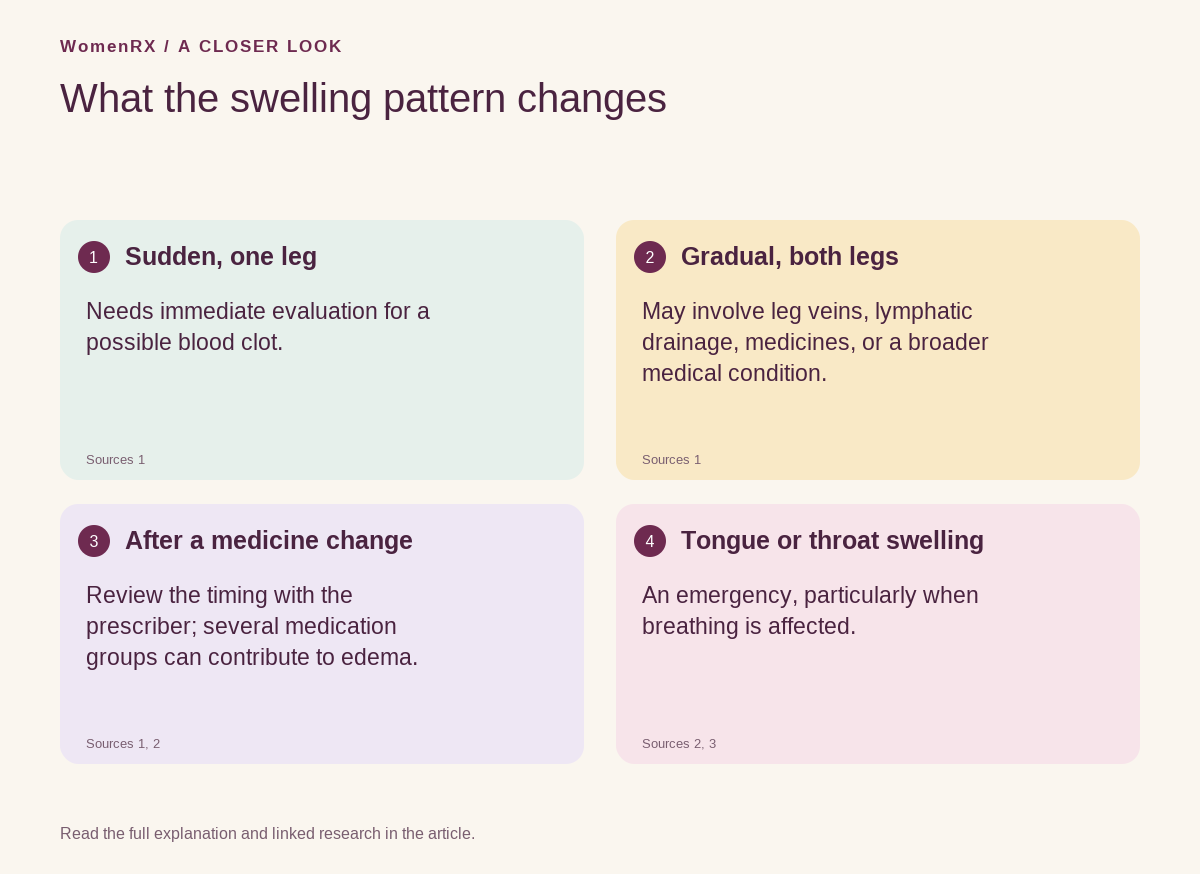
What the swelling pattern changes
Sudden, one leg: Needs immediate evaluation for a possible blood clot.1
Gradual, both legs: May involve leg veins, lymphatic drainage, medicines, or a broader medical condition.1
After a medicine change: Review the timing with the prescriber; several medication groups can contribute to edema.12
Tongue or throat swelling: An emergency, particularly when breathing is affected.23
Read the figure as text
These patterns point to different next steps, not a diagnosis.- Sudden, one leg: Needs immediate evaluation for a possible blood clot.1
- Gradual, both legs: May involve leg veins, lymphatic drainage, medicines, or a broader medical condition.1
- After a medicine change: Review the timing with the prescriber; several medication groups can contribute to edema.12
- Tongue or throat swelling: An emergency, particularly when breathing is affected.23
Sources you can check
- Peripheral Edema: Evaluation and Management in Primary Care.Patel H, Skok C, DeMarco A. · American family physician · 2022Return to first citation
- Etiology of Drug-Induced Edema: A Review of Dihydropyridine, Thiazolidinedione, and Other Medications Causing Edema.Sinnathamby ES, Urban BT, Clark RA, Roberts LT, De Witt AJ, Wenger DM, Mouhaffel A, Willett O, Ahmadzadeh S, Shekoohi S, Kaye AD, Varrassi G. · Cureus · 2024Return to first citation
- Epinephrine Auto-Injectors for Anaphylaxis: A Review of the Clinical Effectiveness, Cost-Effectiveness, and GuidelinesWeir A, Argáez C. · 2020Return to first citation