Could Progesterone Be Behind Your Night Sweats?
New night sweats are worth reviewing, but their timing alone can’t tell you whether progesterone is the cause.
Possibly, but night sweats don’t mean your progesterone dose is too high. In a trial of postmenopausal women, night sweats were reported while taking progesterone capsules with estrogen, but less often than with placebo, so that result doesn’t show progesterone caused them.6 Menopause symptoms, other medicines and other conditions can also cause night sweats.1 Note what changed, then review the full regimen with your prescriber.
What the progesterone evidence actually shows
A night sweat that starts after a prescription change deserves attention. It’s a clue about timing, not a test of your hormone level or proof that the new medicine caused it. Hormone-therapy side effects can resemble menopause symptoms, and treatment may need review if symptoms are troublesome.3
The most directly relevant trial in the US prescribing information for oral progesterone capsules followed postmenopausal women taking cyclic progesterone with conjugated estrogen. Night sweats were reported by 7% of the 178 women in that treatment group, compared with 17% of the 174 women taking placebo over the three-year trial. That comparison does not isolate progesterone: the treatment group took estrogen too. Nor does it predict what will happen with a different progesterone regimen.6
That distinction matters because progesterone can be prescribed for different reasons. In menopausal hormone therapy, it may be taken alongside estrogen; another woman may be taking progesterone without estrogen. Progestogens have also been studied as treatments for menopausal hot flashes and night sweats, though the regimens and quality of evidence vary.4 A sweat while taking progesterone can therefore be an ongoing symptom, a possible treatment-related effect or something unrelated. The symptom alone can’t sort those possibilities.
Medroxyprogesterone acetate isn’t the same product as micronized progesterone. In trials of the contraceptive Depo-Provera injection, hot flashes were reported by 1.0% of users; excessive sweating also appears among postmarketing reports. Those voluntary reports can’t establish how often it happens or whether the injection caused it. Neither finding tells us the night-sweat risk for someone taking oral micronized progesterone or a combined menopause-hormone tablet containing medroxyprogesterone acetate.2 The exact medicine and formulation matter more than the word “progesterone” on its own.
Look for a pattern, not a verdict
Before you speak with your prescriber, jot down a few details that could change the interpretation:
- What you take: the names on every hormone prescription, including estrogen, plus whether your progesterone or progestin is a capsule, a combined tablet or an injection. Hormone-therapy risks vary by type, dose and route.5
- What changed: when the sweating began relative to starting treatment or changing a prescription. If your regimen includes progestogen for only part of the month, note which days you take it. A repeated pattern is useful to describe, but it still doesn’t prove causation.3
- What the night is like: whether you wake feeling suddenly hot and sweaty, or simply find that the room or bedding is too warm. Night sweats that soak nightclothes and bedding even in a cool room are different from ordinary sweating under warm covers.1
- What else is happening: fever or shivering, cough, diarrhea, unexplained weight loss, or a new medicine. Menopause symptoms are common, but medicines and other conditions can cause night sweats too.1
For example, if the sweating began after you changed both estrogen and progesterone, focusing only on the progesterone would miss part of the picture. If it began with no prescription change, that doesn’t rule out a medicine effect, but it makes other explanations worth considering as well.
What to review before changing treatment
Tell the prescriber whether the sweats are new, worsening or continuing despite treatment, and bring the names of the products you actually use. Ask: Could these be ongoing hot flashes, an effect of this particular regimen, or a sign of another problem? If a medicine seems responsible, a clinician may consider changing the treatment; hormone-therapy reviews can also consider its type, dose or route.13 Don’t treat a sweat as evidence that you need to lower or skip progesterone yourself.
There’s a particular reason to discuss changes first if you have a uterus and take systemic estrogen. In a trial of postmenopausal women with an intact uterus, adding cyclic progesterone to conjugated estrogen was associated with substantially less endometrial hyperplasia than estrogen alone over up to 36 months. That finding explains why removing progesterone from a combined regimen isn’t a simple symptom experiment.6
Arrange a medical review if night sweats regularly wake or worry you, especially if your clothes or sheets are soaking wet. Seek a review as well if they occur with fever or shivering, cough, diarrhea or unexplained weight loss. Those details call for looking beyond hormone therapy rather than assuming the prescription is to blame.1
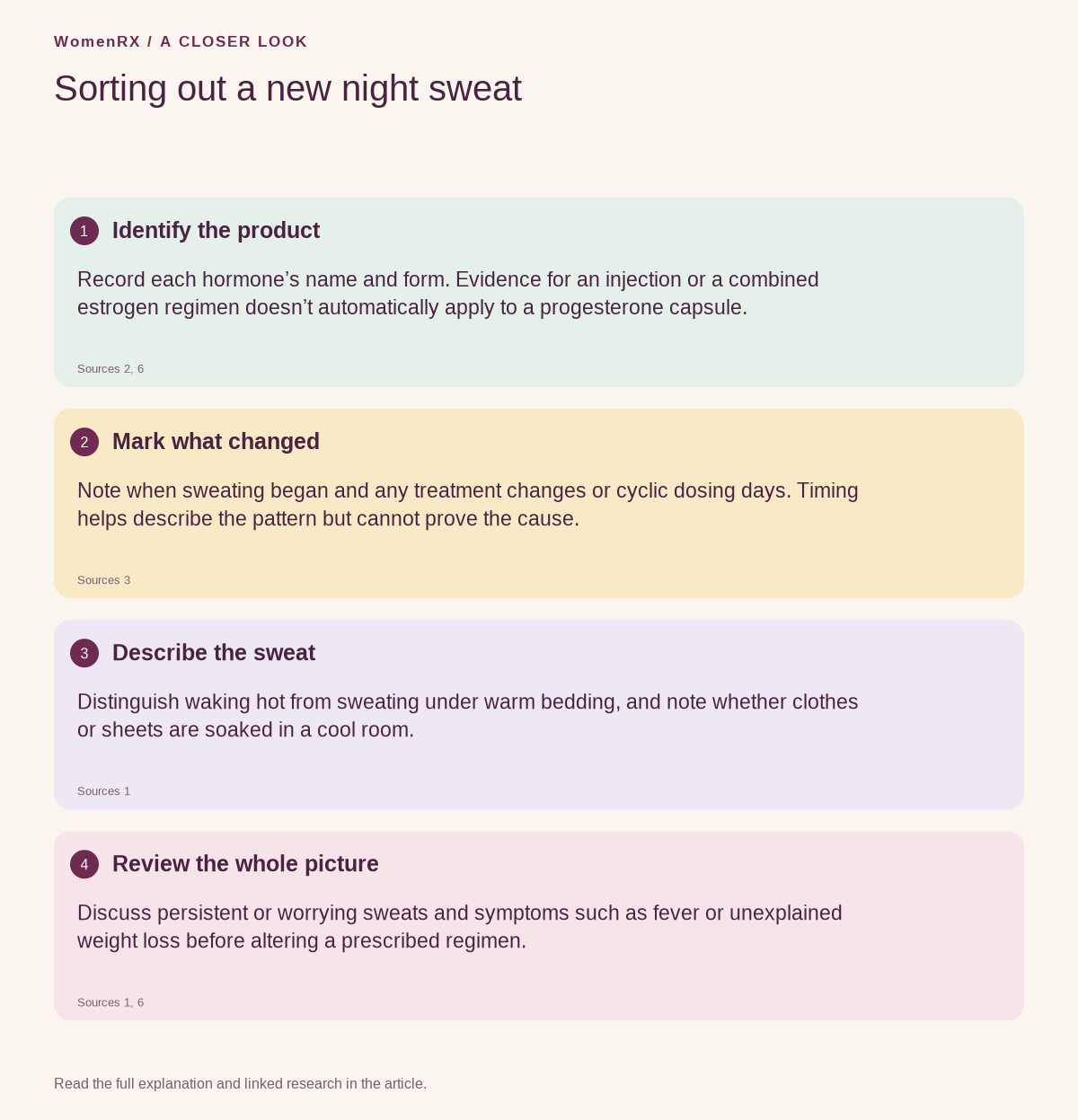
Sorting out a new night sweat
Identify the product: Record each hormone’s name and form. Evidence for an injection or a combined estrogen regimen doesn’t automatically apply to a progesterone capsule.26
Mark what changed: Note when sweating began and any treatment changes or cyclic dosing days. Timing helps describe the pattern but cannot prove the cause.3
Describe the sweat: Distinguish waking hot from sweating under warm bedding, and note whether clothes or sheets are soaked in a cool room.1
Review the whole picture: Discuss persistent or worrying sweats and symptoms such as fever or unexplained weight loss before altering a prescribed regimen.16
Read the figure as text
Follow the details that help frame a useful review without assuming the cause or changing treatment on your own.- Identify the product: Record each hormone’s name and form. Evidence for an injection or a combined estrogen regimen doesn’t automatically apply to a progesterone capsule.26
- Mark what changed: Note when sweating began and any treatment changes or cyclic dosing days. Timing helps describe the pattern but cannot prove the cause.3
- Describe the sweat: Distinguish waking hot from sweating under warm bedding, and note whether clothes or sheets are soaked in a cool room.1
- Review the whole picture: Discuss persistent or worrying sweats and symptoms such as fever or unexplained weight loss before altering a prescribed regimen.16
More questions, answered
Do night sweats mean my progesterone level is too high?
No. Night sweats have several possible causes, including menopause symptoms and some medicines. The progesterone-capsule trial reported night sweats in both the treatment and placebo groups; it did not establish night sweats as a sign of an excessive progesterone level.16
Sources you can check
- Night sweats - NHSAccessed 2026-09-25Return to first citation
- DEPO-PROVERA (MEDROXYPROGESTERONE ACETATE) INJECTION, SUSPENSION [PHARMACIA & UPJOHN COMPANY LLC] | US prescribing information and patient instructionsAccessed 2026-09-25Return to first citation
- Side effects of hormone replacement therapy (HRT) - NHSAccessed 2026-09-25Return to first citation
- Indications and Efficacy of Progestogen-Monotherapy as Menopause Hormone Therapy: A Narrative Review.Thomas C, Carere O, Clarfield L, Jacobson M. · BJOG : an international journal of obstetrics and gynaecology · 2026Return to first citation
- The 2022 hormone therapy position statement of The North American Menopause Society.“The 2022 Hormone Therapy Position Statement of The North American Menopause Society” Advisory Panel. · Menopause (New York, N.Y.) · 2022Return to first citation
- PROGESTERONE CAPSULE [REMEDYREPACK INC.] | US prescribing information and patient instructionsAccessed 2026-09-25Return to first citation