Night Sweats in Your 40s: Could They Be Perimenopause?
Changing periods and hot-flush-like episodes can make perimenopause a plausible explanation, but night sweats alone can’t tell you what’s causing them.
Perimenopause is one possible cause of night sweats in your 40s, especially if your periods are becoming progressively irregular and the sweating feels like a hot flush. Age and night sweats alone can’t confirm the cause. Medicines, an overheated bedroom, anxiety, and sometimes infection may also be relevant. Look at the pattern and any accompanying symptoms to decide what needs attention. 1 3 4
Start with what the sweating is like
Waking warm in a stuffy room or under heavy bedding is different from repeatedly waking with clothes and sheets soaked in a cool room. That more drenching pattern is what health guidance describes as night sweats, and it’s worth paying attention to if it happens regularly. 1
When perimenopause fits the picture
In your 40s, notice whether your menstrual pattern has also changed. The menopausal transition is marked by progressive menstrual irregularity, and menopause symptoms such as hot flushes are a recognized cause of night sweats. So, a shifting cycle alongside episodes that feel like hot flushes makes perimenopause a reasonable possibility. 1 4
Look for a different explanation in the context
Consider what else changed around the time the sweating began. A new medicine or a dose change is worth mentioning, since some medicines, including certain antidepressants, steroids, and painkillers, are listed as possible causes. Anxiety, low blood sugar, alcohol or drug use, and a condition that causes excess sweating all appear on the list of possible explanations, too. A warm bedroom or bedding may account for nighttime sweating without it being the drenching pattern described above. 1
Infection is another possible explanation, particularly worth considering if you also feel ill. Night sweats alone don’t point to an infection: a systematic review describes the symptom as nonspecific and notes that many proposed clinical causes are not well supported. 3
The context can still be useful: whether your cycle changed, whether the sweating began around a medication change, whether it happens only when you’re overheated, and whether you feel unwell in other ways.
Decide whether to get it checked
Arrange medical assessment if you regularly wake with soaking-wet clothes or sheets, or if the sweats are worrying you. Don’t wait to mention them if they come with a very high temperature, feeling hot and cold or shivery, a cough, diarrhea, or unexplained weight loss. These symptoms don’t identify a particular cause, but they change the picture and warrant attention. 1
If you take a medicine that might be involved, bring up when the sweating started and when the medication was started or changed. Don’t stop a prescribed antidepressant suddenly; guidance advises discussing changes rather than stopping it abruptly. 2 1
A practical way to sort the clues is to compare three timelines: your cycle, the nights you sweat, and any medication or health changes. A pattern can help you explain what’s happening when you seek care.
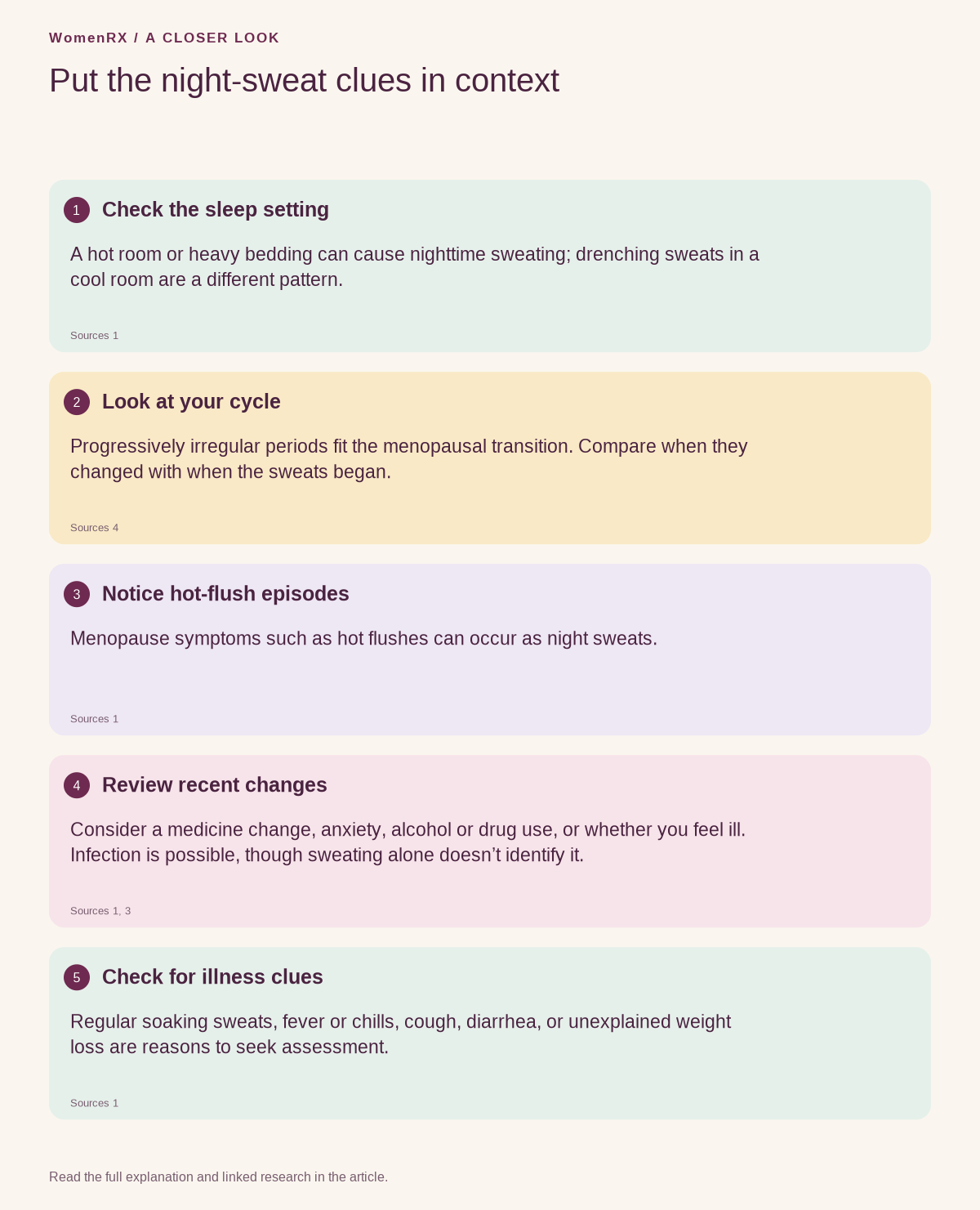
Put the night-sweat clues in context
Check the sleep setting: A hot room or heavy bedding can cause nighttime sweating; drenching sweats in a cool room are a different pattern.1
Look at your cycle: Progressively irregular periods fit the menopausal transition. Compare when they changed with when the sweats began.4
Notice hot-flush episodes: Menopause symptoms such as hot flushes can occur as night sweats.1
Review recent changes: Consider a medicine change, anxiety, alcohol or drug use, or whether you feel ill. Infection is possible, though sweating alone doesn’t identify it.13
Check for illness clues: Regular soaking sweats, fever or chills, cough, diarrhea, or unexplained weight loss are reasons to seek assessment.1
Read the figure as text
Start with the sleep setting, then consider your cycle, recent changes, and whether other symptoms call for assessment.- Check the sleep setting: A hot room or heavy bedding can cause nighttime sweating; drenching sweats in a cool room are a different pattern.1
- Look at your cycle: Progressively irregular periods fit the menopausal transition. Compare when they changed with when the sweats began.4
- Notice hot-flush episodes: Menopause symptoms such as hot flushes can occur as night sweats.1
- Review recent changes: Consider a medicine change, anxiety, alcohol or drug use, or whether you feel ill. Infection is possible, though sweating alone doesn’t identify it.13
- Check for illness clues: Regular soaking sweats, fever or chills, cough, diarrhea, or unexplained weight loss are reasons to seek assessment.1
Sources you can check
- Night sweats - NHSAccessed 2026-09-25Return to first citation
- Antidepressants - NHSAccessed 2026-09-25Return to first citation
- Night sweats: a systematic review of the literature.Mold JW, Holtzclaw BJ, McCarthy L. · Journal of the American Board of Family Medicine : JABFM · 2012Return to first citation
- Perimenopause as an obesogenic sensitive period: Contributions to elevated cardiovascular risk.Manning ME, Stockman SL, Zanni MV. · American journal of preventive cardiology · 2026Return to first citation