How Long Can Perimenopause Night Sweats Continue?
Studies tracking hot flashes and night sweats together find different symptom courses across the transition, but don’t establish a typical end date for night sweats alone.
Studies of vasomotor symptoms, which combine hot flashes and night sweats, find different patterns across the menopause transition, including symptoms that remain high after the final menstrual period. That doesn’t tell us how long night sweats alone typically last. Regular soaking sweats in a cool room, or sweats with other concerning symptoms, deserve assessment rather than an assumption that menopause is the cause. 123
What the studies can tell you about duration
Studies following women through the menopause transition find that vasomotor symptoms, measured as hot flashes and night sweats together, don’t follow one course. In an analysis of 2,377 women followed from before menopause into postmenopause, researchers identified different symptom trajectories, including one that stayed consistently high. These combined-symptom findings show that the final period isn’t necessarily the end of vasomotor symptoms. They don’t establish that night sweats alone follow those same patterns. 2
A separate prospective study followed 2,356 women who had given birth, measuring frequent hot flashes and night sweats annually for 10 years. It examined the duration of each symptom in relation to lifetime breastfeeding and reported an association between longer lifetime lactation and shorter duration of frequent hot flashes and night sweats. It doesn’t give a typical number of years for night sweats alone, and a group-level association can’t predict when your own symptoms will end. 3
What to notice about your nights
Rather than trying to calculate a countdown from the final period, focus on what’s happening now. For example, notice whether you’re waking sweaty repeatedly, whether your clothes or sheets are soaked, and whether the episodes are disrupting your sleep. Consider whether the room or bedding is making you too warm. Sweating because you’re overheated is different from soaking night sweats when the room is cool. 1
Perimenopause is one possible explanation, not the only one. Anxiety, alcohol or drug use, and hyperhidrosis, a condition that causes excessive sweating, are among other possible causes. Sometimes the cause isn’t clear. 1
When the pattern deserves assessment
Arrange an assessment if night sweats regularly wake you or worry you, particularly if your nightclothes or sheets are soaking wet despite a cool room. Seek assessment if sweats come with a very high temperature or feeling hot, cold, or shivery; a cough; diarrhea; or unexplained weight loss. These signs matter more than whether your periods are still changing. 1
If the sweats appear to be menopause-related and are disrupting your sleep, you don’t have to wait for them to run their course. Menopausal hormone therapy is the most effective treatment for vasomotor symptoms, though its benefits and risks depend on the individual. Evidence-supported nonhormonal options include cognitive behavioral therapy and several prescription treatments. Deciding whether to treat symptoms is separate from predicting how long they’ll last. 45
Different courses, no night-sweat countdown
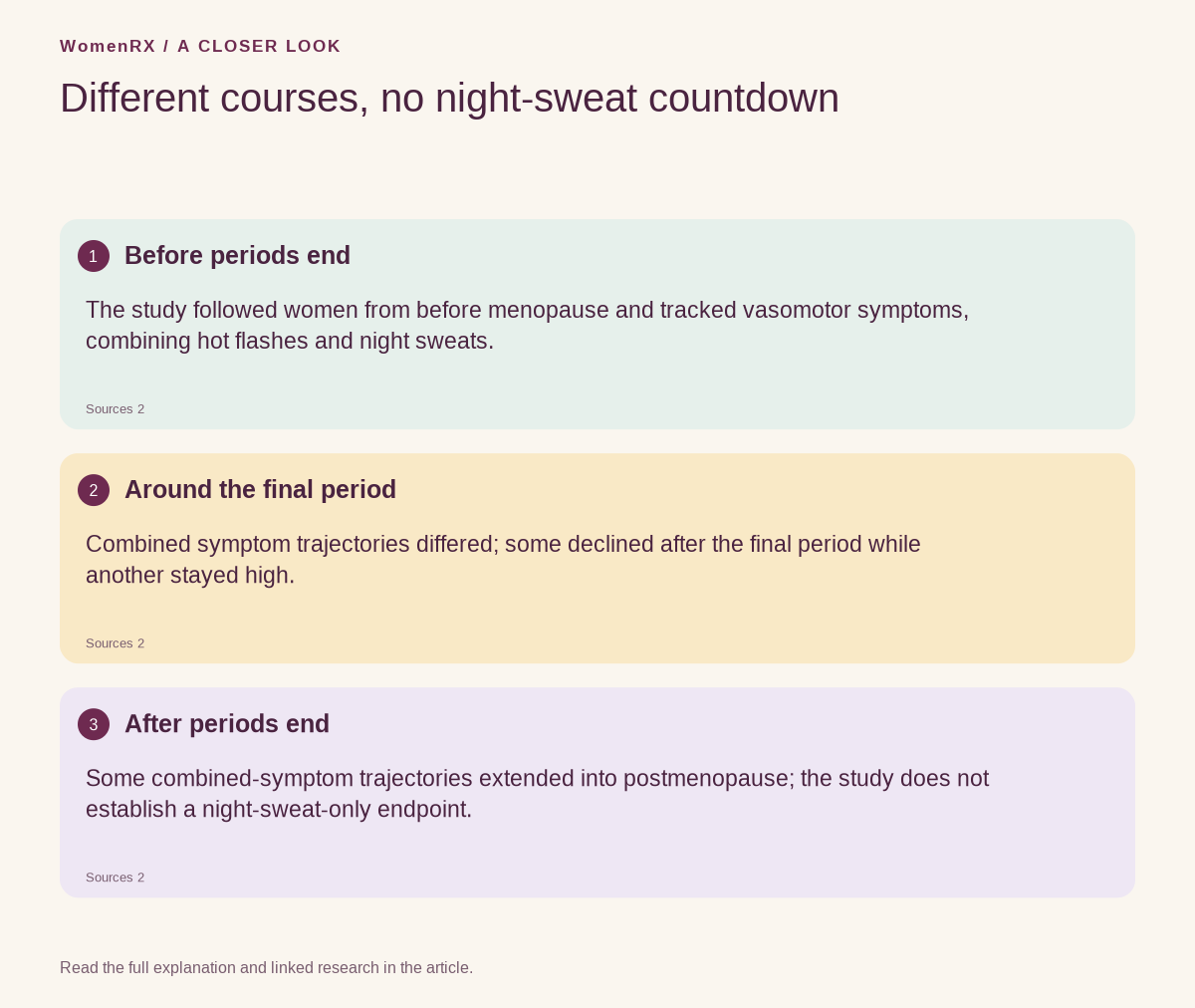
Before periods end: The study followed women from before menopause and tracked vasomotor symptoms, combining hot flashes and night sweats.2
Around the final period: Combined symptom trajectories differed; some declined after the final period while another stayed high.2
After periods end: Some combined-symptom trajectories extended into postmenopause; the study does not establish a night-sweat-only endpoint.2
Read the figure as text
This timeline shows findings on hot flashes and night sweats measured together; it does not predict how long night sweats alone will last.- Before periods end: The study followed women from before menopause and tracked vasomotor symptoms, combining hot flashes and night sweats.2
- Around the final period: Combined symptom trajectories differed; some declined after the final period while another stayed high.2
- After periods end: Some combined-symptom trajectories extended into postmenopause; the study does not establish a night-sweat-only endpoint.2
Sources you can check
- Night sweats - NHSAccessed 2026-09-25Return to first citation
- Does everyday discrimination account for the increased risk of vasomotor symptoms in Black women?: the Study of Women's Health Across the Nation (SWAN).Reeves AN, Lewis TT, Hood MM, Thurston RC, Avis NE, Burnett-Bowie SM, Cortés YI, Neal-Perry G, Harlow SD. · Menopause (New York, N.Y.) · 2024Return to first citation
- Impact of lifetime lactation on the risk and duration of frequent vasomotor symptoms: A longitudinal dose-response analysis.Scime NV, Shea AK, Faris PD, Brennand EA. · BJOG : an international journal of obstetrics and gynaecology · 2023Return to first citation
- The 2022 hormone therapy position statement of The North American Menopause Society.“The 2022 Hormone Therapy Position Statement of The North American Menopause Society” Advisory Panel. · Menopause (New York, N.Y.) · 2022Return to first citation
- The 2023 nonhormone therapy position statement of The North American Menopause Society.Menopause (New York, N.Y.) · 2023Return to first citation