Perimenopause Night Sweats: What Helps and When to Get Checked
A cooler room may help if bedding is making you hot, but recurring drenching sweats can call for a closer look and more targeted treatment.
Night sweats can happen during perimenopause when changes in reproductive hormones affect the body’s temperature regulation, but sweating isn’t automatically menopausal. If you wake with soaking clothes or sheets in a cool room, especially repeatedly, get checked. For bothersome menopause-related symptoms, hormone therapy is the most effective option overall; several nonhormonal treatments also have evidence, while simple cooling measures may offer comfort without reliably treating hot flashes. 1 4 5 7
First, distinguish a hot room from a night sweat
It’s normal to sweat if your room or bedding is too warm. Clinically significant night sweats are more like waking with soaking clothes or sheets even though the room is cool. Repeated episodes can be a menopause symptom, but anxiety, alcohol or drug use, and some other conditions can also cause them. 1
During the menopause transition, changes in reproductive hormones may affect the body’s temperature-regulation system, prompting an exaggerated heat-loss response that can include sweating. Researchers don’t fully understand the mechanism, and the experience varies from person to person. 7
If you’re simply too warm, changing the room temperature or bedding is a reasonable comfort step. But don’t expect cooling tricks or avoiding supposed triggers to reliably stop menopause-related hot flashes: a menopause evidence review did not recommend these as treatments for vasomotor symptoms. 1 5
Options differ in what they can do
Cognitive behavioral therapy (CBT) or clinical hypnosis may be worth considering if symptoms are affecting sleep and daily life. Both are recommended nonhormonal options for menopause-related vasomotor symptoms. In a small randomized study of 53 perimenopausal women, CBT improved some measures, including sleep, more than an educational pamphlet, but the groups did not differ in hot-flash frequency or rating. That suggests CBT may help with the burden of symptoms without necessarily stopping the sweats themselves. 5 8
Menopausal hormone therapy is the most effective treatment for vasomotor symptoms overall. Whether it’s appropriate depends on your health and preferences; its risks vary with factors such as the type of therapy, duration, timing, and whether a progestogen is used. A menopause position statement describes the benefit-risk balance as generally favorable for bothersome symptoms in women younger than 60 or within 10 years of menopause onset who have no contraindications. That broad guidance doesn’t settle every treatment question for perimenopause specifically. 4
Nonhormonal prescription medicines include certain SSRIs or SNRIs, gabapentin, and fezolinetant. These are evidence-supported options for menopause-related vasomotor symptoms, but the right choice depends on your circumstances and the medicine’s trade-offs. Gabapentin can cause sleepiness, tiredness, or dizziness. Fezolinetant is not a hormone; it carries a risk of liver injury and requires liver blood tests before treatment and during treatment. It also cannot be used with certain CYP1A2-inhibiting medicines, so a medication review matters. 2 3 5
Progesterone alone is less settled. In a placebo-controlled trial, 189 perimenopausal women were randomized to oral micronized progesterone or placebo for three months. The trial did not find a statistically significant difference in its primary overall symptom score, although participants reported improvements in night sweats and sleep quality. Those reported improvements are encouraging, but the study does not establish progesterone as a proven treatment for everyone with perimenopausal night sweats. 6
When to get another cause checked
Make an appointment if soaking night sweats happen regularly, wake you, or worry you, particularly when they occur in a cool room. Get checked if they come with a very high temperature, cough, diarrhea, or unexplained weight loss. A clinician can consider whether the pattern fits menopause, another cause, or a medicine you’re taking. 1
A useful way to frame the discussion is: “Could these be menopause-related vasomotor symptoms, and which option best fits my health and sleep concerns?” If you’re considering a prescription, mention all medicines and supplements you take; that’s especially relevant for fezolinetant because of its liver monitoring and interaction cautions. 2
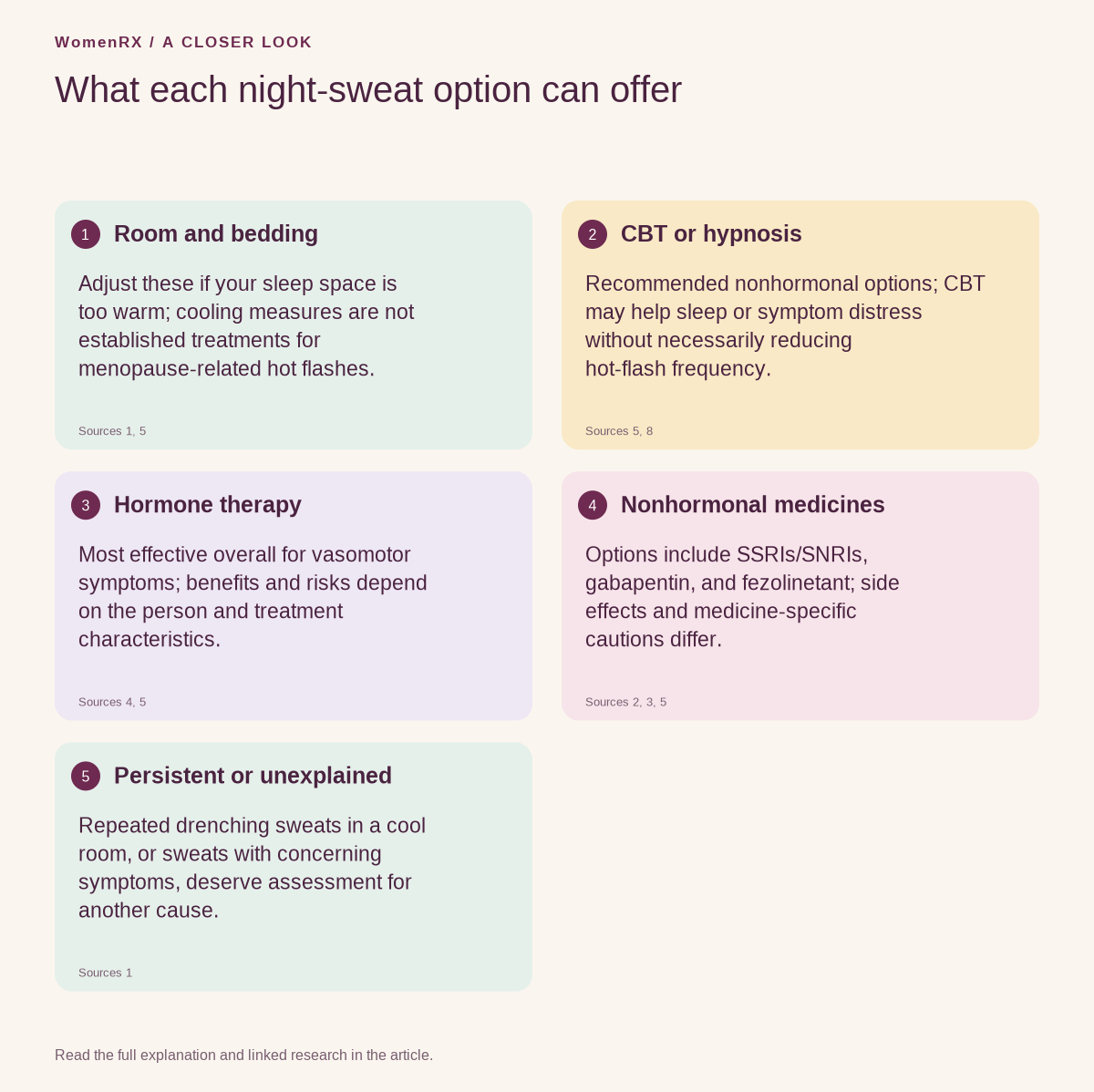
What each night-sweat option can offer
Room and bedding: Adjust these if your sleep space is too warm; cooling measures are not established treatments for menopause-related hot flashes.15
CBT or hypnosis: Recommended nonhormonal options; CBT may help sleep or symptom distress without necessarily reducing hot-flash frequency.58
Hormone therapy: Most effective overall for vasomotor symptoms; benefits and risks depend on the person and treatment characteristics.45
Nonhormonal medicines: Options include SSRIs/SNRIs, gabapentin, and fezolinetant; side effects and medicine-specific cautions differ.235
Persistent or unexplained: Repeated drenching sweats in a cool room, or sweats with concerning symptoms, deserve assessment for another cause.1
Read the figure as text
These options differ: some may make sleep more comfortable, while others are treatments for menopause-related vasomotor symptoms.- Room and bedding: Adjust these if your sleep space is too warm; cooling measures are not established treatments for menopause-related hot flashes.15
- CBT or hypnosis: Recommended nonhormonal options; CBT may help sleep or symptom distress without necessarily reducing hot-flash frequency.58
- Hormone therapy: Most effective overall for vasomotor symptoms; benefits and risks depend on the person and treatment characteristics.45
- Nonhormonal medicines: Options include SSRIs/SNRIs, gabapentin, and fezolinetant; side effects and medicine-specific cautions differ.235
- Persistent or unexplained: Repeated drenching sweats in a cool room, or sweats with concerning symptoms, deserve assessment for another cause.1
Sources you can check
- Night sweats - NHSAccessed 2026-09-25Return to first citation
- VEOZAH (FEZOLINETANT) TABLET, FILM COATED [ASTELLAS PHARMA US, INC.] | US prescribing information and patient instructionsAccessed 2026-09-25Return to first citation
- About gabapentin - NHSAccessed 2026-09-25Return to first citation
- The 2022 hormone therapy position statement of The North American Menopause Society.“The 2022 Hormone Therapy Position Statement of The North American Menopause Society” Advisory Panel. · Menopause (New York, N.Y.) · 2022Return to first citation
- The 2023 nonhormone therapy position statement of The North American Menopause Society.Menopause (New York, N.Y.) · 2023Return to first citation
- Oral micronized progesterone for perimenopausal night sweats and hot flushes a Phase III Canada-wide randomized placebo-controlled 4 month trial.Prior JC, Cameron A, Fung M, Hitchcock CL, Janssen P, Lee T, Singer J. · Scientific reports · 2023Return to first citation
- Understanding the pathophysiology of vasomotor symptoms (hot flushes and night sweats) that occur in perimenopause, menopause, and postmenopause life stages.Deecher DC, Dorries K. · Archives of women's mental health · 2007Return to first citation
- Effectiveness of Cognitive Behavioral Therapy in Managing Physical and Psychological Distress in Women during the Perimenopausal Phase.Bassi R, Bajaj MK, Goel B. · Journal of mid-life health · 2025Return to first citation