Which Menopause Symptoms Does Micronized Progesterone Help?
A trial found relief from hot flashes and night sweats with progesterone alone, while mood and sleep studies tested it alongside estrogen.
Oral micronized progesterone improved hot flashes and night sweats compared with placebo in a 12-week trial of healthy postmenopausal women. Mood and sleep findings are harder to attribute to progesterone because those studies also used estrogen. Progesterone has a separate effect on the uterine lining when estrogen is present; that effect isn’t evidence that it relieves symptoms. 5 3 7 1
Hot flashes and night sweats: progesterone tested on its own
If hot flashes or night sweats are the reason you’re asking about micronized progesterone, there is a direct trial to look at. Researchers randomly assigned 133 healthy women, 1 to 10 years past their final menstrual period, to oral micronized progesterone or placebo for 12 weeks. During the final 28 days of treatment, a score combining symptom frequency and severity favored progesterone by an adjusted 4.3 points. That analysis included 68 women in the progesterone group and 46 in the placebo group who had symptom data both before and during treatment. 5
The result supports a benefit in the women studied, but its reach is limited. Participants were healthy volunteers in early postmenopause, and treatment lasted 12 weeks. The trial doesn’t tell us whether the same result holds during perimenopause, later in postmenopause, or for women with different health profiles. Menopause Society guidance calls hormone therapy overall the most effective treatment for hot flashes and night sweats; that broader statement doesn’t establish that progesterone alone is as effective as estrogen-containing therapy. 5 2
Mood: the trial tested two hormones together
A different question is whether progesterone helps prevent low mood during the menopause transition. In a 12-month randomized trial, 172 perimenopausal and early postmenopausal women who began without clinically significant depressive symptoms received either transdermal estradiol plus intermittent micronized progesterone or placebos. Clinically significant depressive symptoms occurred at least once in 17.3% of the hormone-combination group and 32.3% of the placebo group. Because the active group received both hormones, those percentages don’t show what progesterone would do by itself. This was also a prevention study, not a test of treatment for existing depression. 3
Menopause stage mattered to one of the study’s other results. The difference in average depression-symptom scores favored the combination in the early menopause transition, but wasn’t statistically significant in the late-transition or postmenopausal subgroups. That isn’t the same as proving the combination prevents depression only in early perimenopause, or that progesterone alone improves mood at any stage. 3
Sleep: improvement without a progesterone-alone comparison
In a randomized study of 100 peri- and postmenopausal women with insomnia, both groups received estradiol. One group also received micronized progesterone; the other received a different progestogen, dydrogesterone. Sleep-quality scores improved in both groups over three months, without a statistically significant difference between them. Because there was no estradiol-only or placebo group, the improvement can’t be assigned to micronized progesterone. The study also doesn’t establish that the two progestogens work equally well for sleep. 7
For example, if you hear that women slept better while taking estrogen and progesterone, check what the comparison group took. A comparison with another estrogen-containing regimen answers a different question from progesterone versus placebo.
What its place in an estrogen regimen does, and doesn’t, tell you
Symptom relief isn’t the only reason progesterone appears in menopause hormone therapy. In the presence of estrogen, progesterone changes the uterine lining from a proliferative to a secretory state. That describes an effect on the endometrium, not a trial result showing relief of hot flashes, better sleep, or improved mood. Nor does that biological description, by itself, establish which regimen protects the lining or for whom. 1
The distinction matters when you read results for combined products. A capsule containing estradiol and micronized progesterone reduced the frequency and severity of moderate-to-severe hot flashes and night sweats compared with placebo in a clinical study. The study supports the combination’s effect, but it can’t separate the contribution of each hormone. Likewise, a trial comparing oral with transdermal estradiol gave micronized progesterone to both groups; improvements in those groups can’t establish a progesterone-specific benefit. 1 6
A small study in early postmenopause offers another useful comparison: symptom scores improved during non-oral estradiol treatment, and adding vaginal micronized progesterone did not establish a further symptom improvement. Its short duration and different route of progesterone use mean it doesn’t settle what oral progesterone alone might do. 4
The practical way to judge a benefit claim is to ask what changed between the groups. For hot flashes and night sweats, the progesterone-versus-placebo trial gives a direct, if limited, answer. For the mood and sleep findings discussed here, estrogen was part of treatment, so improvement on the regimen shouldn’t be presented as a proven benefit of progesterone alone. 5 3 7
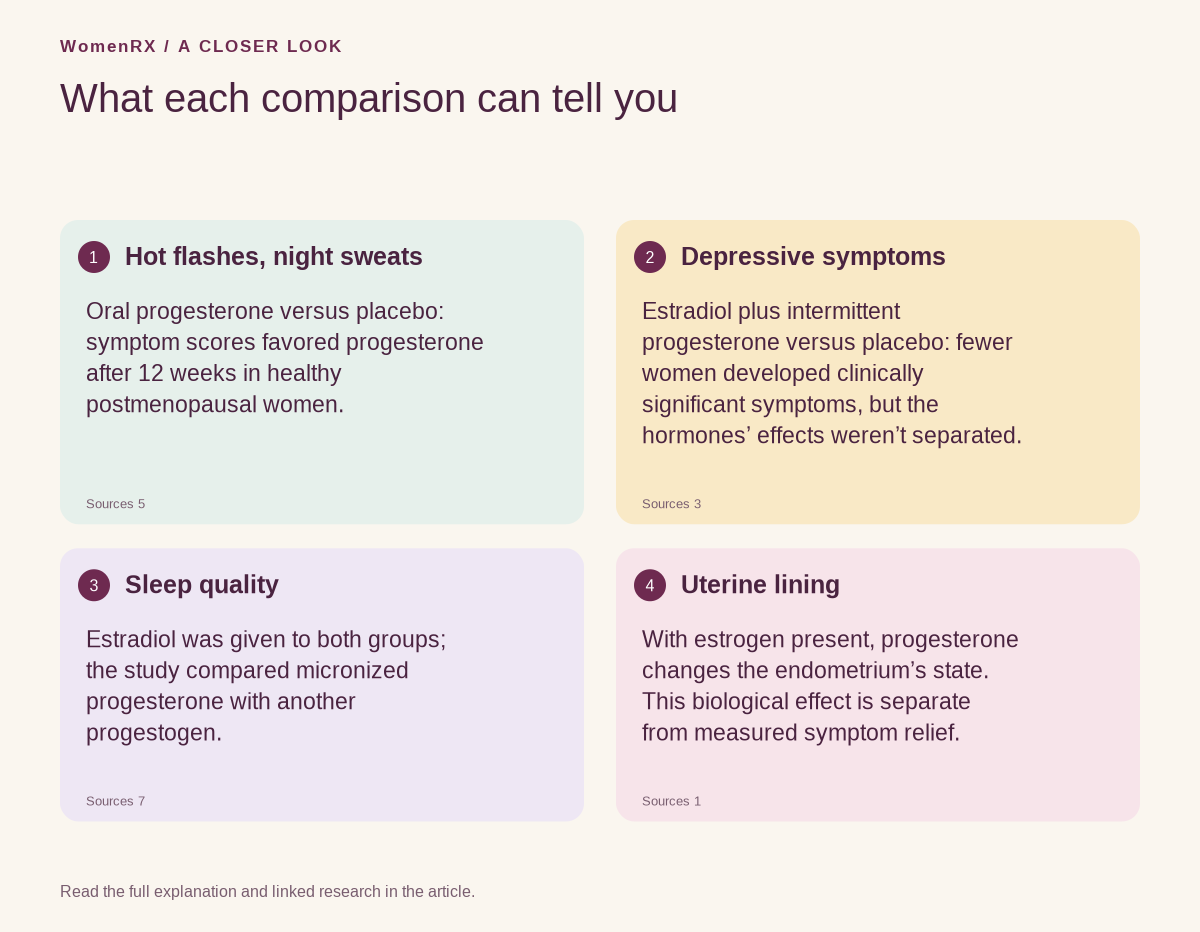
What each comparison can tell you
Hot flashes, night sweats: Oral progesterone versus placebo: symptom scores favored progesterone after 12 weeks in healthy postmenopausal women.5
Depressive symptoms: Estradiol plus intermittent progesterone versus placebo: fewer women developed clinically significant symptoms, but the hormones’ effects weren’t separated.3
Sleep quality: Estradiol was given to both groups; the study compared micronized progesterone with another progestogen.7
Uterine lining: With estrogen present, progesterone changes the endometrium’s state. This biological effect is separate from measured symptom relief.1
Read the figure as text
The treatment in the comparison group determines whether a study can identify a benefit from progesterone alone.- Hot flashes, night sweats: Oral progesterone versus placebo: symptom scores favored progesterone after 12 weeks in healthy postmenopausal women.5
- Depressive symptoms: Estradiol plus intermittent progesterone versus placebo: fewer women developed clinically significant symptoms, but the hormones’ effects weren’t separated.3
- Sleep quality: Estradiol was given to both groups; the study compared micronized progesterone with another progestogen.7
- Uterine lining: With estrogen present, progesterone changes the endometrium’s state. This biological effect is separate from measured symptom relief.1
Sources you can check
- BIJUVA (ESTRADIOL AND PROGESTERONE) CAPSULE [MAYNE PHARMA] | US prescribing information and patient instructionsAccessed 2026-09-25Return to first citation
- The 2022 hormone therapy position statement of The North American Menopause Society.“The 2022 Hormone Therapy Position Statement of The North American Menopause Society” Advisory Panel. · Menopause (New York, N.Y.) · 2022Return to first citation
- Efficacy of Transdermal Estradiol and Micronized Progesterone in the Prevention of Depressive Symptoms in the Menopause Transition: A Randomized Clinical Trial.Gordon JL, Rubinow DR, Eisenlohr-Moul TA, Xia K, Schmidt PJ, Girdler SS. · JAMA psychiatry · 2018Return to first citation
- Effects of micronized progesterone added to non-oral estradiol on lipids and cardiovascular risk factors in early postmenopause: a clinical trial.Casanova G, Spritzer PM. · Lipids in health and disease · 2012Return to first citation
- Oral micronized progesterone for vasomotor symptoms--a placebo-controlled randomized trial in healthy postmenopausal women.Hitchcock CL, Prior JC. · Menopause (New York, N.Y.) · 2012Return to first citation
- Changes in menopausal symptoms comparing oral estradiol versus transdermal estradiol.Tang R, Xie Z, Ruan X, Zhang Z, Ren M, Wu J, Shu K, Shi H, Xie M, Lv S, Yang X, Chen R, Yu Q. · Climacteric : the journal of the International Menopause Society · 2024Return to first citation
- The effect of different progestogens on sleep in postmenopausal women: a randomized trial.Leeangkoonsathian E, Pantasri T, Chaovisitseree S, Morakot N. · Gynecological endocrinology : the official journal of the International Society of Gynecological Endocrinology · 2017Return to first citation