Why Micronized Progesterone Doses Differ in Menopause HRT
The reason you’re taking progesterone, whether you have a uterus, and the estrogen product all matter when comparing prescriptions.
There isn’t one micronized progesterone dose that fits every menopause hormone therapy plan. A key question is whether you have a uterus: progesterone may be included to protect the uterine lining when estrogen is used, while progesterone-only treatment has a different purpose and evidence base. The estrogen product and the prescribed schedule matter too, so compare complete regimens, not just milligrams. 2 4
First, what is progesterone doing in the plan?
For someone with a uterus who uses systemic estrogen, progesterone may be prescribed to reduce the risk of estrogen causing excessive growth of the uterine lining, also called endometrial hyperplasia. The US prescribing information for oral micronized progesterone describes a regimen for this purpose in postmenopausal women with a uterus who are taking estrogen. 2
That makes uterine status a central part of understanding the prescription. If you’ve had a hysterectomy, the reason for including progesterone may be different from endometrial protection, or it may not be needed for that purpose. Don’t stop or change it based on that distinction alone; confirm why it’s part of your specific plan.
Progesterone can also be studied or used on its own for menopause symptoms. That is a different treatment question from protecting the uterine lining alongside estrogen. A systematic review found that trials of progestin-only treatment used varied formulations and schedules, and only some reported improvement in hot flashes. Those study regimens should not be treated as interchangeable with an endometrial-protection plan. 4
The estrogen and progesterone are one regimen
The estrogen product is part of the comparison, not a separate detail. Products may contain estrogen and progesterone together, or provide them separately. For example, US product information lists a combined estradiol and progesterone capsule containing 0.5 mg estradiol and 100 mg progesterone; separate oral micronized progesterone capsules are available in 100 mg and 200 mg strengths. Those product details alone don’t make the regimens equivalent. 1 2
The prescribed schedule matters too. As one product-specific example, the Prometrium label describes 200 mg at bedtime for 12 consecutive days in a 28-day cycle for prevention of endometrial hyperplasia in a postmenopausal woman with a uterus taking estrogen. That is an example from a particular US label, not a universal dose or schedule for every estrogen product or person. 2
So don’t adjust progesterone by comparing its milligrams with someone else’s estrogen dose, or by copying another person’s schedule. Menopause hormone therapy is individualized, and its benefit-risk considerations vary with factors including hormone type, dose, duration, route, timing, and whether a progestogen is used. 3
A useful way to compare two prescriptions
Before deciding that two prescriptions are alike, compare the full plan:
- Uterus status: Is progesterone included to protect the uterine lining, or for another reason?
- Treatment purpose: Is the plan pairing progesterone with estrogen for lining protection, or using progesterone alone for symptoms?
- Estrogen product: Is estrogen in a separate product or combined in the same capsule? What product and route are prescribed?
- Progesterone schedule: Is it taken continuously or on specified days of a cycle? What does the current product information say?
- Exact product and strength: Are you comparing the same formulation and product instructions, rather than just the number of milligrams?
These details explain why two people may have different prescriptions even if both describe them as “micronized progesterone.” A product label can confirm the directions for that product; it cannot establish that another product or schedule is a suitable substitute. For a US prescription, check the current product-specific prescribing information and ask the prescriber or pharmacist to explain any proposed change.
Questions that clarify your own plan
If you’re unsure why your dose or schedule differs from another person’s, ask: “Is progesterone here to protect my uterine lining, or for another treatment purpose?” Then confirm which estrogen product the plan is designed to accompany, whether progesterone is intended every day or on selected days, and which product instructions apply. These questions get you beyond a single number and toward the reason the regimen is set up that way.
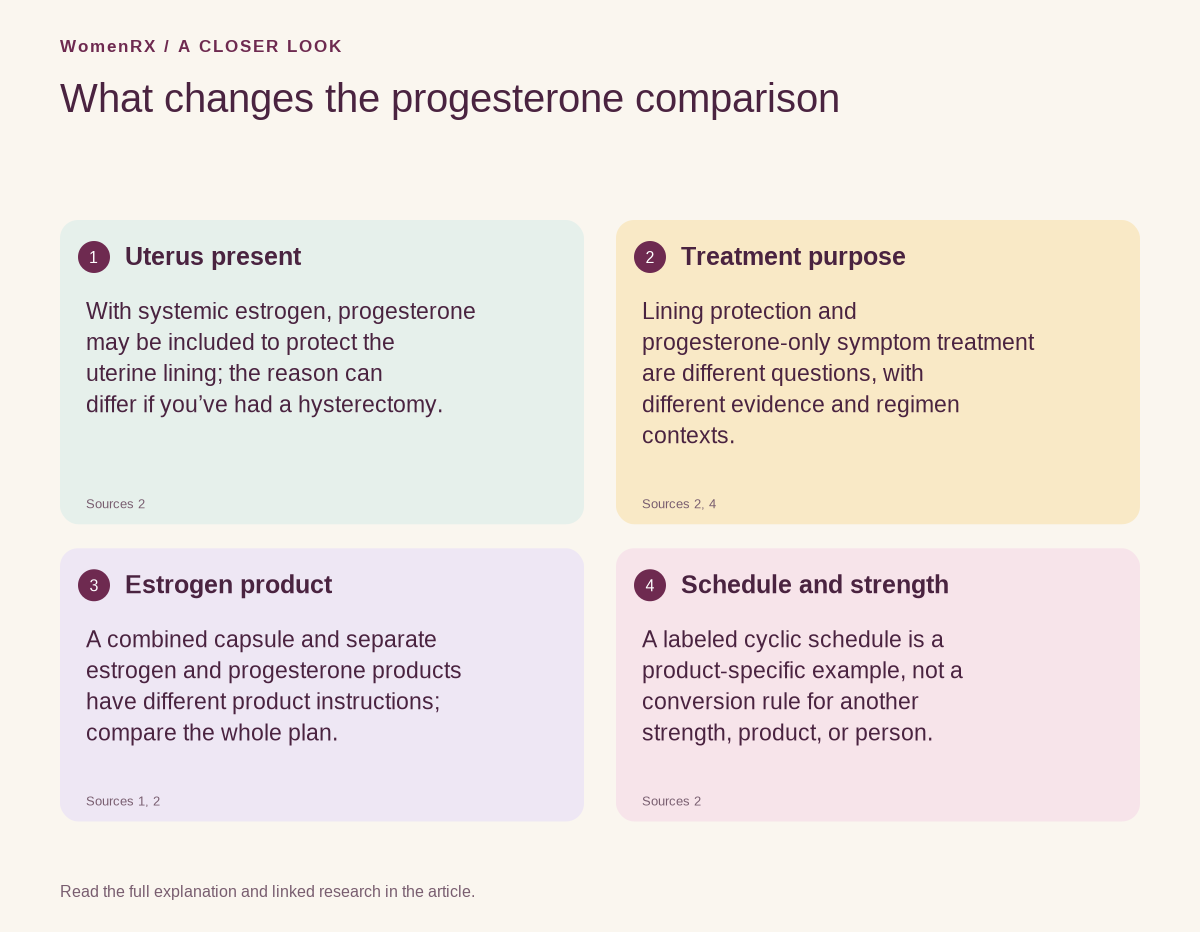
What changes the progesterone comparison
Uterus present: With systemic estrogen, progesterone may be included to protect the uterine lining; the reason can differ if you’ve had a hysterectomy.2
Treatment purpose: Lining protection and progesterone-only symptom treatment are different questions, with different evidence and regimen contexts.24
Estrogen product: A combined capsule and separate estrogen and progesterone products have different product instructions; compare the whole plan.12
Schedule and strength: A labeled cyclic schedule is a product-specific example, not a conversion rule for another strength, product, or person.2
Read the figure as text
A dose makes sense only in the context of the treatment purpose and the rest of the hormone therapy plan.- Uterus present: With systemic estrogen, progesterone may be included to protect the uterine lining; the reason can differ if you’ve had a hysterectomy.2
- Treatment purpose: Lining protection and progesterone-only symptom treatment are different questions, with different evidence and regimen contexts.24
- Estrogen product: A combined capsule and separate estrogen and progesterone products have different product instructions; compare the whole plan.12
- Schedule and strength: A labeled cyclic schedule is a product-specific example, not a conversion rule for another strength, product, or person.2
More questions, answered
Does a progesterone dose used for hot flashes mean the same thing as one used with estrogen?
No. Progesterone-only symptom treatment and progesterone paired with estrogen for uterine-lining protection are different treatment purposes. A systematic review found varied formulations and schedules in progesterone-only symptom trials, with improvement reported in only some trials. A trial dose should not be assumed to be the right dose for another purpose. 2 4
What if I don’t have a uterus?
Uterine status changes the question because the cited US progesterone labeling describes endometrial-hyperplasia prevention for women with a uterus who are taking estrogen. If you’ve had a hysterectomy, ask what purpose progesterone serves in your plan rather than assuming you should start or stop it. 2
Sources you can check
- BIJUVA (ESTRADIOL AND PROGESTERONE) CAPSULE [MAYNE PHARMA] | US prescribing information and patient instructionsAccessed 2026-09-25Return to first citation
- PROMETRIUM (PROGESTERONE) CAPSULE [ACERTIS PHARMACEUTICALS, LLC] | US prescribing information and patient instructionsAccessed 2026-09-25Return to first citation
- The 2022 hormone therapy position statement of The North American Menopause Society.“The 2022 Hormone Therapy Position Statement of The North American Menopause Society” Advisory Panel. · Menopause (New York, N.Y.) · 2022Return to first citation
- Efficacy of progestin-only treatment for the management of menopausal symptoms: a systematic review.Dolitsky SN, Cordeiro Mitchell CN, Stadler SS, Segars JH. · Menopause (New York, N.Y.) · 2020Return to first citation