How Is Progesterone Dosing Chosen for Menopause Hormone Therapy?
The right regimen depends on why progesterone is being used, whether you have a uterus, and the estrogen product and schedule it needs to accompany.
There isn’t one progesterone dose that fits every menopause hormone therapy plan. For someone with a uterus using systemic estrogen, the regimen needs evidence for protecting the uterine lining with that estrogen formulation and schedule. Studied examples include daily progesterone in a combined oral capsule and progesterone taken for part of each cycle with estrogen. Those examples aren’t interchangeable or personal dosing instructions. 1 2 3
First, what is progesterone meant to do?
When systemic estrogen is used by someone who has a uterus, estrogen can stimulate the uterine lining, or endometrium. A progestogen is included to counter that effect and reduce the risk of endometrial hyperplasia, an overgrowth of the lining. Micronized progesterone is one type of progestogen; other medicines in the broader progestogen family have their own products and regimens. 1 5 6
That makes the treatment goal a key part of dose selection. Progesterone used alongside menopause estrogen therapy is not automatically the same regimen as progesterone used for another indication. For example, the US prescribing information for oral micronized progesterone also describes its use for secondary amenorrhea, a different treatment purpose. 1
Continuous and cyclic regimens aren’t the same
With a continuous regimen, progesterone is taken regularly alongside estrogen. One studied example was a single oral capsule containing estradiol and progesterone, taken daily. In a year-long trial of postmenopausal women with a uterus, the tested combinations included 0.5 mg or 1 mg estradiol with 100 mg progesterone. The findings support those specific combinations, not every way of pairing estrogen and progesterone. 2 3
With a cyclic regimen, progesterone is taken for part of a repeating cycle while estrogen is used. The Prometrium prescribing information gives an example for postmenopausal women with a uterus using conjugated estrogens: progesterone for 12 days of a 28-day cycle. That labeled example differs from daily combination therapy in both schedule and estrogen product. It shouldn’t be treated as a substitute for another regimen. 1
These examples show why a chart listing progesterone amounts alone can mislead. The number of days progesterone is used, the estrogen it accompanies, and the specific product all affect what evidence applies. 1 2
The route and product matter, too
A study of a fixed-dose oral estradiol-progesterone capsule can’t establish that separate capsules, a different estrogen route, or a vaginal product will protect the lining in the same way. Researchers have noted that evidence for the combined capsule is specific to that product and may not transfer to similar amounts of estradiol and progesterone taken separately. 3
The distinction matters when comparing an oral capsule with other delivery methods. For example, a small phase 1 study of an estradiol-progesterone vaginal ring examined blood hormone levels and short-term tolerability in 32 postmenopausal women. It was a pharmacokinetic study, not a trial establishing long-term endometrial protection. 4
So the useful question isn’t simply “How much progesterone?” It’s “Which progesterone product and schedule have evidence for the estrogen treatment I’m using?” Estrogen dose, route, and the progesterone regimen are related considerations; one product’s results shouldn’t be assumed to validate another combination. 2 3
What to weigh when a regimen is selected
A prescriber’s decision depends on the treatment goal and the details of the hormone plan, especially whether the uterus is present and whether estrogen is systemic. The evidence also differs between continuous and cyclic schedules and among products. If you’re comparing options, ask which studied regimen the proposed plan is based on and whether the evidence applies to the exact estrogen and progesterone products being considered.
Tolerability is another practical part of the choice. Oral micronized progesterone can cause temporary dizziness or drowsiness, according to its prescribing information. That may matter when weighing a product and schedule against your daily routine. 1
The central takeaway: progesterone dosing is chosen as part of a specific treatment plan, not in isolation. A dose that was studied with one estrogen product or for one purpose does not establish the right dose, route, or schedule for another.
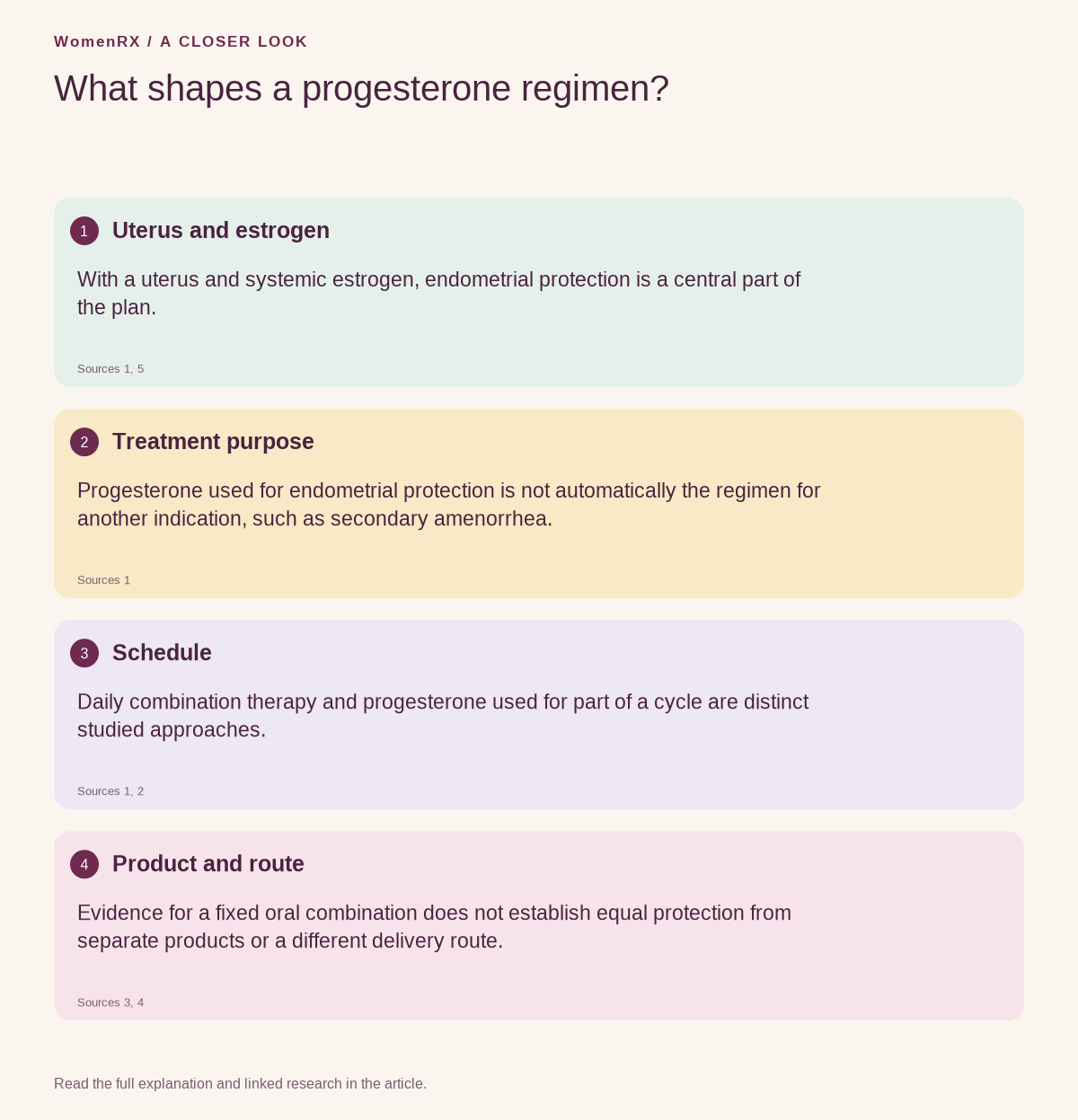
What shapes a progesterone regimen?
Uterus and estrogen: With a uterus and systemic estrogen, endometrial protection is a central part of the plan.15
Treatment purpose: Progesterone used for endometrial protection is not automatically the regimen for another indication, such as secondary amenorrhea.1
Schedule: Daily combination therapy and progesterone used for part of a cycle are distinct studied approaches.12
Product and route: Evidence for a fixed oral combination does not establish equal protection from separate products or a different delivery route.34
Read the figure as text
A dosing decision starts with the treatment purpose and then checks whether the evidence fits the specific estrogen and progesterone products.- Uterus and estrogen: With a uterus and systemic estrogen, endometrial protection is a central part of the plan.15
- Treatment purpose: Progesterone used for endometrial protection is not automatically the regimen for another indication, such as secondary amenorrhea.1
- Schedule: Daily combination therapy and progesterone used for part of a cycle are distinct studied approaches.12
- Product and route: Evidence for a fixed oral combination does not establish equal protection from separate products or a different delivery route.34
Sources you can check
- PROMETRIUM (PROGESTERONE) CAPSULE [ACERTIS PHARMACEUTICALS, LLC] | US prescribing information and patient instructionsAccessed 2026-09-25Return to first citation
- Estradiol and progesterone bioavailability for moderate to severe vasomotor symptom treatment and endometrial protection with the continuous-combined regimen of TX-001HR (oral estradiol and progesterone capsules).Lobo RA, Liu J, Stanczyk FZ, Constantine GD, Pickar JH, Shadiack AM, Bernick B, Mirkin S. · Menopause (New York, N.Y.) · 2019Return to first citation
- Endometrial safety and bleeding profile of a 17β-estradiol/progesterone oral softgel capsule (TX-001HR).Mirkin S, Goldstein SR, Archer DF, Pickar JH, Graham S, Bernick B. · Menopause (New York, N.Y.) · 2020Return to first citation
- Evaluation of 28-day estradiol and progesterone vaginal rings in a phase 1 clinical pharmacokinetic study.Hull L, Stuckey BGA, Hartman K, Zack N, Friend DR. · Menopause (New York, N.Y.) · 2023Return to first citation
- Micronized progesterone and its impact on the endometrium and breast vs. progestogens.Gompel A. · Climacteric : the journal of the International Menopause Society · 2012Return to first citation
- Progestogens in Menopausal Hormone Therapy: A Double-Edged Sword.Ylikorkala O, Joensuu JM, Siitonen H, Mikkola TS. · Seminars in reproductive medicine · 2025Return to first citation