How is progesterone prescribed during menopause hormone therapy?
The plan depends first on whether you have a uterus, then on the estrogen and progestogen products and schedules being considered.
If you have a uterus and use systemic estrogen, a progestogen is generally included to protect the uterine lining. The choice depends on the full regimen, including the estrogen and progestogen products, their routes, and whether the progestogen is taken continuously or on a repeating part-month schedule. These regimens aren’t automatically interchangeable: one studied vaginal progesterone schedule did not adequately oppose the oral estradiol used in that trial. 13
First question: is there a uterine lining to protect?
For someone with a uterus who uses systemic estrogen, a progestogen may be prescribed to counter estrogen’s effects on the uterine lining. If you’ve had a hysterectomy, progesterone generally isn’t needed for that particular purpose because there’s no uterine lining to protect. That doesn’t answer whether a hormone might be considered for some other reason, but it changes the endometrial-protection part of the decision. 5
The question is about systemic estrogen, not simply whether you use any estrogen product. The regimen should be considered as a whole, including the estrogen product and route. Formulation, route, and dosing are individualized parts of menopause hormone therapy, so there isn’t one progestogen plan that fits everyone. 3
The product and route matter
“Progestogen” is a broad term for medicines that act on the uterine lining. Micronized progesterone is one option; medroxyprogesterone acetate is an example of a synthetic progestin. These are different products, so don’t assume a schedule or route used with one applies to another. The choice depends on the full estrogen and progestogen regimen, and no single option is right for everyone. 234
The route deserves particular clarity. In a randomized trial sub-analysis of postmenopausal women with an intact uterus, researchers studied oral estradiol with vaginal micronized progesterone gel for 10 days each month. Over follow-up, that group had increasing endometrial thickness and more endometrial hyperplasia than the placebo group. The researchers concluded that the specific vaginal schedule studied was not enough to fully oppose the oral estradiol’s effects. This is a reason to ask about evidence for your exact products and instructions, not proof that every vaginal progesterone regimen is ineffective. 1
Continuous or cyclic means different instructions
A continuous plan includes the progestogen regularly alongside estrogen. A cyclic plan uses it during a repeating part of the month. Both kinds of schedules appear in the research: one review describes a combined estradiol and micronized-progesterone capsule designed for daily use, while the trial above studied vaginal progesterone for 10 days each month. These examples don’t establish that the schedules are interchangeable or identify which one is right for you. 12
Make sure the practical instructions are explicit: the product, how it’s taken, and which days to use it. If you’re using separate estrogen and progestogen products, or changing an estrogen product, ask whether the progestogen plan needs to be reviewed too. A prescription’s name alone may not make its timing or route clear.
Questions that clarify your plan
- Is my estrogen systemic, and do I have a uterus that needs lining protection?
- What is the exact progestogen product and route?
- Is the schedule continuous or cyclic? Which days does that mean for me?
- What evidence supports this specific combination and schedule?
- If my estrogen product changes, should we revisit the progestogen plan?
If the written label and the instructions you discussed don’t match, clarify the directions before changing how you take either medicine.
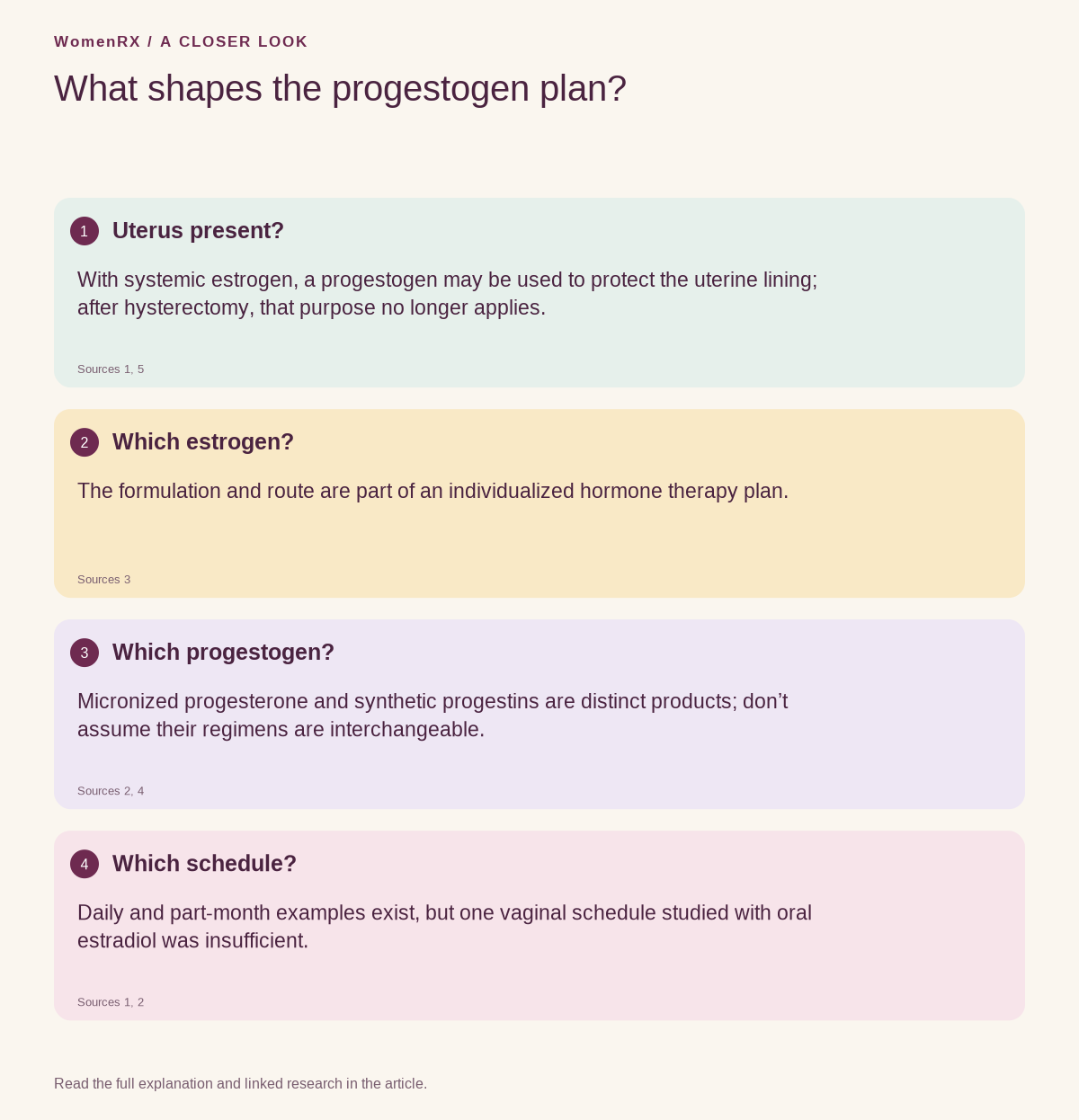
What shapes the progestogen plan?
Uterus present?: With systemic estrogen, a progestogen may be used to protect the uterine lining; after hysterectomy, that purpose no longer applies.15
Which estrogen?: The formulation and route are part of an individualized hormone therapy plan.3
Which progestogen?: Micronized progesterone and synthetic progestins are distinct products; don’t assume their regimens are interchangeable.24
Which schedule?: Daily and part-month examples exist, but one vaginal schedule studied with oral estradiol was insufficient.12
Read the figure as text
These decision points show why the need for uterine-lining protection and the details of a hormone regimen should be considered together.- Uterus present?: With systemic estrogen, a progestogen may be used to protect the uterine lining; after hysterectomy, that purpose no longer applies.15
- Which estrogen?: The formulation and route are part of an individualized hormone therapy plan.3
- Which progestogen?: Micronized progesterone and synthetic progestins are distinct products; don’t assume their regimens are interchangeable.24
- Which schedule?: Daily and part-month examples exist, but one vaginal schedule studied with oral estradiol was insufficient.12
More questions, answered
Does everyone using menopause hormone therapy need progesterone?
No. For someone who has had a hysterectomy, progesterone generally isn’t needed for uterine-lining protection. The reason to include a progestogen in this context is to protect the lining when systemic estrogen is used by someone with a uterus. 53
Does the vaginal progesterone trial mean all vaginal progesterone is ineffective?
No. The trial found that one schedule, vaginal progesterone for 10 days each month with oral estradiol, did not fully oppose the estrogen’s effects on the lining. It does not establish whether other vaginal products or schedules provide adequate protection. 1
Sources you can check
- Use of oral estradiol plus vaginal progesterone in healthy postmenopausal women.Sriprasert I, Mert M, Mack WJ, Hodis HN, Shoupe D. · Maturitas · 2021Return to first citation
- A combined, bioidentical, oral, 17β-estradiol and progesterone capsule for the treatment of moderate to severe vasomotor symptoms due to menopause.Archer DF, Bernick BA, Mirkin S. · Expert review of clinical pharmacology · 2019Return to first citation
- Menopausal Hormone Therapy: A Narrative Review of Contemporary Evidence.Finks SW, Cieri-Hutcherson NE, Vernon V, McBane SE. · Pharmacotherapy · 2026Return to first citation
- Indications and Efficacy of Progestogen-Monotherapy as Menopause Hormone Therapy: A Narrative Review.Thomas C, Carere O, Clarfield L, Jacobson M. · BJOG : an international journal of obstetrics and gynaecology · 2026Return to first citation
- Cryopreservation and transplantation of ovarian tissue exclusively to postpone menopause: technically possible but endocrinologically doubtful.von Wolff M, Stute P. · Reproductive biomedicine online · 2015Return to first citation