How Long Can You Stay on Menopause Hormone Therapy?
There’s no universal stop date: continuing depends on your symptoms, the benefits you’re getting, your health risks, and regular reassessment.
Menopause hormone therapy doesn’t have one fixed maximum duration for everyone. Guidance supports individualizing treatment and periodically reviewing whether its benefits still outweigh its risks. Longer use may be considered for a continuing reason, such as persistent hot flashes, with shared decision-making. The review should include your symptoms, treatment type and route, changing health risks, and preferences. 2
There isn’t a single clock that decides when to stop
Menopause hormone therapy isn’t automatically inappropriate after a set number of years, and continuing isn’t automatically the right choice either. The North American Menopause Society recommends tailoring treatment to the person and periodically reevaluating its benefits and risks. For longer-term use, it points to a documented reason, such as persistent bothersome hot flashes, alongside shared decision-making and reassessment. 2
That means the useful question isn’t just, “How long have I taken it?” It’s, “What is it helping with now, and does that benefit still make sense for me?”
What to revisit at a review
The symptom or goal you’re treating. Note whether the original problem is still affecting daily life. If hot flashes or night sweats continue, that’s relevant to the decision about systemic therapy. If your main concern is now vaginal or urinary symptoms related to menopause, ask whether your current approach still fits: for people without a reason to use systemic therapy, the position statement recommends considering low-dose vaginal estrogen or other treatments for bothersome genitourinary symptoms not relieved by over-the-counter options. 2
Your treatment details. Risk can differ according to hormone type, dose, route, duration, when treatment was started, and whether a progestogen is used. So “hormone therapy” isn’t one identical treatment with one risk profile. Bring the exact product and formulation into the conversation rather than relying on a general rule about all hormone therapy. 2
Your current health picture and preferences. Reassessment is a chance to consider whether anything about your health or what you want from treatment has changed. The right balance can shift; you don’t have to keep a treatment simply because it helped before, or stop solely because you’ve reached a particular duration. Decisions should reflect the benefits and risks relevant to you. 2
Starting later and continuing later aren’t the same question
For women who start hormone therapy after age 60 or more than 10 years after menopause begins, the position statement describes a less favorable benefit-risk balance, in part because the absolute risks of coronary heart disease, stroke, blood clots in the veins, and dementia are higher. 2
That guidance about starting later is not a universal stop rule for someone who began earlier and is now older. It does make periodic reassessment especially worthwhile: the review can distinguish the risks of starting at an older age from the question of whether an established treatment still meets an ongoing need. The position statement supports individualized decisions and periodic reevaluation, not an automatic cutoff. 2
A practical way to make the decision
At a review, you can work through four questions:
- What is the treatment helping with now? Be specific about the symptoms or other documented reason.
- What treatment am I actually using? Confirm the product, dose, and route, and whether it includes a progestogen.
- Has the balance changed? Reconsider the risks in light of your current age, health, and the timing of when you started.
- What do I want to do next? Continuing, changing the approach, or stopping are choices to weigh together, not outcomes dictated by a universal time limit. 2
If you take a specific product, its own instructions may also call for regular discussion of whether treatment is still needed. For example, the US prescribing information for Prempro and Premphase says to talk regularly about whether treatment is still needed; that instruction applies to those products, not automatically to every hormone therapy. 1
A review doesn’t have to end with a change. It should give you a clear reason for the plan you choose now, and a reason to revisit it as your symptoms, health, or preferences evolve.
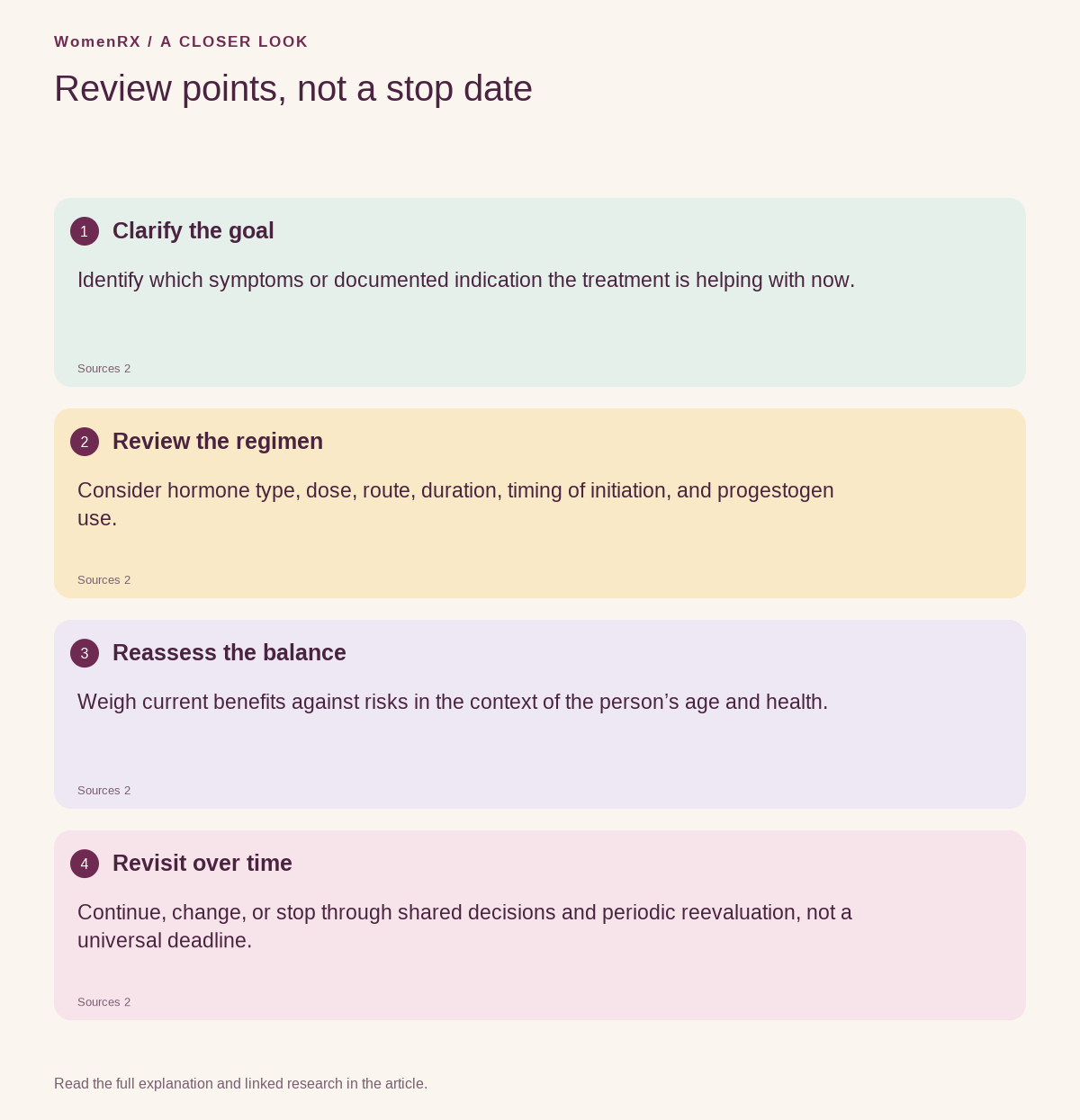
Review points, not a stop date
Clarify the goal: Identify which symptoms or documented indication the treatment is helping with now.2
Review the regimen: Consider hormone type, dose, route, duration, timing of initiation, and progestogen use.2
Reassess the balance: Weigh current benefits against risks in the context of the person’s age and health.2
Revisit over time: Continue, change, or stop through shared decisions and periodic reevaluation, not a universal deadline.2
Read the figure as text
A recurring review can reconnect the treatment plan to the reason for use, the regimen, and the person’s current benefit-risk balance.- Clarify the goal: Identify which symptoms or documented indication the treatment is helping with now.2
- Review the regimen: Consider hormone type, dose, route, duration, timing of initiation, and progestogen use.2
- Reassess the balance: Weigh current benefits against risks in the context of the person’s age and health.2
- Revisit over time: Continue, change, or stop through shared decisions and periodic reevaluation, not a universal deadline.2
More questions, answered
Does turning 65 mean I have to stop hormone therapy?
The cited position statement does not set age 65 as an automatic stop point. It says the balance is less favorable for women who start after age 60 or more than 10 years after menopause begins; that is different from a universal rule requiring someone who started earlier to stop at a particular age. Continuing should be periodically reassessed against current benefits and risks. 2
Sources you can check
- PREMPHASE (CONJUGATED ESTROGENS AND MEDROXYPROGESTERONE ACETATE) KIT PREMPRO (CONJUGATED ESTROGENS AND MEDROXYPROGESTERONE ACETATE) TABLET, SUGAR COATED [WYETH PHARMACEUTICALS LLC, A SUBSIDIARY OF PFIZER INC.] | US prescribing information and patient instructionsAccessed 2026-09-25Return to first citation
- The 2022 hormone therapy position statement of The North American Menopause Society.“The 2022 Hormone Therapy Position Statement of The North American Menopause Society” Advisory Panel. · Menopause (New York, N.Y.) · 2022Return to first citation