When Does Starting Menopause Hormone Therapy Make Sense?
Symptoms and treatment goals matter most; age and time since menopause help put the potential benefits and risks in context.
Menopause hormone therapy may make sense when symptoms such as hot flashes are bothersome, especially for someone younger than 60 or within 10 years of menopause who has no contraindications. That’s a decision-making window, not a required start date or a promise of heart protection. Starting later can carry a less favorable benefit-risk balance, so the reason for treatment and personal health risks deserve careful attention. 3
Start with what you want treatment to do
Hormone therapy is most clearly useful when menopause symptoms are affecting daily life. It’s the most effective treatment for hot flashes and night sweats, and it can also help with genitourinary symptoms such as vaginal or urinary changes. It also prevents bone loss while treatment is being used. Those are different goals, though, and they don’t all call for the same approach. 3
For example, if hot flashes and disrupted sleep are the main problem, systemic hormone therapy may be a topic to discuss. If the concern is mainly vaginal or urinary discomfort, the North American Menopause Society’s 2022 position statement recommends considering low-dose vaginal estrogen or other targeted treatments when over-the-counter options haven’t helped and systemic therapy isn’t otherwise needed. 3
A useful first question is: “Which symptoms am I hoping to improve?” That keeps the decision focused on a benefit that treatment is meant to provide, rather than on a hoped-for effect on heart disease or aging.
What the timing window means
The 2022 position statement describes a generally favorable benefit-risk balance for treating bothersome hot flashes and preventing bone loss in women younger than 60 or within 10 years of menopause onset, provided they have no contraindications. The “or” matters: these are ways of describing a group in whom the balance is often more favorable, not a requirement that everyone meet both conditions. 3
This isn’t a universal deadline or an instruction to start hormones by a certain birthday. It’s context for weighing benefits and risks. In perimenopause or early postmenopause, the symptoms you’re treating and how close you are to menopause are part of that conversation. Age and years since menopause both matter, but neither tells the whole story by itself. 3
If therapy is first considered more than 10 years after menopause or after age 60, the balance appears less favorable on average. The position statement points to greater absolute risks of coronary heart disease, stroke, blood clots in veins, and dementia in these later-start groups. That does not make later treatment automatically wrong; it does make the reason for treatment, the person’s health risks, and the available alternatives especially important. 3
Timing is not heart-disease prevention
The timing hypothesis proposes that starting hormones closer to menopause may have a different risk-benefit profile than starting them much later. It does not establish hormone therapy as a way to prevent heart disease. US prescribing information for both estrogen-alone and estrogen-plus-progestin products says not to use those therapies to prevent cardiovascular disease. The age-related trends described in those labels are not proof of protection. 12
That distinction matters if you’re weighing treatment partly because you’ve heard that “early hormones protect the heart.” A more grounded question is whether the likely symptom or bone benefit is worth the treatment’s individual risks. Heart-health prevention should not be the reason to start hormone therapy. 123
The decision is more than a calendar calculation
The position statement says risks vary with the type and dose of hormones, how they’re taken, how long they’re used, timing of initiation, and whether a progestogen is included. That means two people of the same age and years since menopause may not have the same decision. The 2022 statement recommends individualizing treatment and periodically reevaluating benefits and risks. Longer use is described in the context of a documented reason, such as persistent hot flashes, rather than as an automatic continuation. 3
A discussion is more useful when it covers:
- The symptom goal: hot flashes, vaginal or urinary symptoms, or concern about bone loss.
- Your timing: approximate age and how long it has been since menopause; if you’re in perimenopause, describe your symptoms and menstrual changes.
- Your health history: conditions or risks that could change whether systemic treatment is suitable.
- Your treatment options: whether the goal calls for systemic or more targeted treatment, and how the formulation and route affect the tradeoffs.
- The plan for reassessment: what improvement would count as worthwhile and when the benefits and risks should be reviewed again.
These points don’t calculate your personal risk. They help make sure that the decision is tied to your actual symptoms and health picture, rather than to a single age cutoff. 3
For someone starting later, persistent symptoms can still be part of a treatment discussion, but the more cautious average balance deserves attention. For someone considering treatment earlier, a favorable window is not the same as a guarantee of benefit or safety. In either case, the intended benefit should be specific and the choice individualized. 3
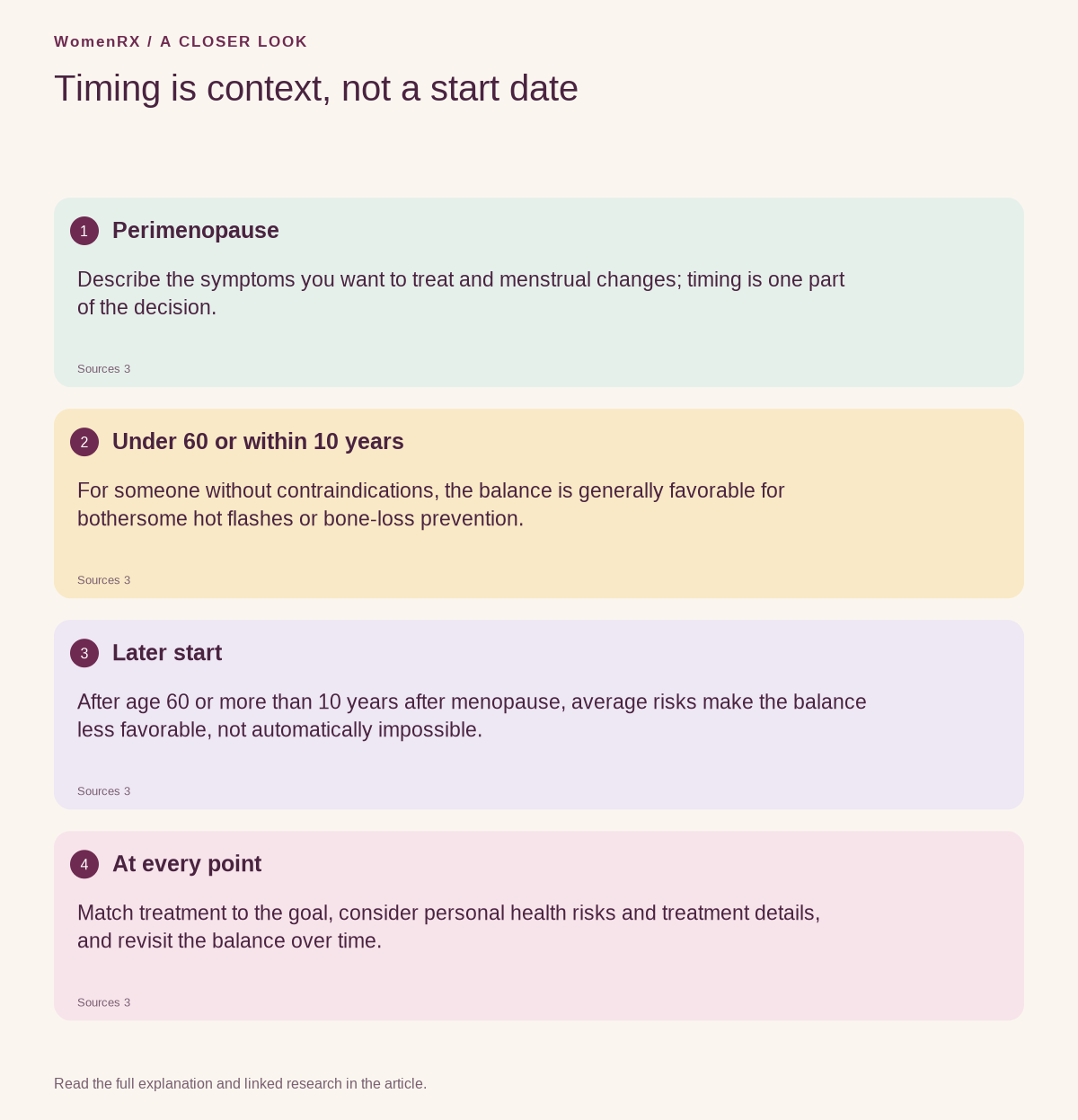
Timing is context, not a start date
Perimenopause: Describe the symptoms you want to treat and menstrual changes; timing is one part of the decision.3
Under 60 or within 10 years: For someone without contraindications, the balance is generally favorable for bothersome hot flashes or bone-loss prevention.3
Later start: After age 60 or more than 10 years after menopause, average risks make the balance less favorable, not automatically impossible.3
At every point: Match treatment to the goal, consider personal health risks and treatment details, and revisit the balance over time.3
Read the figure as text
These checkpoints show how symptoms and time since menopause can shape a discussion without setting one best date for everyone.- Perimenopause: Describe the symptoms you want to treat and menstrual changes; timing is one part of the decision.3
- Under 60 or within 10 years: For someone without contraindications, the balance is generally favorable for bothersome hot flashes or bone-loss prevention.3
- Later start: After age 60 or more than 10 years after menopause, average risks make the balance less favorable, not automatically impossible.3
- At every point: Match treatment to the goal, consider personal health risks and treatment details, and revisit the balance over time.3
More questions, answered
Does everyone need to start before age 60?
No. The position statement describes a generally favorable balance for people younger than 60 or within 10 years of menopause who have no contraindications. It is a way to frame the discussion, not a mandatory start date. 3
Can hormone therapy prevent a heart attack?
It should not be started to prevent heart disease. US prescribing information for estrogen-alone and estrogen-plus-progestin products says they should not be used for cardiovascular prevention. 12
Sources you can check
- PREMARIN (ESTROGENS, CONJUGATED) TABLET, FILM COATED [WYETH PHARMACEUTICALS LLC, A SUBSIDIARY OF PFIZER INC.] | US prescribing information and patient instructionsAccessed 2026-09-25Return to first citation
- PREMPHASE (CONJUGATED ESTROGENS AND MEDROXYPROGESTERONE ACETATE) KIT PREMPRO (CONJUGATED ESTROGENS AND MEDROXYPROGESTERONE ACETATE) TABLET, SUGAR COATED [WYETH PHARMACEUTICALS LLC, A SUBSIDIARY OF PFIZER INC.] | US prescribing information and patient instructionsAccessed 2026-09-25Return to first citation
- The 2022 hormone therapy position statement of The North American Menopause Society.“The 2022 Hormone Therapy Position Statement of The North American Menopause Society” Advisory Panel. · Menopause (New York, N.Y.) · 2022Return to first citation