Does Starting Menopausal Hormone Therapy Earlier Protect the Heart?
Starting hormone therapy closer to menopause may affect its overall risk-benefit balance, but it isn’t established as a way to prevent heart disease.
No. Starting menopausal hormone therapy (MHT) earlier may have a different cardiovascular risk profile than starting later, but it hasn’t been established as heart-disease prevention. Age at treatment start and years since menopause are separate measures, and the guidance thresholds can overlap. They help frame a symptom-treatment decision; they don’t create a guaranteed heart-protection window. 134
Two timing measures, not two neat boxes
When guidance discusses starting MHT “earlier,” it may refer to your age when treatment begins or to how long it’s been since menopause. Those measures often move together, but they aren’t interchangeable. A person could be younger than 60 and more than 10 years past menopause, for example, or older than 60 but within 10 years of menopause.
The North American Menopause Society’s 2022 position statement describes a generally favorable benefit-risk balance for people younger than 60 or within 10 years of menopause who have no contraindications, when treatment is for bothersome symptoms or bone-loss prevention. It describes a less favorable balance for people starting after age 60 or more than 10 years after menopause, citing greater absolute risks of coronary heart disease, stroke, blood clots, and dementia. 1
Because those “or” categories overlap, they aren’t mutually exclusive eligibility bands. If one measure falls on the earlier side and the other on the later side, the thresholds don’t cancel each other out or provide a simple yes-or-no answer. They’re considerations in an individualized benefit-risk assessment, not a way to determine heart protection. 1
What the timing hypothesis can tell you
The timing hypothesis proposes that cardiovascular effects may differ depending on when MHT begins. A review summarizing major randomized trials reports no overall cardiovascular benefit from MHT, while describing early initiation as potentially neutral or modestly favorable and later initiation as less favorable. That possibility is not proof that starting early prevents heart disease. 3
It helps to keep the treatment goal clear. MHT is an effective option for menopausal symptoms, and timing can matter when weighing its benefits and risks. But treating symptoms and preventing cardiovascular disease are different aims. A review of current recommendations says major medical societies do not recommend MHT for primary prevention of cardiovascular disease. 14
If you already have cardiovascular disease
Being younger or closer to menopause doesn’t settle whether systemic MHT is appropriate. The North American Menopause Society’s nonhormone therapy statement names cardiovascular disease as an example of a contraindication when discussing people who may not be good candidates for hormone therapy. Your cardiovascular history therefore needs to be considered in its own right, alongside age and time since menopause. 2
If systemic hormones aren’t a suitable option, there are evidence-supported nonhormone treatments for hot flashes and night sweats. The same statement lists options including cognitive behavioral therapy, clinical hypnosis, certain prescription medicines, and gabapentin. The best fit depends on the symptoms being treated and the person’s circumstances and preferences. 2
Questions that make the decision more useful
Rather than asking only, “Am I early enough to protect my heart?”, separate the questions:
- What symptom or other established reason would MHT address?
- How do my age and years since menopause affect the overall balance, especially if they point in different directions?
- Does my cardiovascular history change whether systemic treatment is appropriate?
- If hormones aren’t a good fit, which evidence-supported symptom treatments could I consider?
There isn’t one regimen that follows automatically from a timing category. The position statement says MHT risks also vary with type, dose, duration, route, timing of initiation, and whether a progestogen is used. 1
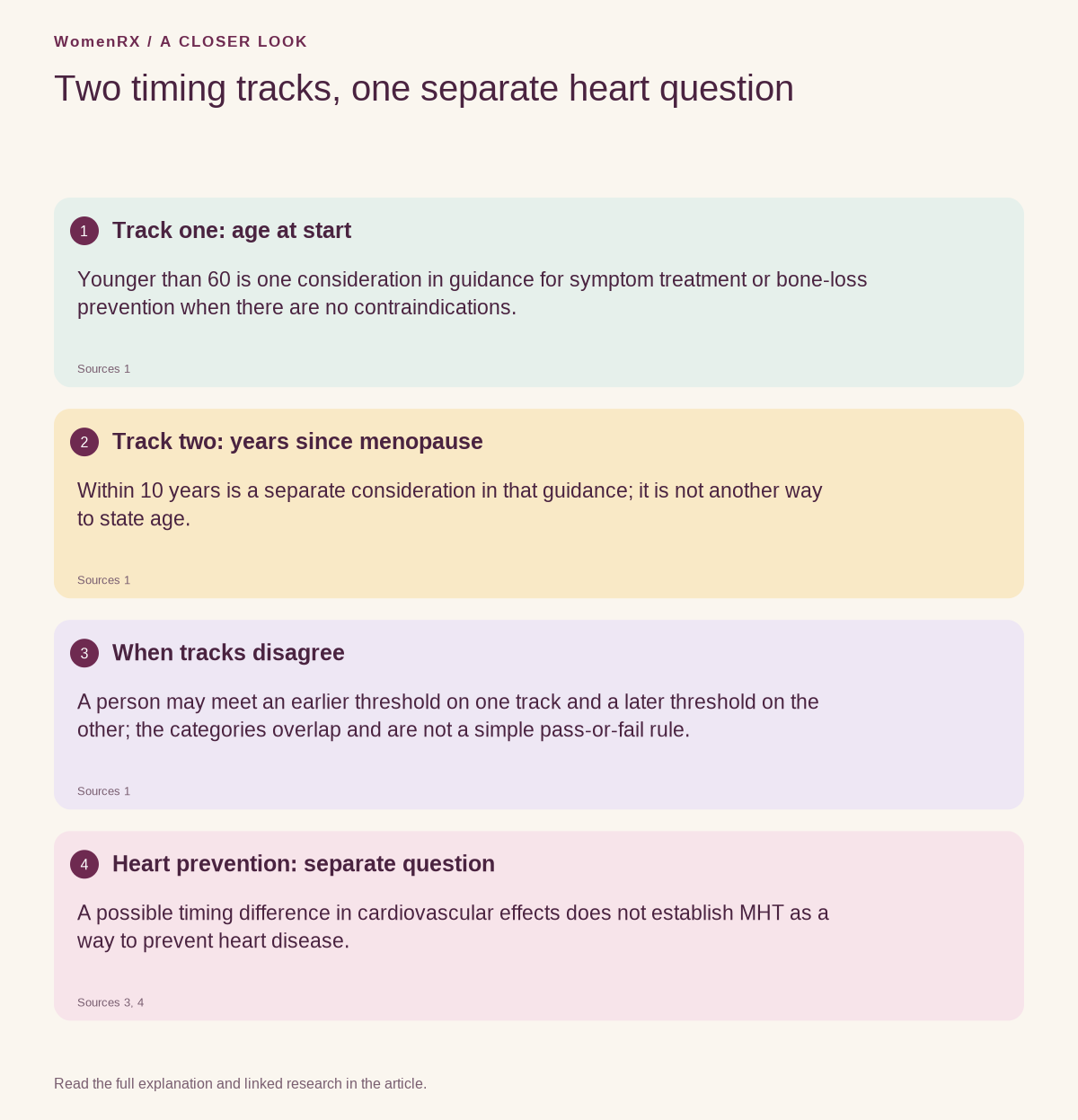
Two timing tracks, one separate heart question
Track one: age at start: Younger than 60 is one consideration in guidance for symptom treatment or bone-loss prevention when there are no contraindications.1
Track two: years since menopause: Within 10 years is a separate consideration in that guidance; it is not another way to state age.1
When tracks disagree: A person may meet an earlier threshold on one track and a later threshold on the other; the categories overlap and are not a simple pass-or-fail rule.1
Heart prevention: separate question: A possible timing difference in cardiovascular effects does not establish MHT as a way to prevent heart disease.34
Read the figure as text
Age at treatment start and years since menopause are distinct measures. Guidance thresholds overlap, and neither track promises heart protection.- Track one: age at start: Younger than 60 is one consideration in guidance for symptom treatment or bone-loss prevention when there are no contraindications.1
- Track two: years since menopause: Within 10 years is a separate consideration in that guidance; it is not another way to state age.1
- When tracks disagree: A person may meet an earlier threshold on one track and a later threshold on the other; the categories overlap and are not a simple pass-or-fail rule.1
- Heart prevention: separate question: A possible timing difference in cardiovascular effects does not establish MHT as a way to prevent heart disease.34
More questions, answered
Does being under 60 mean hormone therapy is heart-safe?
No. Age is one consideration, not a guarantee. Years since menopause, cardiovascular history, and treatment details also matter; the guidance thresholds can overlap. 1
Can hormone therapy replace other heart-prevention care?
No. MHT is not recommended for primary prevention of cardiovascular disease. Using it for menopausal symptoms is a separate decision from preventing heart disease. 4
Sources you can check
- The 2022 hormone therapy position statement of The North American Menopause Society.“The 2022 Hormone Therapy Position Statement of The North American Menopause Society” Advisory Panel. · Menopause (New York, N.Y.) · 2022Return to first citation
- The 2023 nonhormone therapy position statement of The North American Menopause Society.Menopause (New York, N.Y.) · 2023Return to first citation
- Menopausal Hormone Therapy and Cardiovascular Risk: Current Evidence and Clinical Implications.Buzduga CM, Bobu AM, Covali R, Costea CF, Cucu AI, Graur M, Patrascanu E, Solomon-Condriuc I, Carauleanu A. · Medical sciences (Basel, Switzerland) · 2026Return to first citation
- Management of menopausal hormone therapy.Switzer J, Vignali L, Vignali J, Jackson R. · Current opinion in obstetrics & gynecology · 2026Return to first citation