How Soon Might Micronized Progesterone Have an Effect?
The research offers a few specific measurement points, not one dependable timeline for feeling better.
There isn’t one established time by which micronized progesterone should help. A small study measured sleep changes over 21-day treatment periods in postmenopausal women, while a review of varied progestin-only trials found mixed results across different study durations. Those findings don’t predict your response or set a personal review date. 34
The reason for taking it changes the answer
Micronized progesterone can be used on its own or alongside estrogen, and the evidence about timing depends on the outcome researchers measured. A sleep finding, a hot-flash result, and a laboratory measurement during combined hormone therapy aren’t interchangeable signs of when you’ll feel a difference. 234
For sleep: one small, short study
A randomized crossover study tested oral micronized progesterone in 10 healthy postmenopausal women. Each treatment period lasted 21 days. At the end of those periods, sleep recordings showed less intermittent time awake. That’s a measured change in a small study, not proof that everyone will sleep better within three weeks. 4
For hot flashes: mixed results across different progestins
A systematic review included seven randomized trials of progestin-only treatment, with 601 participants. The trials used different medicines and formulations, and lasted from 21 days to 12 months, with a median duration of 12 weeks. Three of the seven reported improvement in vasomotor symptoms, such as hot flashes, among postmenopausal women. This range describes the trials as a group, not a timeline specifically established for micronized progesterone. 3
The review also reported a result from one oral micronized progesterone trial: improvement in vasomotor symptoms was 58.9%, compared with 23.5% with placebo, among 133 participants. That single study result doesn’t tell you when an individual might respond. Across the reviewed trials, mood symptoms did not improve, and the review did not establish a separate onset timeline for perimenopause. 3
With estrogen, the measurement may be about something else
Progesterone is commonly used with estrogen therapy, but a study of the combination doesn’t necessarily answer when symptoms will improve. For example, a randomized trial in women with premature ovarian insufficiency or early menopause compared micronized progesterone with another progestogen alongside transdermal estradiol. Researchers measured blood-clotting markers, including at three months; the study wasn’t designed to establish symptom relief or its timing. 23
The small sleep study involved postmenopausal women, and the review reported vasomotor improvements in postmenopausal women. These findings don’t provide a reliable perimenopause-specific timeline. 34
A study endpoint isn’t your follow-up deadline
Researchers choose when to measure an outcome for a study. That point doesn’t tell you how long you personally should wait, and a study duration isn’t a recommended treatment duration. Menopause hormone therapy is individualized and should be periodically reevaluated; the right timing depends on why you’re taking it, what benefit you’re looking for, and how treatment is going. 1
If you’re not seeing the intended benefit, ask the person who prescribed it what change they expected and when they want to review whether the plan is helping. Bring up troublesome effects sooner rather than waiting for a study’s endpoint. In the progestin-only trials reviewed, headaches and vaginal bleeding were among the reported side effects; side effects led some participants to stop treatment. Those trial findings don’t predict whether you’ll have them. 3
A useful question is: “What outcome are we looking for, and when should I let you know if it isn’t improving or if I’m having side effects?” That keeps the conversation tied to your treatment goal instead of a borrowed timeline.
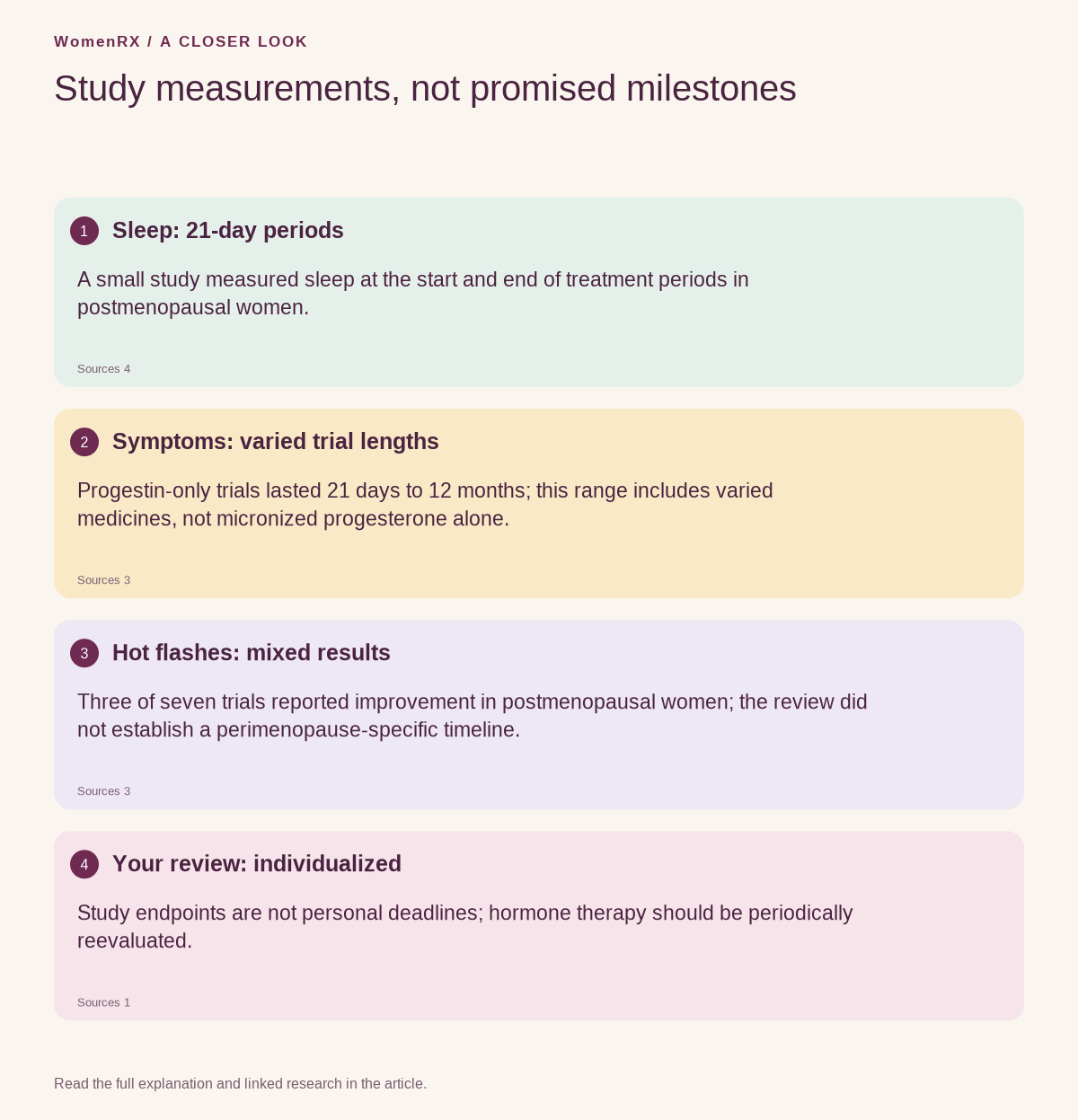
Study measurements, not promised milestones
Sleep: 21-day periods: A small study measured sleep at the start and end of treatment periods in postmenopausal women.4
Symptoms: varied trial lengths: Progestin-only trials lasted 21 days to 12 months; this range includes varied medicines, not micronized progesterone alone.3
Hot flashes: mixed results: Three of seven trials reported improvement in postmenopausal women; the review did not establish a perimenopause-specific timeline.3
Your review: individualized: Study endpoints are not personal deadlines; hormone therapy should be periodically reevaluated.1
Read the figure as text
These points show when particular research outcomes were assessed. They do not predict when you will feel a benefit or set your personal follow-up date.- Sleep: 21-day periods: A small study measured sleep at the start and end of treatment periods in postmenopausal women.4
- Symptoms: varied trial lengths: Progestin-only trials lasted 21 days to 12 months; this range includes varied medicines, not micronized progesterone alone.3
- Hot flashes: mixed results: Three of seven trials reported improvement in postmenopausal women; the review did not establish a perimenopause-specific timeline.3
- Your review: individualized: Study endpoints are not personal deadlines; hormone therapy should be periodically reevaluated.1
More questions, answered
Does the research show that progesterone works faster for sleep than for hot flashes?
No. The sleep study measured a specific outcome over 21-day periods, while the hot-flash review combined trials of different progestins and durations. Those studies don’t offer a direct comparison of which effect appears sooner. 34
Is there a separate timeline for perimenopause?
The findings here don’t establish one. The sleep study involved postmenopausal women, and the symptom review reported vasomotor improvements in postmenopausal women without establishing a perimenopause-specific onset. 34
Sources you can check
- The 2022 hormone therapy position statement of The North American Menopause Society.“The 2022 Hormone Therapy Position Statement of The North American Menopause Society” Advisory Panel. · Menopause (New York, N.Y.) · 2022Return to first citation
- The effect of micronized progesterone and medroxyprogesterone acetate in combination with transdermal estradiol on hemostatic biomarkers in postmenopausal women diagnosed with POI and early menopause: a randomized trial.Mittal M, Chitongo P, Supramaniam PR, Cardozo L, Savvas M, Panay N, Arya R, Hamoda H. · Menopause (New York, N.Y.) · 2022Return to first citation
- Efficacy of progestin-only treatment for the management of menopausal symptoms: a systematic review.Dolitsky SN, Cordeiro Mitchell CN, Stadler SS, Segars JH. · Menopause (New York, N.Y.) · 2020Return to first citation
- Progesterone reduces wakefulness in sleep EEG and has no effect on cognition in healthy postmenopausal women.Schüssler P, Kluge M, Yassouridis A, Dresler M, Held K, Zihl J, Steiger A. · Psychoneuroendocrinology · 2008Return to first citation