When might a clinician prescribe progesterone?
The reason, formulation, and follow-up plan depend on whether treatment is for menopause-related hormone therapy, a pregnancy-related concern, or another specific goal.
A clinician may prescribe progesterone or a related progestogen as part of hormone therapy, or consider a particular progesterone formulation for a pregnancy-related indication. During menopause hormone therapy, it may be paired with systemic estrogen when you have a uterus, because estrogen without progesterone can leave the uterine lining unprotected. It isn’t automatically needed for menopause symptoms alone; the treatment goal and product matter. 1 2
Start with the reason for the prescription
“Progesterone” doesn’t describe one interchangeable treatment plan. A prescription should be connected to a specific goal, such as using hormone therapy for symptoms or addressing a pregnancy-related concern. The formulation matters too: guidance about vaginal progesterone in pregnancy, for example, cannot automatically be applied to other progesterone products or purposes. 2
If a prescription is being started or renewed, ask what problem it is intended to address, what change would count as success, and why this product and route fit that goal. Those questions are especially useful when a medication is being continued even though the original reason is no longer clear.
Menopause: ask how progesterone fits with estrogen
In menopause hormone therapy, progesterone may be prescribed alongside systemic estrogen when a woman has a uterus. The concern is that estrogen without progesterone can increase the risk of endometrial cancer; one study assessing prescribing records specifically identified failure to prescribe progesterone to some women with a uterus who were receiving systemic estrogen as a safety concern. 1
That does not mean progesterone is automatically appropriate for menopause symptoms, or that everyone needs the same hormone combination. A useful question is: “Is this being prescribed to protect my uterine lining, to address a symptom, or for another reason?” If estrogen is also part of the plan, clarify whether it is systemic and how the clinician has accounted for whether you have a uterus.
The expected balance of benefit and risk also belongs in the conversation. A study of prescribing records found that documentation of indications and contraindications was often incomplete in the VA facilities it examined. That finding describes those records, not every clinician or current prescribing practice, but it underscores why the reason for treatment and the individual rationale should be clear at a new prescription or renewal. 1
Premature ovarian insufficiency is a separate context from typical menopause: it involves loss of ovarian activity before age 40. A review based on evidence used for a clinical guideline describes hormone therapy as strongly recommended in this group, while noting limited evidence about the best type, regimen, and dose. If this applies to you, ask how the plan accounts for your diagnosis, preferences, and any contraceptive needs. 3
Pregnancy-related use is a different decision
In pregnancy, the relevant question is not simply whether progesterone “helps.” The Society for Maternal-Fetal Medicine distinguishes vaginal progesterone discussions from 17-alpha hydroxyprogesterone caproate (17-OHPC), whose approval was withdrawn in 2023 after evidence did not show reduced risk of recurrent spontaneous preterm birth. The statement says the withdrawal did not change recommendations for vaginal progesterone in patients with a short cervix. For prevention of recurrent preterm birth without cervical-length information, or when cervical length is at least 25 mm, it recommends shared decision-making. 2
So if progesterone is proposed during pregnancy, ask which formulation is meant, what pregnancy-related finding or history supports it, and how cervical-length information affects the decision. A recommendation about one formulation should not be treated as evidence for another. 2
Before starting or renewing, get the plan in plain language
Try to leave the conversation knowing:
- The indication: What diagnosis, symptom, or risk is the prescription addressing?
- The intended product and route: Is it progesterone or another progestogen, and why is this formulation being used for this goal?
- The expected benefit: What change should you look for, and how will you and the clinician judge whether it is helping?
- The risk discussion: Which risks matter for your situation, and what information about your health or other treatment choices shaped the decision?
- The review plan: When will the reason for continuing treatment and its effects be reconsidered?
These questions don’t determine whether a prescription is right for you. They make the clinical goal and the reasoning behind starting or continuing it easier to understand. A clear answer should connect the product to your situation, rather than relying on the word “hormones” alone.
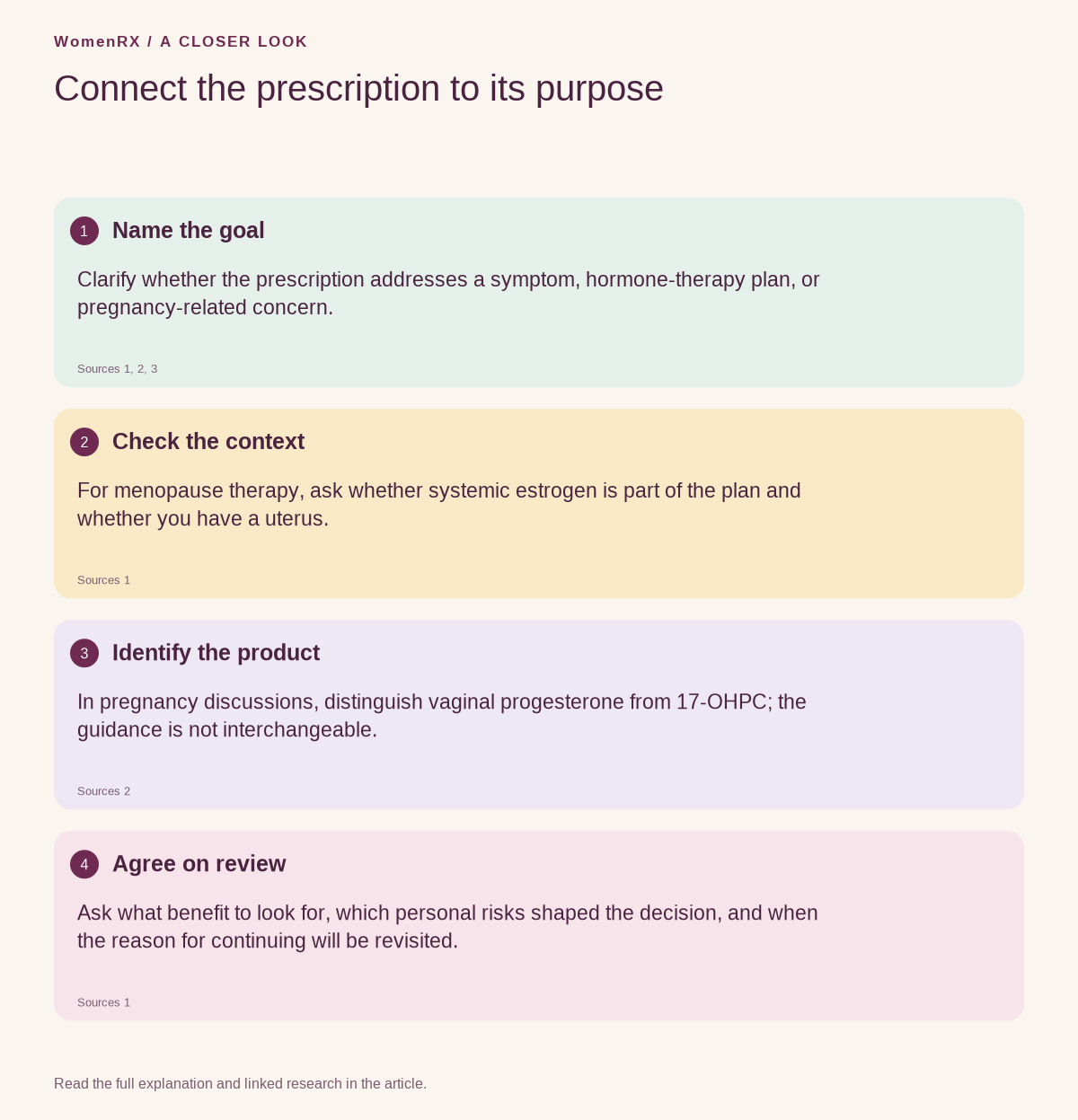
Connect the prescription to its purpose
Name the goal: Clarify whether the prescription addresses a symptom, hormone-therapy plan, or pregnancy-related concern.123
Check the context: For menopause therapy, ask whether systemic estrogen is part of the plan and whether you have a uterus.1
Identify the product: In pregnancy discussions, distinguish vaginal progesterone from 17-OHPC; the guidance is not interchangeable.2
Agree on review: Ask what benefit to look for, which personal risks shaped the decision, and when the reason for continuing will be revisited.1
Read the figure as text
These questions help distinguish menopause hormone therapy from pregnancy-related decisions before discussing a product or renewal.- Name the goal: Clarify whether the prescription addresses a symptom, hormone-therapy plan, or pregnancy-related concern.123
- Check the context: For menopause therapy, ask whether systemic estrogen is part of the plan and whether you have a uterus.1
- Identify the product: In pregnancy discussions, distinguish vaginal progesterone from 17-OHPC; the guidance is not interchangeable.2
- Agree on review: Ask what benefit to look for, which personal risks shaped the decision, and when the reason for continuing will be revisited.1
More questions, answered
Does a menopause diagnosis mean I need progesterone?
No. The menopause context described here is specifically about progesterone being used with systemic estrogen, including to address the risk to the uterine lining in a woman with a uterus. Whether it belongs in an individual plan depends on the treatment and the reason for it. 1
Are all progesterone formulations interchangeable?
No. The pregnancy guidance distinguishes vaginal progesterone from 17-OHPC and gives different considerations for each. Ask your clinician to name the specific product and explain why it matches the indication. 2
Sources you can check
- Veterans Health Administration Primary Care Provider Adherence to Prescribing Guidelines for Systemic Hormone Therapy in Menopausal Women.Cordasco KM, Yuan AH, Danz MJ, Jackson L, Yee EF, Tcheung LS, Washington DL. · Journal for healthcare quality : official publication of the National Association for Healthcare Quality · 2019Return to first citation
- Society for Maternal-Fetal Medicine Statement: Response to the Food and Drug Administration's withdrawal of 17-alpha hydroxyprogesterone caproate.Society for Maternal-Fetal Medicine (SMFM). Electronic address: pubs@smfm.org, SMFM Publications Committee. · American journal of obstetrics and gynecology · 2023Return to first citation
- HRT for women with premature ovarian insufficiency: a comprehensive review.Webber L, Anderson RA, Davies M, Janse F, Vermeulen N. · Human reproduction open · 2017Return to first citation