What Is Progesterone Used for in Menopause Care?
Its clearest role is protecting the uterine lining when systemic estrogen is used, but the purpose and evidence depend on your situation and the exact formulation.
Progesterone or another progestogen may be paired with systemic estrogen for someone with a uterus to protect the uterine lining from the effects of estrogen. That is different from using progesterone as a general menopause-symptom treatment. If you don’t use systemic estrogen, or don’t have a uterus, ask what specific purpose your prescription is meant to serve. 3
Start with the treatment purpose
One established reason to prescribe progesterone or another progestogen is to protect the uterine lining, also called the endometrium, when someone with a uterus uses systemic estrogen. Estrogen without a progestogen can increase endometrial risk; the progestogen is included to address that risk. 3
This role doesn’t mean progesterone is a general treatment for menopause symptoms. Menopause hormone therapy is individualized, and its risks vary with factors including hormone type, route, duration, timing, and whether a progestogen is used. 1
If you don’t have a uterus, endometrial protection doesn’t explain the prescription. And if you aren’t using systemic estrogen, ask what goal your clinician has in mind rather than assuming the medicine is intended for hot flashes, sleep, or another symptom.
A combination treatment isn’t evidence for progesterone alone
A review summarizing the REPLENISH trial reported that the two highest tested doses of a combined estradiol-progesterone capsule reduced hot-flash frequency and severity compared with placebo at four and 12 weeks. Because participants received both hormones, the result can’t show how much benefit came from progesterone itself. 2
That distinction matters if progesterone is being offered on its own for a symptom. Ask what evidence applies to that specific use and formulation; a result for a combined treatment doesn’t establish a general benefit from progesterone alone.
The exact formulation matters
“Progestogen” is a broad term used for medicines that include progesterone and synthetic alternatives. Research or recommendations about one formulation shouldn’t automatically be applied to another. A 2026 narrative review favors oral micronized progesterone over synthetic progestogens when endometrial protection is needed, while also identifying a need for more research on modern formulations and long-term outcomes. 4
So it’s useful to ask for the exact name and form of the medicine, not just whether it’s “progesterone.” The role it is meant to serve and the formulation being discussed should fit together.
Questions that make the prescription clearer
You could ask:
- Is this meant to protect my uterine lining while I use systemic estrogen, or does it have another purpose?
- How does my uterus status affect the reason for taking it?
- What is the exact formulation, and what evidence supports using that form for this purpose?
- If it’s intended to help a symptom, what evidence applies to this medicine on its own?
These questions help separate an established role alongside systemic estrogen from a separate symptom-treatment claim. They also make clear when a finding about one hormone combination or formulation may not apply to another.
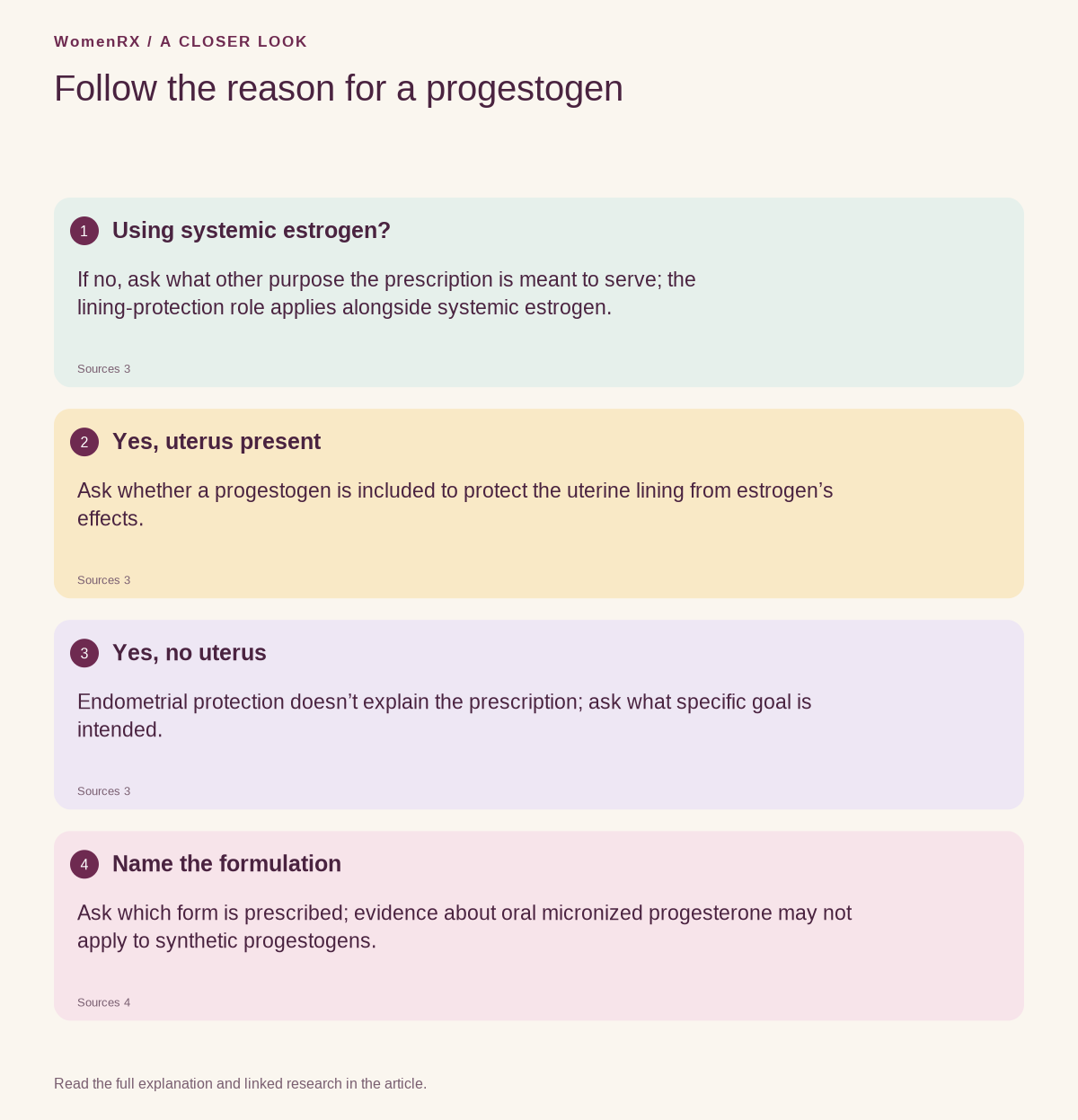
Follow the reason for a progestogen
Using systemic estrogen?: If no, ask what other purpose the prescription is meant to serve; the lining-protection role applies alongside systemic estrogen.3
Yes, uterus present: Ask whether a progestogen is included to protect the uterine lining from estrogen’s effects.3
Yes, no uterus: Endometrial protection doesn’t explain the prescription; ask what specific goal is intended.3
Name the formulation: Ask which form is prescribed; evidence about oral micronized progesterone may not apply to synthetic progestogens.4
Read the figure as text
Start with systemic estrogen use, then consider uterus status. The resulting path clarifies whether endometrial protection fits the situation and what to ask about the formulation.- Using systemic estrogen?: If no, ask what other purpose the prescription is meant to serve; the lining-protection role applies alongside systemic estrogen.3
- Yes, uterus present: Ask whether a progestogen is included to protect the uterine lining from estrogen’s effects.3
- Yes, no uterus: Endometrial protection doesn’t explain the prescription; ask what specific goal is intended.3
- Name the formulation: Ask which form is prescribed; evidence about oral micronized progesterone may not apply to synthetic progestogens.4
Sources you can check
- The 2022 hormone therapy position statement of The North American Menopause Society.“The 2022 Hormone Therapy Position Statement of The North American Menopause Society” Advisory Panel. · Menopause (New York, N.Y.) · 2022Return to first citation
- A combined, bioidentical, oral, 17β-estradiol and progesterone capsule for the treatment of moderate to severe vasomotor symptoms due to menopause.Archer DF, Bernick BA, Mirkin S. · Expert review of clinical pharmacology · 2019Return to first citation
- Progestins and menopause: epidemiological studies of risks of endometrial and breast cancer.Pike MC, Ross RK. · Steroids · 2000Return to first citation
- Menopausal Hormone Therapy: A Narrative Review of Contemporary Evidence.Finks SW, Cieri-Hutcherson NE, Vernon V, McBane SE. · Pharmacotherapy · 2026Return to first citation