What Is Estradiol, and When Is It Used in Menopause Care?
Estradiol is used in menopause hormone therapy, but the right product depends on whether you’re treating symptoms throughout the body or mainly in vaginal tissues.
Estradiol (E2) is an estrogen used in menopause hormone therapy. Systemic hormone therapy may be considered for bothersome hot flashes and night sweats, while specific low-dose vaginal estradiol inserts have been studied for vaginal dryness and pain with sex. These routes serve different goals, and a symptom by itself doesn’t show that you have an estradiol deficiency. 2 3
Estradiol (often shortened to E2) is an estrogen used in menopause hormone therapy. During the menopausal transition, ovarian production of estrogen changes and declines, but symptoms such as poor sleep or mood changes don’t, on their own, establish an estradiol deficiency. 1 2
The useful first distinction is the treatment goal: symptoms such as hot flashes affect you more broadly, while vaginal dryness and pain with sex are centered in vaginal tissues. Estradiol products are not interchangeable just because they contain the same hormone.
When treatment is meant to work throughout the body
Menopause hormone therapy is the most effective treatment for vasomotor symptoms, including hot flashes and night sweats. It has also been shown to prevent bone loss and fractures. A transdermal estradiol spray is one example of a skin-applied form used for menopause symptom management. The available evidence doesn’t establish that this product or route is the best choice for every woman. 3 6
Whether systemic hormone therapy makes sense depends on more than the symptom. The North American Menopause Society’s 2022 position statement says the benefit-risk balance is favorable for bothersome vasomotor symptoms and prevention of bone loss for women younger than 60 or within 10 years of menopause onset who have no contraindications. For women starting later, the balance appears less favorable, in part because certain risks are greater. Route, duration, timing, and whether a progestogen is used also affect the risk-benefit picture. 3
This is why one symptom can’t select a treatment on its own. A hot flash may be a reason to consider options for vasomotor symptoms, but a treatment decision also depends on your health circumstances and preferences. Hormone therapy isn’t recommended as a way to prevent cardiovascular disease. 3 5
When the problem is vaginal dryness or pain
For symptoms centered in the vagina, low-dose vaginal estrogen is a separate option. One randomized trial studied specific low-dose vaginal estradiol inserts in postmenopausal women with moderate to severe pain with sex. The trial reported improvement in vaginal dryness and pain; research on those particular inserts also found negligible systemic absorption. That finding applies to the products studied, not automatically to every vaginal estradiol product or dose. 2
The distinction is practical: a vaginal product studied for vaginal symptoms isn’t a substitute for systemic treatment when the main concern is hot flashes. For bothersome genitourinary symptoms that haven’t improved with over-the-counter therapies, the NAMS statement recommends considering low-dose vaginal estrogen or other therapies when systemic hormone therapy isn’t otherwise indicated. 3
A useful way to frame the choice
Start with the symptom you most want to improve, then ask which treatment route is meant for that goal. If hot flashes or night sweats are the main concern, ask about systemic options and how your age, time since menopause, and health history affect the balance. If vaginal dryness or pain with sex is the main concern, ask whether a local vaginal option fits better. Evidence about one estradiol product shouldn’t be treated as evidence about all the others.
If hormone therapy isn’t a fit or isn’t your preference, there are evidence-supported nonhormonal options for vasomotor symptoms. The NAMS nonhormone position statement includes cognitive behavioral therapy, clinical hypnosis, certain antidepressants, gabapentin, and fezolinetant among its recommended options. 4
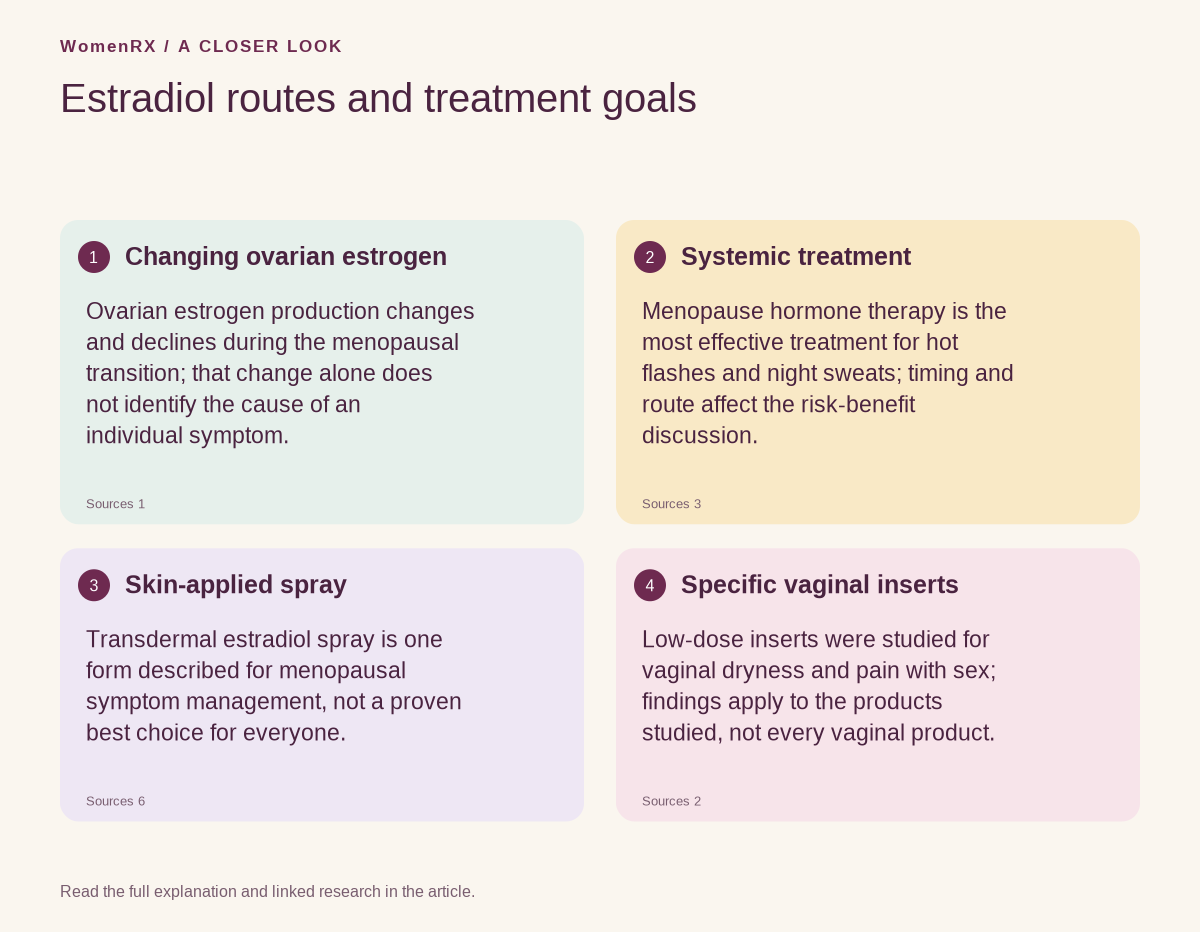
Estradiol routes and treatment goals
Changing ovarian estrogen: Ovarian estrogen production changes and declines during the menopausal transition; that change alone does not identify the cause of an individual symptom.1
Systemic treatment: Menopause hormone therapy is the most effective treatment for hot flashes and night sweats; timing and route affect the risk-benefit discussion.3
Skin-applied spray: Transdermal estradiol spray is one form described for menopausal symptom management, not a proven best choice for everyone.6
Specific vaginal inserts: Low-dose inserts were studied for vaginal dryness and pain with sex; findings apply to the products studied, not every vaginal product.2
Read the figure as text
The intended treatment goal helps distinguish a systemic menopause therapy from specific vaginal products studied for vaginal symptoms.- Changing ovarian estrogen: Ovarian estrogen production changes and declines during the menopausal transition; that change alone does not identify the cause of an individual symptom.1
- Systemic treatment: Menopause hormone therapy is the most effective treatment for hot flashes and night sweats; timing and route affect the risk-benefit discussion.3
- Skin-applied spray: Transdermal estradiol spray is one form described for menopausal symptom management, not a proven best choice for everyone.6
- Specific vaginal inserts: Low-dose inserts were studied for vaginal dryness and pain with sex; findings apply to the products studied, not every vaginal product.2
More questions, answered
Does one menopause symptom mean my estradiol is low?
No. Symptoms such as sleep trouble and mood changes can occur during the menopausal transition, but a symptom alone doesn’t establish an estradiol deficiency or show which treatment would help. 1
Is a vaginal estradiol insert the same as systemic hormone therapy?
No. The low-dose vaginal inserts discussed in research were studied for vaginal dryness and pain with sex, with negligible systemic absorption reported for those specific products. That evidence shouldn’t be generalized to every vaginal product. 2
Sources you can check
- Menopause | Menopause Symptoms | MedlinePlusAccessed 2026-09-25Return to first citation
- Evaluation of endometrial progesterone receptor expression after 12 weeks of exposure to a low-dose vaginal estradiol insert.Mirkin S, Simon JA, Liu JH, Archer DF, Castro PD, Graham S, Bernick B, Komm B. · Menopause (New York, N.Y.) · 2021Return to first citation
- The 2022 hormone therapy position statement of The North American Menopause Society.“The 2022 Hormone Therapy Position Statement of The North American Menopause Society” Advisory Panel. · Menopause (New York, N.Y.) · 2022Return to first citation
- The 2023 nonhormone therapy position statement of The North American Menopause Society.Menopause (New York, N.Y.) · 2023Return to first citation
- Management of menopausal hormone therapy.Switzer J, Vignali L, Vignali J, Jackson R. · Current opinion in obstetrics & gynecology · 2026Return to first citation
- Estradiol transdermal spray for menopausal symptom management: From RCT to real-world evidence.Hirschberg AL, Stute P, Águas F, Fait T, Polo-Kantola P, Amorim FG, Rézette I, Hadji P. · Maturitas · 2026Return to first citation