What Estradiol Is Used For and How It’s Taken
Estradiol can be used for menopause symptoms, vaginal and urinary symptoms, bone health, and some fertility treatments, but the goal determines which form makes sense.
Estradiol is prescribed in different forms for different goals. Systemic forms, such as pills, patches, or gel, are used in menopause care; vaginal forms can treat local symptoms. Estradiol is also used to prepare the uterine lining in some fertility protocols and in gender-affirming care. Menopause hormone therapy can support bone strength, but the right choice depends on the person and treatment goal. 2 4 6
The treatment goal comes first
Estradiol is a form of estrogen, but “estradiol treatment” doesn’t refer to one interchangeable medicine. Pills, patches, gels, and vaginal products differ in where they deliver estrogen and how much reaches the rest of the body. The reason for prescribing it matters just as much as the route. 1 6
For example, someone treating hot flashes may be discussing systemic therapy, while someone treating vaginal dryness may be offered a vaginal product intended to act locally. Estradiol may also be part of a fertility clinic’s plan to prepare the uterine lining before a frozen embryo transfer. Those goals call for different products and clinical decisions.
Estradiol is also used in gender-affirming hormone therapy, so prescribing isn’t limited to women or to menopause and fertility care. The treatment goal and the person’s circumstances still guide which formulation is considered. 6
Menopause symptoms: systemic or local treatment
Systemic estradiol, taken by mouth or absorbed through the skin from a patch or gel, is used in menopause hormone therapy. A clinical review lists oral tablets, transdermal patches and gels, and vaginal products among menopausal hormone therapy options. It notes that a progestogen is included when needed based on whether a person has a uterus. 6
Vaginal estradiol products, including creams, tablets, and rings, are used for vaginal and urinary symptoms linked to estrogen deficiency after menopause. One product-specific example is Estring, a vaginal ring used for postmenopausal urogenital symptoms. Its prescribing information reports that estradiol is released locally, with some entering the bloodstream. That finding applies to Estring, not automatically to every vaginal product. 1 6
This is a useful distinction when comparing options: local vaginal treatment is aimed at symptoms in vaginal and nearby urinary tissues, while systemic treatment reaches beyond that area. A vaginal product should not be assumed to treat symptoms throughout the body, and different vaginal products may not have identical absorption or effects. 1 6
Bone health is a possible part of menopause care
Menopause hormone therapy can help keep bones strong and reduce osteoporosis risk, according to NHS treatment guidance. Bone health may therefore be part of the discussion when systemic hormone therapy is being considered for menopause-related reasons. That does not make every estradiol product a bone treatment, or mean that estradiol is the right choice for everyone seeking to prevent fractures. Osteoporosis care can involve other bone-strengthening medicines, and decisions depend on fracture risk and other factors. 2
Hormone therapy can benefit bone, but a bone-health goal should be considered alongside the treatment’s other effects and alternatives. It shouldn’t be treated as proof that local vaginal estradiol will provide the same bone benefit as systemic therapy. The Estring information describes a vaginal product for urogenital symptoms, not osteoporosis treatment. 1 2
Fertility care: preparing the uterine lining
Estradiol can also be used in fertility care, in a different way from menopause treatment. In hormone-replacement protocols for frozen embryo transfer, estrogen is used to prepare the endometrium, or uterine lining; progesterone is added as part of the protocol. A randomized trial in women with PCOS compared a hormone-replacement approach using oral estradiol followed by injectable progesterone with a mild ovarian stimulation approach. A separate randomized trial in women undergoing frozen embryo transfer compared oral estrogen with transdermal gel for endometrial preparation. 3 5
These studies describe specialist fertility protocols, not a general use of estradiol for infertility or a treatment someone should start on their own. In one trial of 128 women, hormone-replacement and modified natural-cycle approaches had no statistically significant difference in clinical pregnancy rate. That result illustrates that the protocol choice is a fertility-care decision, not a simple matter of choosing an estradiol route. 4
Route changes the comparison, not just convenience
Estradiol products include oral tablets, transdermal patches and gels, and vaginal creams, tablets, and rings. In a small randomized trial of 82 women who completed treatment for frozen embryo transfer, oral estradiol and transdermal gel had similar measured reproductive outcomes, with fewer reported side effects in the gel group. That finding belongs to this specific fertility setting and study; it doesn’t establish that gel is generally safer or better than pills for other uses. 5 6
Risks also can’t be inferred from the word “estradiol” alone. A clinical review says clot risk varies with hormone type and dose, as well as personal factors. Product, route, treatment purpose, and whether a progestogen is also needed all matter. For instance, the Estring label reports some systemic absorption, so “vaginal” does not mean none enters the bloodstream. 1 6
One further distinction: some contraceptive and menstrual treatments contain ethinyl estradiol, which is not the same estrogen as estradiol. Evidence or uses for a combined contraceptive pill shouldn’t be automatically attributed to estradiol alone. 6 7
When comparing prescriptions, it helps to ask what the treatment is intended to address, whether it acts locally or systemically, and what other hormone or medicine may be part of the plan. Those questions make the tradeoffs clearer without assuming that one route is best for every person.
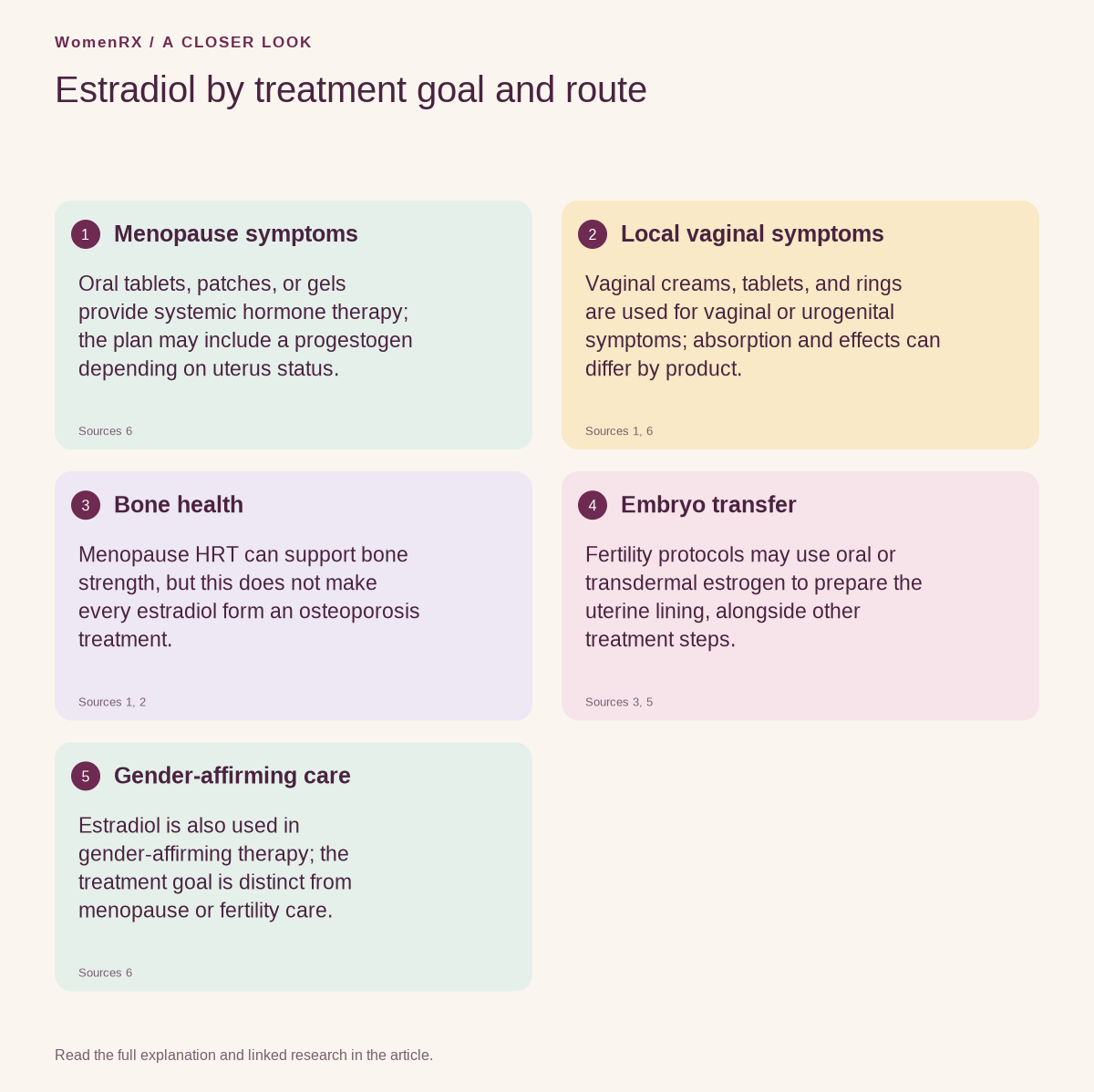
Estradiol by treatment goal and route
Menopause symptoms: Oral tablets, patches, or gels provide systemic hormone therapy; the plan may include a progestogen depending on uterus status.6
Local vaginal symptoms: Vaginal creams, tablets, and rings are used for vaginal or urogenital symptoms; absorption and effects can differ by product.16
Bone health: Menopause HRT can support bone strength, but this does not make every estradiol form an osteoporosis treatment.12
Embryo transfer: Fertility protocols may use oral or transdermal estrogen to prepare the uterine lining, alongside other treatment steps.35
Gender-affirming care: Estradiol is also used in gender-affirming therapy; the treatment goal is distinct from menopause or fertility care.6
Read the figure as text
The intended goal helps explain why systemic and local forms, or treatments used in other care settings, should not be treated as interchangeable.- Menopause symptoms: Oral tablets, patches, or gels provide systemic hormone therapy; the plan may include a progestogen depending on uterus status.6
- Local vaginal symptoms: Vaginal creams, tablets, and rings are used for vaginal or urogenital symptoms; absorption and effects can differ by product.16
- Bone health: Menopause HRT can support bone strength, but this does not make every estradiol form an osteoporosis treatment.12
- Embryo transfer: Fertility protocols may use oral or transdermal estrogen to prepare the uterine lining, alongside other treatment steps.35
- Gender-affirming care: Estradiol is also used in gender-affirming therapy; the treatment goal is distinct from menopause or fertility care.6
More questions, answered
Is estradiol the same as the estrogen in birth control pills?
Not always. Many combined contraceptive pills contain ethinyl estradiol, a different estrogen from estradiol. The uses and evidence for one shouldn’t automatically be applied to the other. 6 7
Does vaginal estradiol treat hot flashes?
Vaginal estradiol products are used for local vaginal and urinary symptoms. They should not be assumed to provide the same whole-body effects as systemic menopause therapy. 1 6
Sources you can check
- ESTRING (ESTRADIOL) SYSTEM [PFIZER LABORATORIES DIV PFIZER INC] | US prescribing information and patient instructionsAccessed 2026-09-25Return to first citation
- Osteoporosis - Treatment - NHSAccessed 2026-09-25Return to first citation
- Comparison of frozen embryo transfer outcomes in hormonal vs. mild stimulation protocols in polycystic ovary syndrome women: A randomized controlled trial.Hamdi K, Khakpour S, Ghasemzadeh Darjani A, Farzadi L, Niknafs B, Navali N, Hakimi P, Anvari Aliabad R, Hajipour H. · International journal of reproductive biomedicine · 2025Return to first citation
- Comparison of clinical pregnancy rates between hormone replacement therapy and modified natural cycle for endometrial preparation in frozen embryo transfer cycles: An RCT.Safarloo F, Zamaniyan M, Nazar E, Gelehkolaee KS, Omid M, Peivandi S. · International journal of reproductive biomedicine · 2025Return to first citation
- A randomized clinical trial of transdermal (gel) versus oral estrogen for endometrial preparation in frozen embryo transfer cycle.Carvalho MOC, Lima SMRR, Glina CG, Tso LO, Romano RS, Glina S, Busso NE, Busso CE. · Revista da Associacao Medica Brasileira (1992) · 2024Return to first citation
- Hormonal therapies in females with blood disorders: thrombophilia, thrombosis, hemoglobinopathies, and anemias.Baldwin MK, Samuelson Bannow B, Rosovsky RP, Sokkary N, Srivaths LV. · Research and practice in thrombosis and haemostasis · 2023Return to first citation
- Consensus Statement on the Use of Oral Contraceptive Pills in Polycystic Ovarian Syndrome Women in India.Shah D, Patil M, National PCOS Working Group. · Journal of human reproductive sciences · 2018Return to first citation