What Metformin Does, and When It’s Used
Metformin is best established for type 2 diabetes; its use for PCOS depends on the treatment goal.
Metformin is an oral medicine most firmly established for managing type 2 diabetes. 1 It lowers blood sugar partly by reducing glucose released by the liver and helping the body respond better to insulin. 2 In PCOS, it may be used for particular metabolic or ovulation-related goals, but it isn’t a one-size-fits-all treatment for PCOS symptoms, and its effects don’t predict an individual response. 2 3
Its clearest role: type 2 diabetes
Metformin is an oral medicine used to help manage type 2 diabetes. In that setting, the goal is better blood-sugar control. 1 It can reduce the glucose the liver puts into the bloodstream and improve how responsive the body’s tissues are to insulin. 2
That’s a useful starting explanation, not a complete map of everything the drug does. Researchers have studied several possible pathways, including AMPK-related and other cellular effects, but the full mechanism is not settled. A simplified explanation can describe why metformin may help with blood sugar; it can’t tell you exactly how much it will help one person or predict every effect. 3
PCOS is a different treatment question
Metformin is also used off-label in some people with polycystic ovary syndrome (PCOS). The relevant question is what the prescriber is trying to address. Research and clinical use have included metabolic concerns related to insulin resistance and ovulation-related goals. Metformin has also been used for acne and excess hair growth, but evidence for those anti-androgen effects is inconsistent. 2
So “metformin for PCOS” doesn’t mean it treats every part of the condition. A plan aimed at metabolic health is not automatically a plan for acne, hair growth, cycle concerns, or fertility. If pregnancy is the goal, that’s a distinct discussion: a review describes metformin use for ovulation in PCOS, while a later review notes that it is not interchangeable with other ovulation-induction medicines. 2 4
This difference between a medicine’s general action and a person’s treatment goal matters. A medicine can affect insulin response without reliably improving every symptom linked with PCOS. Studies of a possible effect also don’t establish that the effect will happen for a particular person. 2 3
Pregnancy calls for its own decision
Taking metformin for PCOS and using medication to manage gestational diabetes are not the same indication. A review of reproductive-health research describes metformin use in gestational diabetes, but that does not settle whether someone should continue, stop, or start it during pregnancy for another reason. That decision depends on the reason it was prescribed and the pregnancy context; it shouldn’t be inferred from the mechanism or from a previous PCOS prescription. 2
What to take into a prescription conversation
It may help to ask: “What specific goal are we using metformin for?” and “How will we know whether it’s helping that goal?” If the reason is PCOS, clarify whether the aim is metabolic, ovulation-related, or something else. If pregnancy is planned or underway, ask about that separately rather than assuming the original plan still applies.
Metformin can cause gastrointestinal symptoms, and kidney function can affect how safely it is used. Those are practical parts of the prescribing discussion, alongside the intended benefit. 1 3
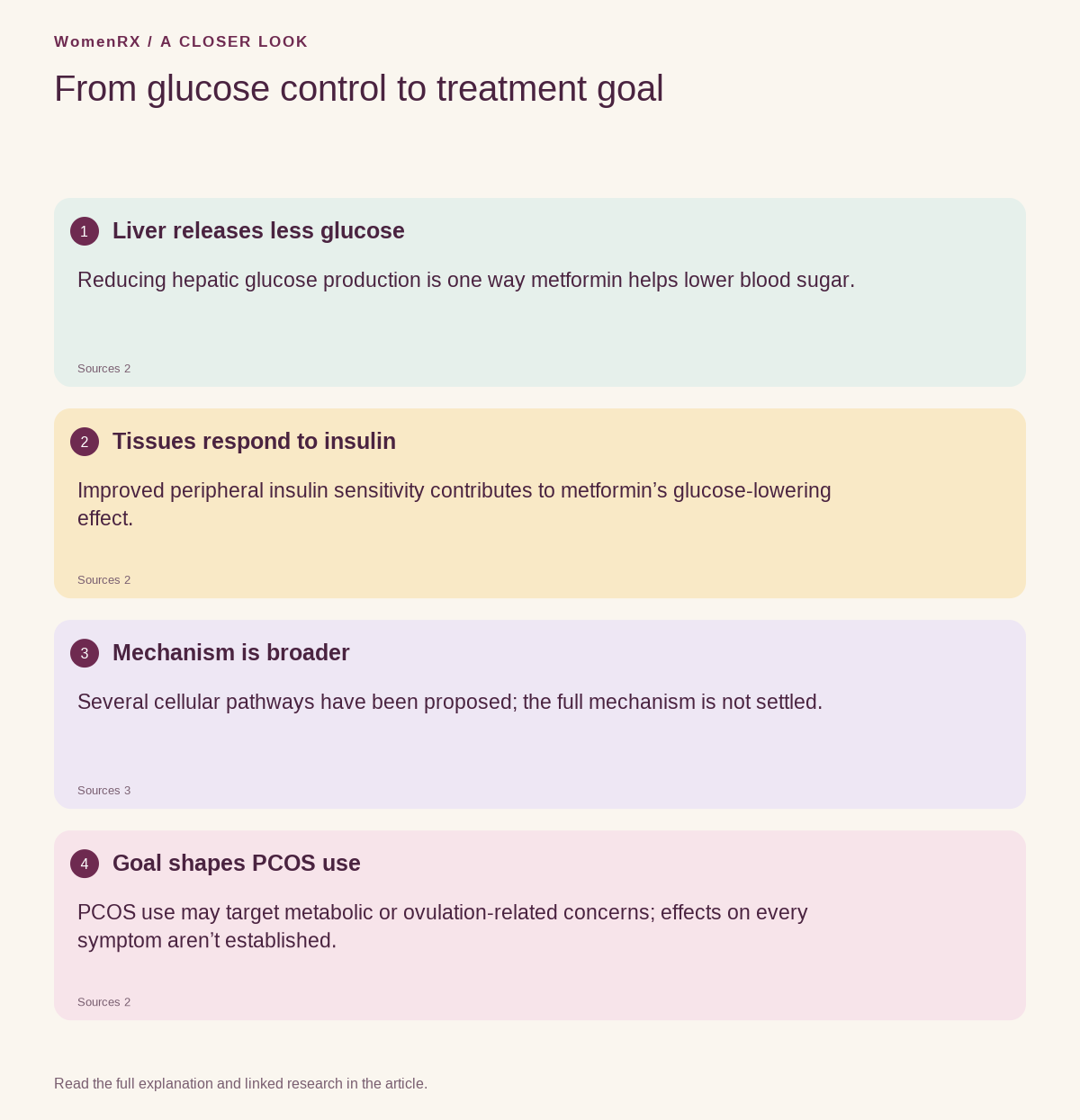
From glucose control to treatment goal
Liver releases less glucose: Reducing hepatic glucose production is one way metformin helps lower blood sugar.2
Tissues respond to insulin: Improved peripheral insulin sensitivity contributes to metformin’s glucose-lowering effect.2
Mechanism is broader: Several cellular pathways have been proposed; the full mechanism is not settled.3
Goal shapes PCOS use: PCOS use may target metabolic or ovulation-related concerns; effects on every symptom aren’t established.2
Read the figure as text
Metformin’s broad metabolic effects help explain its role in diabetes and why a PCOS prescription should be tied to a specific goal.- Liver releases less glucose: Reducing hepatic glucose production is one way metformin helps lower blood sugar.2
- Tissues respond to insulin: Improved peripheral insulin sensitivity contributes to metformin’s glucose-lowering effect.2
- Mechanism is broader: Several cellular pathways have been proposed; the full mechanism is not settled.3
- Goal shapes PCOS use: PCOS use may target metabolic or ovulation-related concerns; effects on every symptom aren’t established.2
More questions, answered
Does metformin treat every PCOS symptom?
No. It may be used for specific metabolic or ovulation-related goals, but evidence for effects on acne and excess hair growth is inconsistent. The treatment goal matters when judging whether it’s a good fit. 2
Does taking metformin for PCOS mean I should take it during pregnancy?
Not by itself. Use for PCOS and use for gestational diabetes are separate clinical questions. Discuss pregnancy plans or a current pregnancy separately with the prescriber rather than assuming the original reason for treatment still applies. 2
Sources you can check
- GLIPIZIDE AND METFORMIN HYDROCHLORIDE TABLET, FILM COATED [REMEDYREPACK INC.] | US prescribing information and patient instructionsAccessed 2026-09-25Return to first citation
- Metformin in reproductive health, pregnancy and gynaecological cancer: established and emerging indications.Sivalingam VN, Myers J, Nicholas S, Balen AH, Crosbie EJ. · Human reproduction update · 2014Return to first citation
- Metformin in therapeutic applications in human diseases: its mechanism of action and clinical study.Du Y, Zhu YJ, Zhou YX, Ding J, Liu JY. · Molecular biomedicine · 2022Return to first citation
- Metformin and Myo-Inositol: A Comparative Analysis.Russo M, Oliva MM, Nordio M, Porcaro G, Unfer V. · Gynecologic and obstetric investigation · 2026Return to first citation