How Is Testosterone Dosed and Used in Women?
There isn’t one standard women’s dose: the product, prescribed amount, and blood-test follow-up all matter.
For women prescribed systemic testosterone for hypoactive sexual desire disorder (HSDD), guidance favors transdermal treatment adjusted to avoid levels above the premenopausal reference range, rather than aiming for a particular lab number. A testosterone test alone can’t diagnose HSDD. The prescriber should specify the product, amount, application instructions, and monitoring plan. Don’t copy a male dose or adjust your own. 1 2
Start with the reason for treatment
The women’s health guideline discusses systemic testosterone for HSDD. It recommends considering the broader picture, including whether other factors such as relationship or mental health concerns may be contributing. A total testosterone test can provide a baseline for monitoring, but it should not be used on its own to diagnose HSDD. 1
The evidence is strongest for postmenopausal women. The guideline describes evidence for women in the later reproductive years as limited, and a 2026 systematic review found fewer trials in premenopausal than postmenopausal women. That review also identified a need for more research on dosing in premenopausal women. 1 3
Why dosing is individualized
Guidance aims to keep testosterone concentrations within the physiologic premenopausal range, using the reference range from the laboratory that runs the test. The goal is to avoid excessive exposure, not to raise a level to a particular number in pursuit of a stronger effect. 2
A male product’s usual dose should not simply be copied for a woman. The guideline describes a cautious clinician-directed starting approach of one-tenth of the recommended male starting dose when a government-approved male transdermal product is used. That is not a dose to calculate or apply on your own: the prescriber needs to account for the specific product and strength and tell you exactly how much to use. 2
The guideline recommends systemic transdermal treatment for appropriate women with HSDD. Formulations aren’t automatically interchangeable: absorption can differ, and the timing of peak blood levels is unknown for many products when used by women. Ask for the product name, strength, exact prescribed amount, and clear directions for measuring and applying it. Confirm any product-specific instructions about what to do after application. 1 2
Testosterone’s approval for women varies by country. The guideline says it is not approved for women by most regulatory agencies and cautions against compounded products because efficacy and safety data are lacking. Ask whether your prescribed product is approved for women where you live or is being used off-label, and why that product was chosen. 1
Blood tests help catch excess, not chase a target
The guideline recommends a total testosterone test before treatment, another about 3-6 weeks after starting, and a repeat within 6 weeks if the dose is increased. Once levels are stable, it recommends monitoring every 4-6 months. Confirm the timing with the prescriber, since products differ and the right timing of a blood draw may depend on the formulation. 2
A result should be interpreted against the laboratory’s reference range for premenopausal women. The guideline’s aim is to prevent excessive dosing, not to treat toward a specific testosterone target. A level that significantly exceeds the upper end of that range can matter even if you feel well. 2
At supraphysiologic levels, testosterone can cause acne, increased facial or body hair, scalp hair loss, or a deeper voice. Tell the prescriber about new or worsening changes. If a test is above the expected range, ask for specific instructions before changing the amount; symptoms or a lab result alone aren’t a reason to adjust your dose yourself. 2
Make the instructions concrete
Before leaving with a prescription, check that you can answer these questions:
- What is the exact product and strength?
- What exact amount should I use, and how do I measure it?
- Where and how should I apply it? Are there product-specific instructions for after application?
- When should I have my first blood test, and when should later tests happen?
- Which changes should I report, and who will guide any dose adjustment?
These details are worth clarifying because products can differ and dosing is intended to be individualized. Shared decision-making should also cover expected benefits and risks, whether use is off-label, and the fact that long-term safety has not been established. 1 2
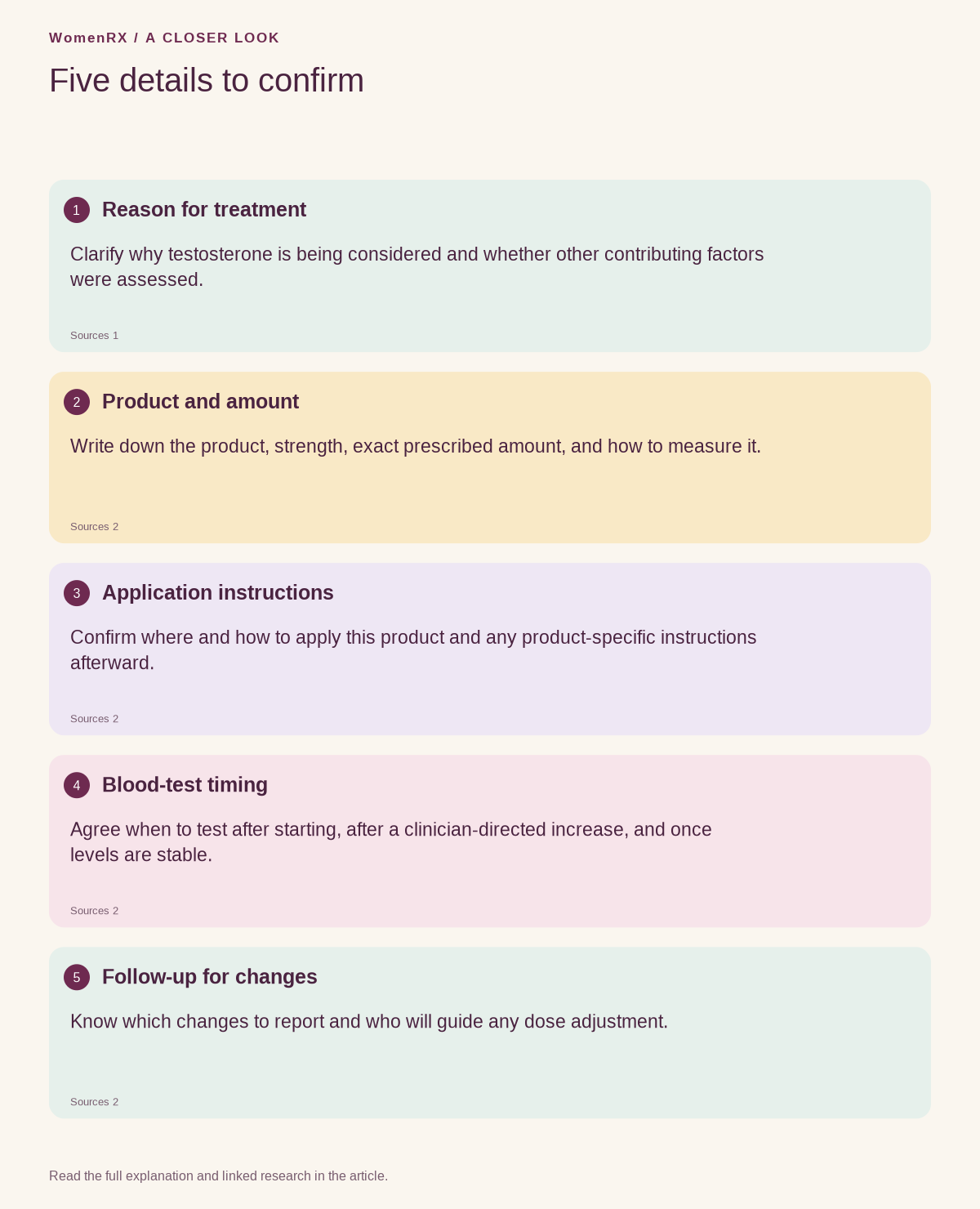
Five details to confirm
Reason for treatment: Clarify why testosterone is being considered and whether other contributing factors were assessed.1
Product and amount: Write down the product, strength, exact prescribed amount, and how to measure it.2
Application instructions: Confirm where and how to apply this product and any product-specific instructions afterward.2
Blood-test timing: Agree when to test after starting, after a clinician-directed increase, and once levels are stable.2
Follow-up for changes: Know which changes to report and who will guide any dose adjustment.2
Read the figure as text
Use this checklist to make the prescription and follow-up plan clear without relying on a one-size-fits-all dose.- Reason for treatment: Clarify why testosterone is being considered and whether other contributing factors were assessed.1
- Product and amount: Write down the product, strength, exact prescribed amount, and how to measure it.2
- Application instructions: Confirm where and how to apply this product and any product-specific instructions afterward.2
- Blood-test timing: Agree when to test after starting, after a clinician-directed increase, and once levels are stable.2
- Follow-up for changes: Know which changes to report and who will guide any dose adjustment.2
More questions, answered
Does a low testosterone result mean I need treatment?
No. The guideline says total testosterone should not be used to diagnose HSDD or decide by itself whether treatment is appropriate. It can serve as a baseline for monitoring when treatment is being considered. 1 2
Should I increase the amount if I don’t notice a change?
Don’t increase it on your own. The guideline describes follow-up using both clinical response and blood levels. Ask the prescriber to review your response and results before any change. 2
Sources you can check
- International Society for the Study of Women's Sexual Health Clinical Practice Guideline for the Use of Systemic Testosterone for Hypoactive Sexual Desire Disorder in Women.Parish SJ, Simon JA, Davis SR, Giraldi A, Goldstein I, Goldstein SW, Kim NN, Kingsberg SA, Morgentaler A, Nappi RE, Park K, Stuenkel CA, Traish AM, Vignozzi L. · The journal of sexual medicine · 2021Return to first citation
- International Society for the Study of Women's Sexual Health Clinical Practice Guideline for the Use of Systemic Testosterone for Hypoactive Sexual Desire Disorder in Women.Parish SJ, Simon JA, Davis SR, Giraldi A, Goldstein I, Goldstein SW, Kim NN, Kingsberg SA, Morgentaler A, Nappi RE, Park K, Stuenkel CA, Traish AM, Vignozzi L. · Journal of women's health (2002) · 2021Return to first citation
- Testosterone therapy for female sexual dysfunction: a systematic review of the literature demonstrating outcomes in premenopausal and postmenopausal women.Furlan VA, Hammad MAM, Quesada S, Nguyen S, Yih J. · The journal of sexual medicine · 2026Return to first citation