What Is Testosterone Therapy for Women Used For, and What Are Its Risks?
For postmenopausal women, testosterone’s evidence-based role is narrow: treating distressing low sexual desire after a thorough assessment, not general menopause symptoms.
Testosterone may be considered for postmenopausal women with hypoactive sexual desire disorder (HSDD), after a formal assessment of possible contributing factors. It can improve sexual desire and related aspects of sexual function in the short term. It isn’t a general treatment for low energy, mood, cognition, aging, or vaginal symptoms, and long-term safety remains uncertain. 4 6
The treatment question is about desire, not a “low testosterone” test
Testosterone therapy has a specific, limited role: it may help postmenopausal women with hypoactive sexual desire disorder (HSDD). Guidance recommends considering it only after a formal biopsychosocial evaluation, which looks beyond a hormone number to the wider context of sexual desire and distress. A blood test by itself doesn’t diagnose HSDD. 4
In studies of postmenopausal women with HSDD, testosterone improved desire and other areas of sexual function, including arousal, orgasm, pleasure, and responsiveness. One review describes a meaningful improvement as about one additional satisfying sexual episode per month. These are short-term findings, not a promise that every woman will notice the same change. 1 6
That distinction matters if the main concern is a different menopause symptom. Testosterone isn’t established as a general treatment for low energy, mood changes, cognitive symptoms, or aging. A retrospective clinic study reported improvements in mood and cognition among women using testosterone, but without a randomized comparison it can’t establish that testosterone caused those changes. 4 5
Vaginal discomfort is a different problem
Low desire can occur alongside vaginal dryness or pain with sex, but testosterone isn’t an established treatment for genitourinary syndrome of menopause (GSM), which includes vulvovaginal and urinary symptoms. A systematic review found that evidence does not demonstrate vaginal testosterone’s effectiveness for GSM symptoms. 2 7
For GSM, other options have more encouraging, though still limited, evidence: vaginal estrogen, vaginal DHEA, oral ospemifene, and vaginal moisturizers may improve some symptoms in the short term. The evidence is low certainty, and long-term comparative safety and effectiveness data are limited. These treatments address GSM symptoms; they aren’t interchangeable with testosterone treatment for HSDD. 2
Formulation and monitoring shape the safety discussion
Guidance favors a transdermal formulation, such as a cream or gel, rather than pellets or injections. The aim is to keep testosterone within the premenopausal physiological range. The position statement recommends checking a baseline level before treatment to rule out an already elevated concentration, then monitoring treatment within three to six weeks. A testosterone result shouldn’t be used on its own to decide whether a woman has HSDD. 4
No testosterone preparation is approved specifically for women, so treatment is off-label. The cited position statement advises against pellets and compounded testosterone. A review of pellet studies describes early above-physiologic hormone peaks and wide variation between individuals; much of the reported benefit and safety information comes from observational research, which can’t establish cause and effect. 3 4 6
The more established short-term side effects are androgenic, especially acne and unwanted hair growth. Longer-term effects on cardiovascular health, cancer, and cognition aren’t well established. Studies have generally been too limited in duration or size to settle those questions, so short-term results shouldn’t be treated as proof of long-term safety. 1 6
A focused discussion can clarify whether it fits
If you’re considering testosterone, useful questions include: Is the concern specifically low desire that causes distress, or is pain or dryness making sex difficult? What did the assessment consider besides hormone levels? What formulation is being proposed, and how will levels and side effects be monitored? What improvement would count as worthwhile, and what is known about safety over the longer term?
The key tradeoff is a possible short-term improvement in sexual desire for some postmenopausal women with HSDD, weighed against off-label use, potential androgenic effects, and unresolved long-term safety. For symptoms centered on vaginal dryness or pain, ask about treatments studied for GSM rather than assuming testosterone addresses both problems.
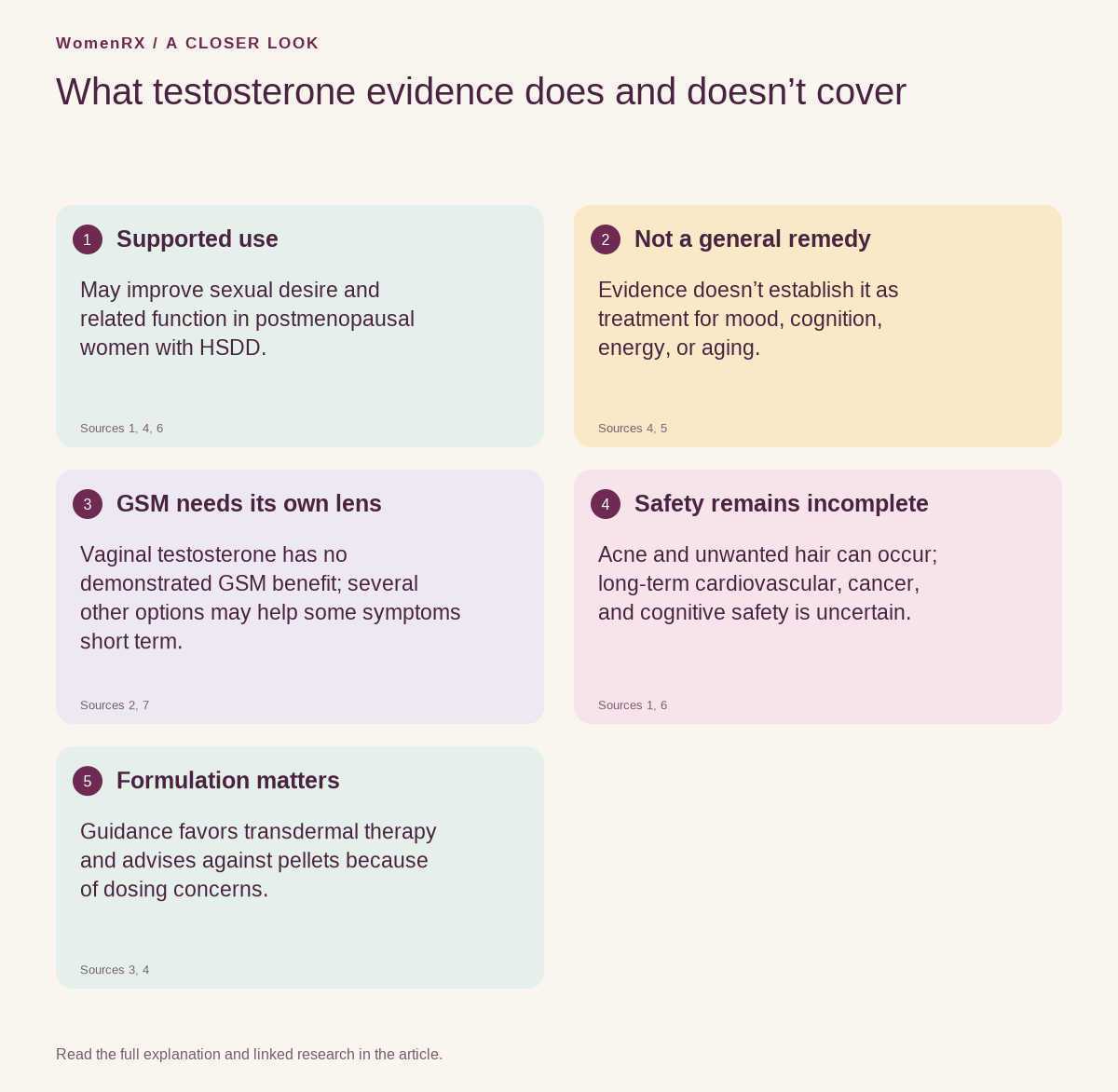
What testosterone evidence does and doesn’t cover
Supported use: May improve sexual desire and related function in postmenopausal women with HSDD.146
Not a general remedy: Evidence doesn’t establish it as treatment for mood, cognition, energy, or aging.45
GSM needs its own lens: Vaginal testosterone has no demonstrated GSM benefit; several other options may help some symptoms short term.27
Safety remains incomplete: Acne and unwanted hair can occur; long-term cardiovascular, cancer, and cognitive safety is uncertain.16
Formulation matters: Guidance favors transdermal therapy and advises against pellets because of dosing concerns.34
Read the figure as text
Compare the supported use with symptoms and formulations where evidence is limited or safety questions remain.- Supported use: May improve sexual desire and related function in postmenopausal women with HSDD.146
- Not a general remedy: Evidence doesn’t establish it as treatment for mood, cognition, energy, or aging.45
- GSM needs its own lens: Vaginal testosterone has no demonstrated GSM benefit; several other options may help some symptoms short term.27
- Safety remains incomplete: Acne and unwanted hair can occur; long-term cardiovascular, cancer, and cognitive safety is uncertain.16
- Formulation matters: Guidance favors transdermal therapy and advises against pellets because of dosing concerns.34
More questions, answered
Does a low testosterone blood result mean I need treatment?
No. A hormone level alone doesn’t diagnose HSDD. Guidance describes a formal assessment as the basis for identifying the condition; a baseline level may be checked before treatment for a different purpose, including ruling out an elevated level. 4
Is vaginal testosterone a treatment for menopause-related dryness?
Current evidence doesn’t demonstrate that vaginal testosterone improves GSM symptoms. Vaginal estrogen, vaginal DHEA, oral ospemifene, and vaginal moisturizers may improve some symptoms in the short term, although certainty and long-term data are limited. 2 7
Sources you can check
- [Efficacy and safety of testosterone in the treatment of hypoactive sexual desire in women: what does the evidence say?]Espitia De La Hoz FJ. · Revista internacional de andrologia · 2023Return to first citation
- Hormonal Treatments and Vaginal Moisturizers for Genitourinary Syndrome of Menopause : A Systematic Review.Danan ER, Sowerby C, Ullman KE, Ensrud K, Forte ML, Zerzan N, Anthony M, Kalinowski C, Abdi HI, Friedman JK, Landsteiner A, Greer N, Nardos R, Fok C, Dahm P, Butler M, Wilt TJ, Die... · Annals of internal medicine · 2024Return to first citation
- Testosterone Pellets in Women: Revisiting Safety and Clinical Outcomes.Pinto da Costa Viana D, Jacobsen L, Gabriel LH, Lobo de Souza Correia E, da Maia Fernandes D, Nagel ML, Comin A. · Cureus · 2025Return to first citation
- Androgen therapy in midlife and older women: a position statement of the Latin American Association of Gynecological Endocrinology (ALEG).Pilnik S, Belardo A, Marchesan LB, Camero-Lascano A, Acuña-San Martín M, Elizalde-Cremonte A, Ojeda E, Manzur A, Chedraui P. · Climacteric : the journal of the International Menopause Society · 2025Return to first citation
- Effect of transdermal testosterone therapy on mood and cognitive symptoms in peri- and postmenopausal women: a pilot study.Glynne S, Kamal A, Kamel AM, Reisel D, Newson L. · Archives of women's mental health · 2025Return to first citation
- Risks of Testosterone for Postmenopausal Women.Pinkerton JV, Blackman I, Conner EA, Kaunitz AM. · Endocrinology and metabolism clinics of North America · 2021Return to first citation
- Genitourinary Syndrome of Menopause: A Systematic ReviewDanan ER, Diem S, Sowerby C, Ullman K, Ensrud K, Landsteiner A, Greer N, Zerzan N, Anthony M, Kalinowski C, Forte M, Abdi HI, Friedman JK, Nardos R, Fok C, Dahm P, Butler M, Wilt T... · 2024Return to first citation