Testosterone Therapy for Women: Evidence, Risks, and Limits
The clearest guideline-supported use is for postmenopausal women with distressing low sexual desire, not a general boost in energy or wellbeing.
Testosterone isn’t a routine treatment for menopause, low energy, or mood. A 2025 position statement supports considering it for postmenopausal women with hypoactive sexual desire disorder (HSDD) after a formal assessment of physical, emotional, and relationship factors. It favors transdermal treatment and monitoring. Evidence for mood, cognition, and long-term safety is less settled. 12
Match the treatment to a specific concern
Before weighing testosterone’s risks, clarify what symptom it’s meant to address. A 2025 position statement from the Latin American Association of Gynecological Endocrinology identifies postmenopausal HSDD, after a formal biopsychosocial evaluation, as the specific use to consider. That means the assessment looks beyond hormone levels to physical health, emotional wellbeing, and relationship circumstances. The statement does not recommend diagnosing HSDD with a testosterone blood test. 1
This is not a recommendation to use testosterone routinely for menopause, or as a general treatment for fatigue, mood, brain fog, or wellbeing. The guidance identifies postmenopausal HSDD as the use it supports; it does not establish those broader benefits. 1
Menopause stage matters. The guidance’s specific recommendation is for postmenopausal women. A study of women in both perimenopause and postmenopause can’t, by itself, show that treatment works equally well for each group, or establish a benefit for women who are still cycling. 12
Mood and cognition: promising observations, not proof
It can be confusing to hear different accounts of testosterone and mood. In a UK specialist menopause clinic, a retrospective study followed 510 peri- and postmenopausal women who were using hormone therapy and had persistent low libido along with mood or cognitive symptoms. After four months using testosterone cream or gel, participants reported improvements in mood, cognition, and libido. 2
But the study had no comparison group, and the changes were self-reported. Symptoms improving during treatment doesn’t establish that testosterone caused the improvement. The study also doesn’t show that testosterone treats low energy or general wellbeing. Its authors called for randomized trials to establish efficacy and long-term safety for mood and cognitive symptoms. 2
So if the main promise is more energy, a brighter mood, or clearer thinking, ask how strong the evidence is for that particular goal. The clinic findings may be a reason to study these symptoms further, but they don’t make testosterone an established treatment for them. 12
Formulation and monitoring are part of the safety question
The position statement prefers transdermal testosterone, such as a cream or gel, and advises against subcutaneous pellets and compounded “bioidentical” testosterone. It cites concerns about doses becoming higher than the normal physiological range and insufficient evidence for those products. 1
There is a retrospective chart review of pellet use in women with low libido, but it doesn’t establish that pellets are safer or more effective than transdermal treatment. A small number of clinical findings from one practice can’t settle that comparison or replace the position statement’s formulation advice. 13
The position statement recommends checking a baseline testosterone level before treatment to rule out an already elevated level. It does not recommend routine testosterone testing to diagnose HSDD. If treatment is started, it recommends follow-up within 3-6 weeks and monitoring to keep testosterone within the premenopausal physiological range. 1
Ask what symptoms and test results will be reviewed, and what would prompt a change in the plan. In the menopause-clinic study, acne and localized hair growth at the application site are described as possible effects of transdermal use; the passage characterizes them as usually mild and reversible when levels are physiological. That doesn’t guarantee the same experience for every woman, and it doesn’t answer longer-term safety questions. 2
Questions to bring to the conversation
- What specific symptom are we treating, and how will we judge whether it improves?
- Has low desire been assessed in the context of my health, emotional wellbeing, and relationship circumstances?
- Does the recommendation apply to my menopause stage and treatment goal?
- Which formulation is being proposed, and why?
- What baseline test and follow-up will be used to check that levels stay in the intended range?
- What effects should I watch for, and when will we revisit whether the benefits are worth continuing?
The useful distinction is between a defined postmenopausal HSDD indication and broader promises about feeling more energetic or well. A clear plan should explain which goal is being addressed, why the proposed formulation fits, and how both benefits and unwanted effects will be reviewed. 12
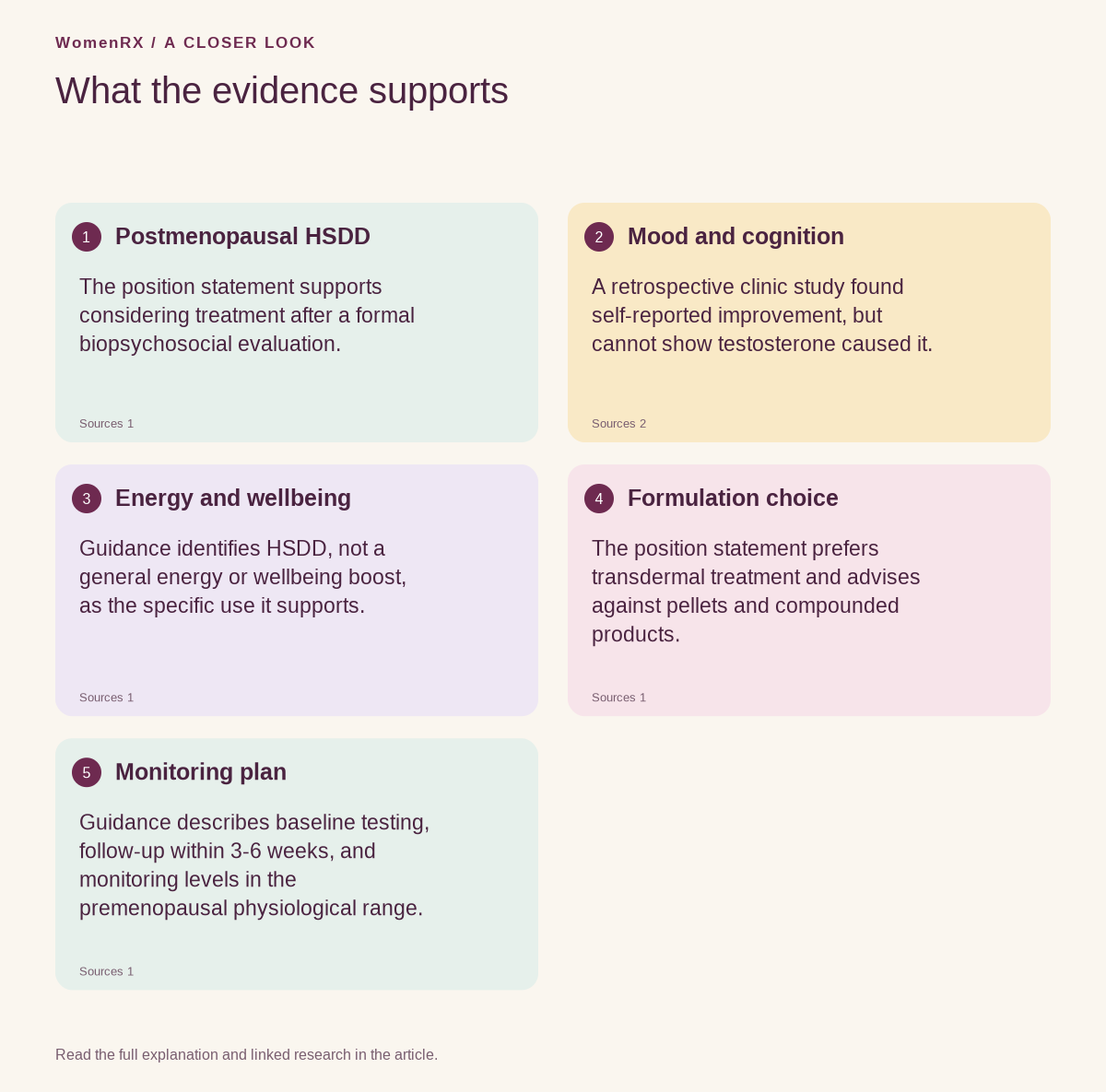
What the evidence supports
Postmenopausal HSDD: The position statement supports considering treatment after a formal biopsychosocial evaluation.1
Mood and cognition: A retrospective clinic study found self-reported improvement, but cannot show testosterone caused it.2
Energy and wellbeing: Guidance identifies HSDD, not a general energy or wellbeing boost, as the specific use it supports.1
Formulation choice: The position statement prefers transdermal treatment and advises against pellets and compounded products.1
Monitoring plan: Guidance describes baseline testing, follow-up within 3-6 weeks, and monitoring levels in the premenopausal physiological range.1
Read the figure as text
Compare the specific postmenopausal use identified by guidance with less-established symptom claims and the practical questions about treatment.- Postmenopausal HSDD: The position statement supports considering treatment after a formal biopsychosocial evaluation.1
- Mood and cognition: A retrospective clinic study found self-reported improvement, but cannot show testosterone caused it.2
- Energy and wellbeing: Guidance identifies HSDD, not a general energy or wellbeing boost, as the specific use it supports.1
- Formulation choice: The position statement prefers transdermal treatment and advises against pellets and compounded products.1
- Monitoring plan: Guidance describes baseline testing, follow-up within 3-6 weeks, and monitoring levels in the premenopausal physiological range.1
More questions, answered
Can a testosterone blood test show whether I have HSDD?
No. The position statement advises against routine testosterone or other androgen measurements to diagnose HSDD. It recommends a baseline measurement before treatment for a different reason: to rule out an already elevated level. 1
Is testosterone approved for low sexual desire after menopause?
Approval rules depend on where you live. The Latin American position statement advises telling women that testosterone use for this purpose is off-label; that statement doesn’t establish approval status in every jurisdiction. 1
Sources you can check
- Androgen therapy in midlife and older women: a position statement of the Latin American Association of Gynecological Endocrinology (ALEG).Pilnik S, Belardo A, Marchesan LB, Camero-Lascano A, Acuña-San Martín M, Elizalde-Cremonte A, Ojeda E, Manzur A, Chedraui P. · Climacteric : the journal of the International Menopause Society · 2025Return to first citation
- Effect of transdermal testosterone therapy on mood and cognitive symptoms in peri- and postmenopausal women: a pilot study.Glynne S, Kamal A, Kamel AM, Reisel D, Newson L. · Archives of women's mental health · 2025Return to first citation
- Long-term testosterone pellet insertion in women with low libido shows no evidence of erythrocytosis and a minimal side effect profile.Hernandez BS, Saffati G, Lowrey KA, Reddy A, Park BS, Song JJ, Lyon G, Khera M. · Translational andrology and urology · 2025Return to first citation