How Is Response to Testosterone Therapy Assessed?
For women using testosterone for low sexual desire, progress is judged by the change in the concern being treated, not by a hormone number alone.
For women prescribed testosterone for hypoactive sexual desire disorder (HSDD), response is assessed by whether desire and related distress improve in a way that matters to you. A blood test can help monitor testosterone exposure and avoid levels above the usual premenopausal range, but a serum level does not predict whether treatment is working. Review symptoms and possible androgen-related side effects with your prescriber. 3 4

Start with the reason it was prescribed
The evidence-based framework for testosterone therapy in women is focused on HSDD: persistently low sexual desire that causes distress. Guidance supports systemic testosterone mainly for postmenopausal women whose HSDD isn’t primarily explained by factors such as relationship concerns, mental health issues, or other modifiable conditions. Evidence for women in the later reproductive years is more limited. This isn’t a general treatment framework for menopause symptoms such as low energy, mood changes, or hot flashes. 2 5
Before treatment, make the goal specific. For example, you might want to feel more interested in sex, have less distress about a change in desire, or find sexual activity more satisfying. These are examples of outcomes to discuss, not a required scorecard. Desire, satisfying sexual activity, sexual function, and distress are among the outcomes studied in women with HSDD. 1 2
Keep the symptom review separate from the blood test
At follow-up, the central question is whether the original concern has changed. Has desire shifted? Is the change meaningful to you? Has distress eased, stayed the same, or worsened? If the goal was different, such as improving satisfaction, include that in the conversation too.
A total testosterone test answers a different question. It can provide a baseline and help monitor levels during treatment, including checking that they don’t rise above the usual premenopausal range. A testosterone level shouldn’t be used to diagnose HSDD, and serum concentrations don’t predict treatment efficacy. So a result within a target range doesn’t prove that you’re benefiting, and a symptom change shouldn’t be judged by the lab result alone. 2 4
Review benefit, side effects, and the treatment context
Testosterone can have a moderate benefit for sexual desire in appropriately selected women, but not everyone will experience a noticeable change. The review should include both benefit and tolerability. Acne and increased facial or body hair are reported androgen-related effects; guidance also recommends monitoring for signs of androgen excess. Tell your prescriber about new or bothersome changes rather than trying to interpret a lab result on its own. 1 2
If the benefit is unclear, revisit the original goal and whether other factors affecting desire have changed. HSDD guidance uses a broader assessment that can include mental health, relationship context, medical conditions, and other potentially modifiable factors. The useful next step is a treatment review with your prescriber, not increasing the dose on your own. 2 5
If there’s little or no meaningful improvement, or side effects are getting in the way, ask your prescriber to reassess whether the treatment still fits your situation and what alternatives or other contributing factors deserve attention. Long-term safety data for physiologic testosterone use in women remain limited, so ongoing benefit and tolerability matter, not just the initial decision to start. 2
Agree on when to check in
Set a follow-up point with the clinician who prescribed treatment, and make sure that visit includes both a symptom review and any planned safety monitoring. The guidance supports post-treatment monitoring and follow-up, but a single response deadline shouldn’t be assumed from a hormone test. If you’re unsure what change to look for, write down the treatment goal in plain language before the review so you and your prescriber can assess the same thing.
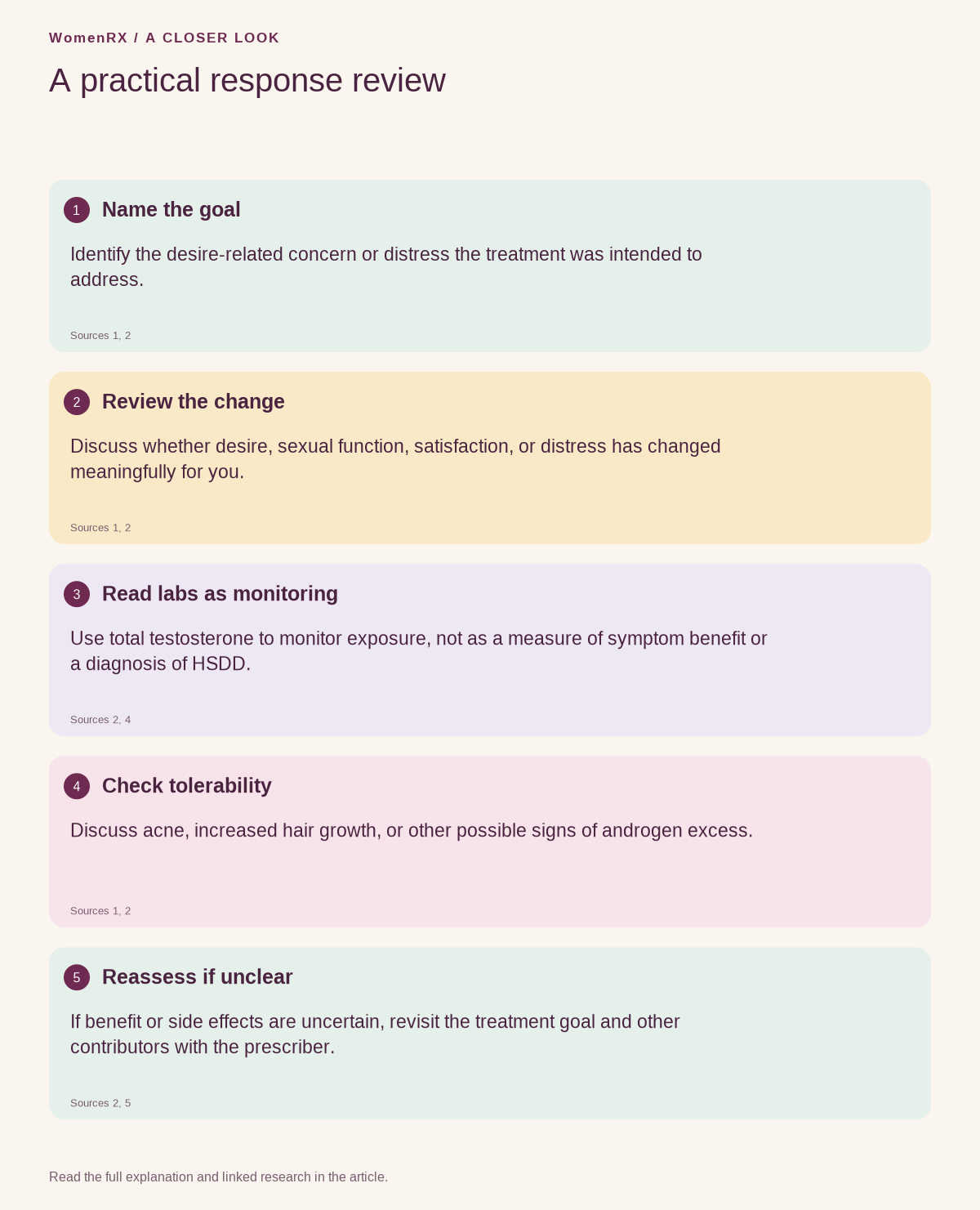
A practical response review
Name the goal: Identify the desire-related concern or distress the treatment was intended to address.12
Review the change: Discuss whether desire, sexual function, satisfaction, or distress has changed meaningfully for you.12
Read labs as monitoring: Use total testosterone to monitor exposure, not as a measure of symptom benefit or a diagnosis of HSDD.24
Check tolerability: Discuss acne, increased hair growth, or other possible signs of androgen excess.12
Reassess if unclear: If benefit or side effects are uncertain, revisit the treatment goal and other contributors with the prescriber.25
Read the figure as text
Keep the treatment goal, symptom response, lab monitoring, and safety review distinct when discussing progress with your prescriber.- Name the goal: Identify the desire-related concern or distress the treatment was intended to address.12
- Review the change: Discuss whether desire, sexual function, satisfaction, or distress has changed meaningfully for you.12
- Read labs as monitoring: Use total testosterone to monitor exposure, not as a measure of symptom benefit or a diagnosis of HSDD.24
- Check tolerability: Discuss acne, increased hair growth, or other possible signs of androgen excess.12
- Reassess if unclear: If benefit or side effects are uncertain, revisit the treatment goal and other contributors with the prescriber.25
More questions, answered
Does a higher testosterone level mean the treatment is working?
No. Blood testing helps monitor testosterone exposure and avoid levels above the usual premenopausal range, but serum concentrations don’t predict treatment efficacy. Assess benefit through the symptoms and distress the treatment was intended to address. 4
What if I don’t notice a meaningful change?
Bring that back to the prescribing clinician. Revisit the original treatment goal, possible contributors to low desire, side effects, and whether the approach still makes sense for you. Don’t raise the dose on your own. 2 5
Sources you can check
- [Efficacy and safety of testosterone in the treatment of hypoactive sexual desire in women: what does the evidence say?]Espitia De La Hoz FJ. · Revista internacional de andrologia · 2023Return to first citation
- International Society for the Study of Women's Sexual Health Clinical Practice Guideline for the Use of Systemic Testosterone for Hypoactive Sexual Desire Disorder in Women.Parish SJ, Simon JA, Davis SR, Giraldi A, Goldstein I, Goldstein SW, Kim NN, Kingsberg SA, Morgentaler A, Nappi RE, Park K, Stuenkel CA, Traish AM, Vignozzi L. · The journal of sexual medicine · 2021Return to first citation
- International Society for the Study of Women's Sexual Health Clinical Practice Guideline for the Use of Systemic Testosterone for Hypoactive Sexual Desire Disorder in Women.Parish SJ, Simon JA, Davis SR, Giraldi A, Goldstein I, Goldstein SW, Kim NN, Kingsberg SA, Morgentaler A, Nappi RE, Park K, Stuenkel CA, Traish AM, Vignozzi L. · Climacteric : the journal of the International Menopause Society · 2021Return to first citation
- International Society for the Study of Women's Sexual Health Clinical Practice Guideline for the Use of Systemic Testosterone for Hypoactive Sexual Desire Disorder in Women.Parish SJ, Simon JA, Davis SR, Giraldi A, Goldstein I, Goldstein SW, Kim NN, Kingsberg SA, Morgentaler A, Nappi RE, Park K, Stuenkel CA, Traish AM, Vignozzi L. · Journal of women's health (2002) · 2021Return to first citation
- The International Society for the Study of Women's Sexual Health Process of Care for Management of Hypoactive Sexual Desire Disorder in Women.Clayton AH, Goldstein I, Kim NN, Althof SE, Faubion SS, Faught BM, Parish SJ, Simon JA, Vignozzi L, Christiansen K, Davis SR, Freedman MA, Kingsberg SA, Kirana PS, Larkin L, McCabe... · Mayo Clinic proceedings · 2018Return to first citation