Does Testosterone Therapy Change Weight in Women?
Trials in women recorded an overall increase in weight with testosterone, but they don’t establish whether that change was fat, muscle, or something else.
Testosterone isn’t an established weight-loss treatment for women. A review of randomized trials recorded an overall increase in weight with treatment, while finding no reported effect on body composition. Relatively few women contributed to the body-composition results, so the research doesn’t explain the weight finding or predict what will happen on your scale. 3
Weight and body composition answer different questions
In a systematic review and meta-analysis of 36 randomized trials involving 8,480 participants, researchers recorded an overall increase in weight with testosterone treatment. They reported no effect on body composition, but relatively few women contributed data for that outcome. The finding is a reason not to expect weight loss from testosterone. It isn’t evidence that every woman will gain weight. 3
A scale measures the combined weight of muscle, bone, fat, and water. Body-composition measurements ask a different question: whether components such as fat and lean mass changed. So an increase on the scale doesn’t, by itself, tell you that you gained fat or built muscle. The limited body-composition findings in these trials don’t settle which component, if any, explains the overall weight result. 1 3
That distinction matters if you’re considering testosterone partly because you hope it will change your shape or make weight management easier. The randomized-trial evidence supports a benefit for some postmenopausal women with low sexual desire that causes distress; it doesn’t establish testosterone as a treatment for weight or body composition. 3
Menopause may be part of the picture, but it’s not a diagnosis
Fat distribution can change around and after menopause. A review describes a tendency toward more abdominal fat in postmenopausal women. That’s different from saying menopause necessarily caused a particular change on your scale, or that testosterone did. A change in where you carry fat and a change in total body weight aren’t the same observation. 2 1
You may also see claims that testosterone increases lean mass and decreases fat mass. Those findings often come from studies of transgender men receiving gender-affirming testosterone. They’re worth identifying correctly, but the population and treatment context differ from those of a woman considering testosterone for menopause-related sexual concerns. They aren’t a reliable forecast for her weight or body composition. 4
If your weight changes while you’re taking it
Think of the timing as a clue, not proof of cause. For example, a weight change that begins after treatment starts is worth mentioning when you review how treatment is going, but the scale alone can’t identify what changed or why. Other health and everyday factors can affect weight too. 1
If you gain or lose weight suddenly without trying, don’t write it off as testosterone or menopause. An unexpected change can sometimes signal a medical problem, so bring it up with a healthcare professional. 1
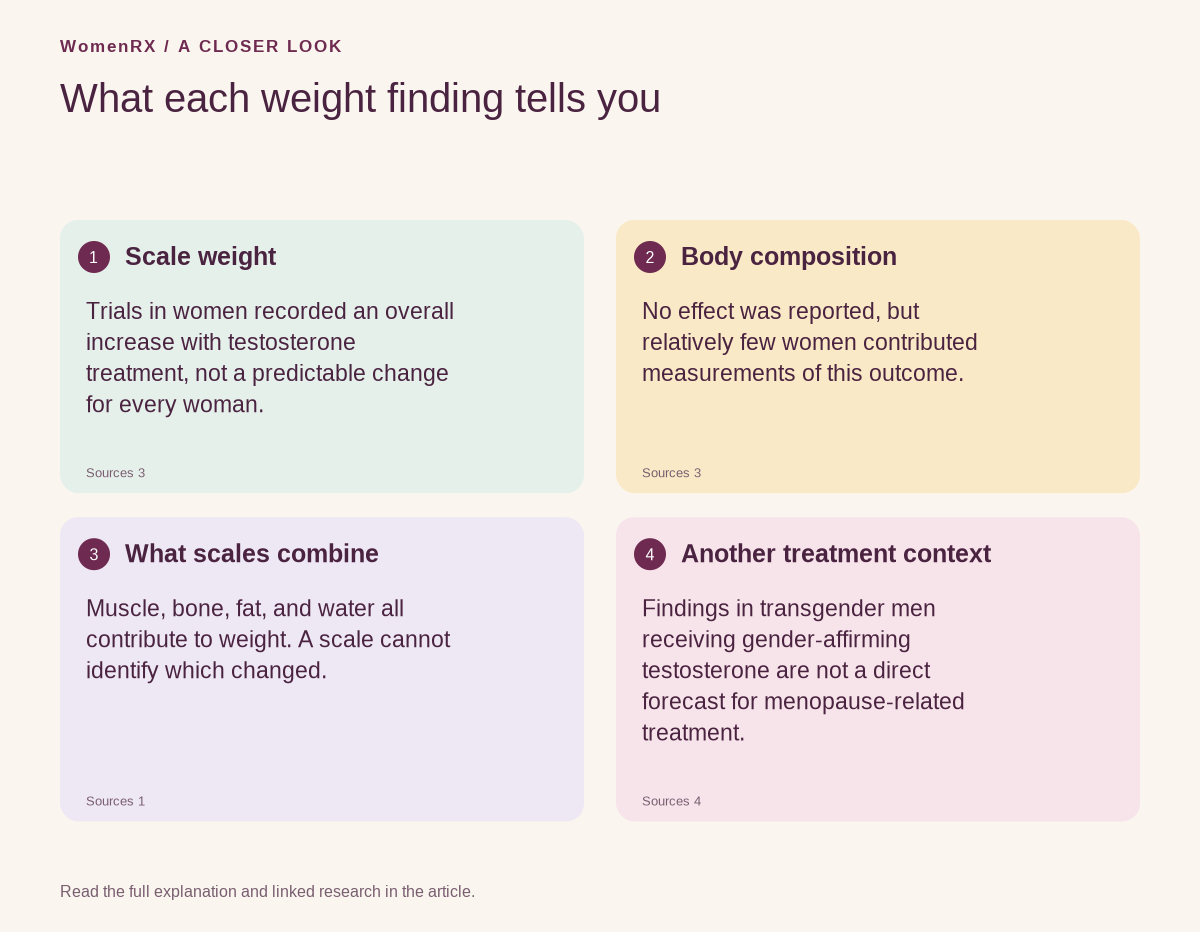
What each weight finding tells you
Scale weight: Trials in women recorded an overall increase with testosterone treatment, not a predictable change for every woman.3
Body composition: No effect was reported, but relatively few women contributed measurements of this outcome.3
What scales combine: Muscle, bone, fat, and water all contribute to weight. A scale cannot identify which changed.1
Another treatment context: Findings in transgender men receiving gender-affirming testosterone are not a direct forecast for menopause-related treatment.4
Read the figure as text
These findings measure different things and cannot be used interchangeably to predict your response.- Scale weight: Trials in women recorded an overall increase with testosterone treatment, not a predictable change for every woman.3
- Body composition: No effect was reported, but relatively few women contributed measurements of this outcome.3
- What scales combine: Muscle, bone, fat, and water all contribute to weight. A scale cannot identify which changed.1
- Another treatment context: Findings in transgender men receiving gender-affirming testosterone are not a direct forecast for menopause-related treatment.4
Sources you can check
- Body Weight: MedlinePlusAccessed 2026-09-25Return to first citation
- Endocrine Changes in Postmenopausal Women: A Comprehensive View.Motlani V, Motlani G, Pamnani S, Sahu A, Acharya N. · Cureus · 2023Return to first citation
- Safety and efficacy of testosterone for women: a systematic review and meta-analysis of randomised controlled trial data.Islam RM, Bell RJ, Green S, Page MJ, Davis SR. · The lancet. Diabetes & endocrinology · 2019Return to first citation
- Effects of gender-affirming hormone therapy on insulin resistance and body composition in transgender individuals: A systematic review.Spanos C, Bretherton I, Zajac JD, Cheung AS. · World journal of diabetes · 2020Return to first citation