Testosterone Therapy and Weight Loss: What Women Should Know
Testosterone isn’t an established weight-loss treatment for women, and body-composition findings don’t prove it will lower the number on the scale.
Testosterone therapy isn’t an established weight-loss treatment for women. The guideline-supported use described in a recent clinical review is for low sexual desire, not weight management. Some research in postmenopausal women has explored body composition, but it doesn’t establish that testosterone reliably reduces body weight. If weight is your main concern, ask what outcome the treatment is intended to improve and how it would be assessed. 3
If weight has changed during midlife, it makes sense to ask whether a hormone treatment could help. The available guidance points to a different purpose for testosterone: a recent clinical review identifies improved sexual desire as its only guideline-supported use in women. That is not the same as recommending it for weight loss. 3
A change in body composition isn’t necessarily weight loss
Body weight combines fat, muscle, bone, and water, so a change in one part of the body doesn’t automatically mean the scale will move down. 1 A scoping review of testosterone and cardiovascular risk in postmenopausal women described possible effects on body composition, but it included only seven studies in its final synthesis. The review notes that research often involved testosterone alongside estrogen and that substantial questions remain. Those findings don’t establish testosterone as a treatment that reduces body weight. 2
A separate randomized trial helps show why population and outcome matter. It studied 90 women aged 18 to 45 with anorexia nervosa, not women considering testosterone for menopause-related weight concerns. After 24 weeks, average BMI was unchanged in the testosterone group and increased in the placebo group. The result was less weight gain relative to placebo, not weight loss, and it shouldn’t be generalized to midlife women. 5
So if someone mentions “body composition,” ask what was measured: body weight, fat, muscle, or another outcome? A result about one measure, in a particular group of women, isn’t proof of a different benefit in another group.
Menopause stage and reason for treatment matter
The postmenopausal research is not automatically evidence for women in perimenopause. And women with premature ovarian insufficiency (POI), which involves loss of ovarian activity before age 40, are a distinct group. In its POI guidance, a clinical guideline says testosterone may be considered for hypoactive sexual desire disorder and sexual function, but it says testosterone should not be offered for muscle health because its effects there are uncertain. Neither recommendation supports using testosterone for weight loss. 4
For women at the usual age of menopause, the recent clinical review describes low sexual desire as the only guideline-supported indication. That distinction can help keep a conversation clear: testosterone might be discussed for a specific sexual-health concern, but it shouldn’t be presented as an established treatment for weight management. 3
Questions to clarify the tradeoff
If testosterone comes up in a visit about weight, you could ask:
- “What specific symptom or condition would testosterone be intended to treat for me?”
- “Is the expected outcome about sexual desire, body composition, or body weight?”
- “What evidence supports that outcome for women at my menopause stage?”
- “What side effects and uncertainties should I weigh, and what would monitoring involve?”
- “If weight loss is my main goal, what options are actually intended to address that?”
These questions don’t assume that testosterone is right or wrong for you. They separate the reason for treatment from a hoped-for side effect, and make it easier to judge whether the proposed benefit matches your goal.
Long-term safety data for testosterone therapy in women remain limited, according to the recent clinical review. The review says serious adverse events appear uncommon when testosterone levels are maintained within normal female ranges, but it does not provide a detailed monitoring protocol. Ask what monitoring would involve in your circumstances rather than assuming that a potential body-composition effect also means weight loss or long-term benefit. 3
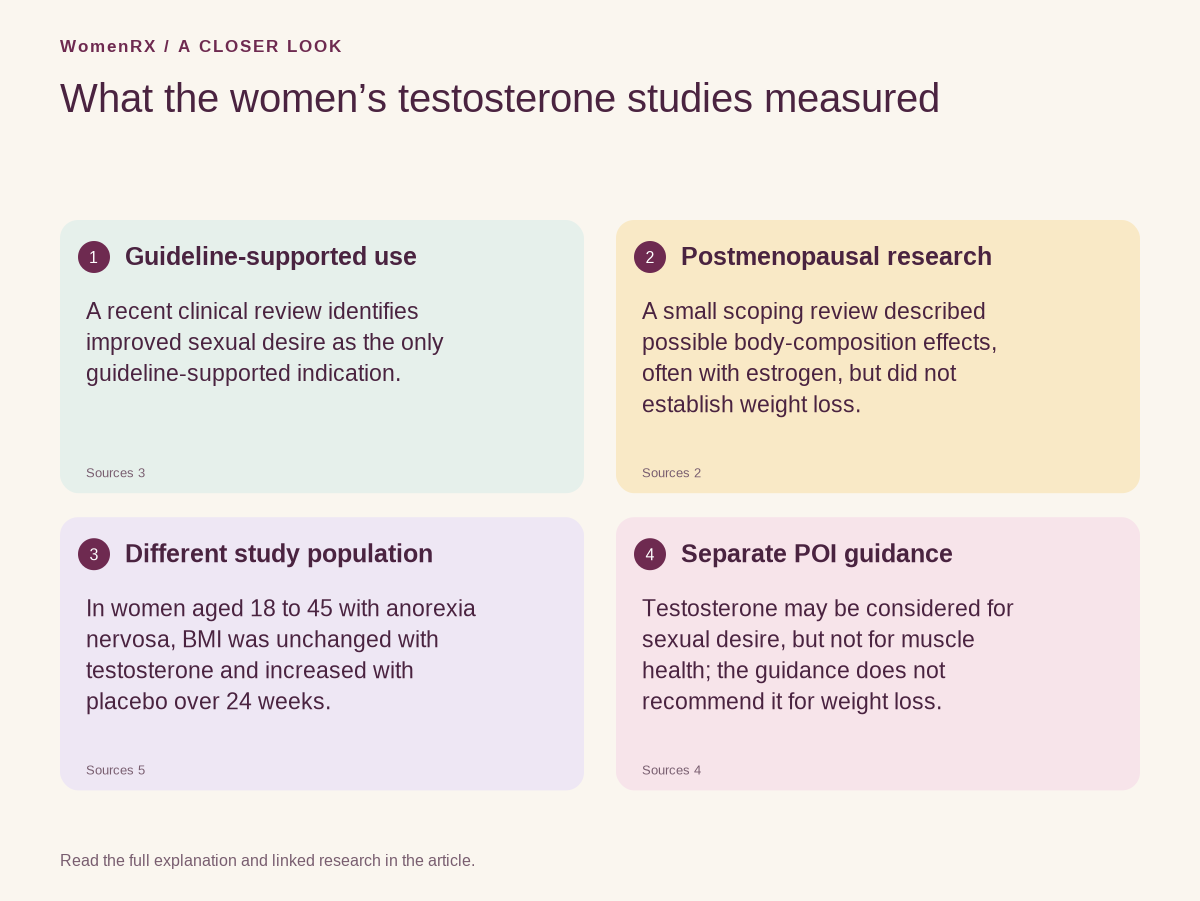
What the women’s testosterone studies measured
Guideline-supported use: A recent clinical review identifies improved sexual desire as the only guideline-supported indication.3
Postmenopausal research: A small scoping review described possible body-composition effects, often with estrogen, but did not establish weight loss.2
Different study population: In women aged 18 to 45 with anorexia nervosa, BMI was unchanged with testosterone and increased with placebo over 24 weeks.5
Separate POI guidance: Testosterone may be considered for sexual desire, but not for muscle health; the guidance does not recommend it for weight loss.4
Read the figure as text
These findings concern different populations and outcomes. They don’t add up to proof that testosterone causes weight loss in women.- Guideline-supported use: A recent clinical review identifies improved sexual desire as the only guideline-supported indication.3
- Postmenopausal research: A small scoping review described possible body-composition effects, often with estrogen, but did not establish weight loss.2
- Different study population: In women aged 18 to 45 with anorexia nervosa, BMI was unchanged with testosterone and increased with placebo over 24 weeks.5
- Separate POI guidance: Testosterone may be considered for sexual desire, but not for muscle health; the guidance does not recommend it for weight loss.4
More questions, answered
Does a body-composition change mean testosterone causes weight loss?
No. Body composition and total body weight are different outcomes. The limited postmenopausal research describes possible body-composition effects, often in studies involving estrogen as well, but it doesn’t establish testosterone as a weight-loss treatment. 2
What is testosterone therapy considered for in women?
A recent clinical review identifies improved sexual desire as the only guideline-supported indication. POI guidance also says testosterone may be considered for hypoactive sexual desire disorder and sexual function in that distinct population. Neither source recommends it for weight loss. 34
Sources you can check
- Body Weight: MedlinePlusAccessed 2026-09-25Return to first citation
- The Impact of Testosterone Therapy on Cardiovascular Risk Among Postmenopausal Women.Britton RC, Beamish NF. · Journal of the Endocrine Society · 2023Return to first citation
- Testosterone in Women: Clinical Evidence and Practice Guidelines.Lanoff J, Simon JA. · Obstetrics and gynecology clinics of North America · 2026Return to first citation
- Evidence-based guideline: premature ovarian insufficiency.Panay N, Anderson RA, Bennie A, Cedars M, Davies M, Ee C, Gravholt CH, Kalantaridou S, Kallen A, Kim KQ, Misrahi M, Mousa A, Nappi RE, Rocca WA, Ruan X, Teede H, Vermeulen N, Vogt ... · Human reproduction open · 2024Return to first citation
- A Randomized Placebo-Controlled Trial of Low-Dose Testosterone Therapy in Women With Anorexia Nervosa.Kimball A, Schorr M, Meenaghan E, Bachmann KN, Eddy KT, Misra M, Lawson EA, Kreiger-Benson E, Herzog DB, Koman S, Keane RJ, Ebrahimi S, Schoenfeld D, Klibanski A, Miller KK. · The Journal of clinical endocrinology and metabolism · 2019Return to first citation