When Is Testosterone Therapy Considered After Menopause?
The clearest reason to discuss testosterone after menopause is persistently low sexual desire that causes distress, not a low lab result or a hope for more energy.
Testosterone may be considered for a postmenopausal woman whose low sexual desire is distressing and isn’t primarily explained by factors such as relationship strain or mental health concerns. The assessment should look at the experience and its context, including other sexual symptoms, rather than treating a testosterone result as a diagnosis. Evidence doesn’t support using testosterone for general wellbeing, energy, mood, or cognition. 3 4 6
The symptom that may prompt a conversation
Testosterone is considered after menopause mainly for hypoactive sexual desire disorder (HSDD): low sexual desire that is troubling to the person experiencing it. The evidence-based indication identified in menopause guidance is HSDD in postmenopausal women. The aim isn’t to reach a particular level of desire or meet someone else’s expectations. What matters is whether the change bothers you and what may be contributing to it. 3 4
A clinician may ask how your desire has changed, how much distress it causes, and whether other parts of sexual function are affected. Desire, arousal, orgasm, and pain are related but distinct concerns. For example, pain with sex or a difficult relationship situation may call for a different conversation than low desire on its own. Reviews emphasize considering distress and possible contributors such as relationship or mental health concerns when assessing low desire. 5 6
A blood test alone can’t tell you if you’re a candidate
There isn’t an established diagnosis of androgen deficiency in women that can, by itself, identify who should receive testosterone. So a low testosterone result isn’t enough to establish that treatment is appropriate. The clinical question is whether you have distressing low desire in a context where testosterone’s potential benefit is relevant, not whether a lab value falls below a cutoff. 4
At a prescribing visit, you could ask:
- What makes my low desire fit the situation testosterone has been studied for?
- Could pain, another sexual concern, mental health, or relationship factors be affecting my desire?
- What benefit is realistic for me, and how would we decide whether it’s helping?
- What monitoring would treatment involve, and what is known about longer-term safety?
These questions help keep the discussion focused on your experience and the evidence, rather than on a hormone number alone. The research and guidelines describe patient identification, monitoring, and follow-up as part of care; long-term safety information remains limited. 3 4 6
What testosterone has, and hasn’t, been shown to do
For appropriately selected postmenopausal women with distressing low desire, studies and guidance support a modest benefit. That is a narrower claim than saying testosterone treats menopause generally. Current evidence does not support using it to improve energy or cognition or to support bone or brain health. 4
If your main concern is hot flashes or night sweats, testosterone isn’t an established treatment for those symptoms. Menopause guidance identifies other approaches for vasomotor symptoms, including hormone therapy and evidence-supported nonhormonal options, depending on a person’s circumstances. 1 2
If you’re in perimenopause
The clearest evidence and guidance apply to postmenopausal women. Research in younger, premenopausal groups is more limited, and a 2025 review describes evidence for women of late reproductive age as limited as well. If you’re still having periods or moving through perimenopause, ask how your life stage affects the relevance of the evidence and what other explanations for low desire should be considered. 4 5
The useful starting point is not “Is my testosterone low?” but “What has changed, how is it affecting me, and does the evidence for testosterone fit my situation?”
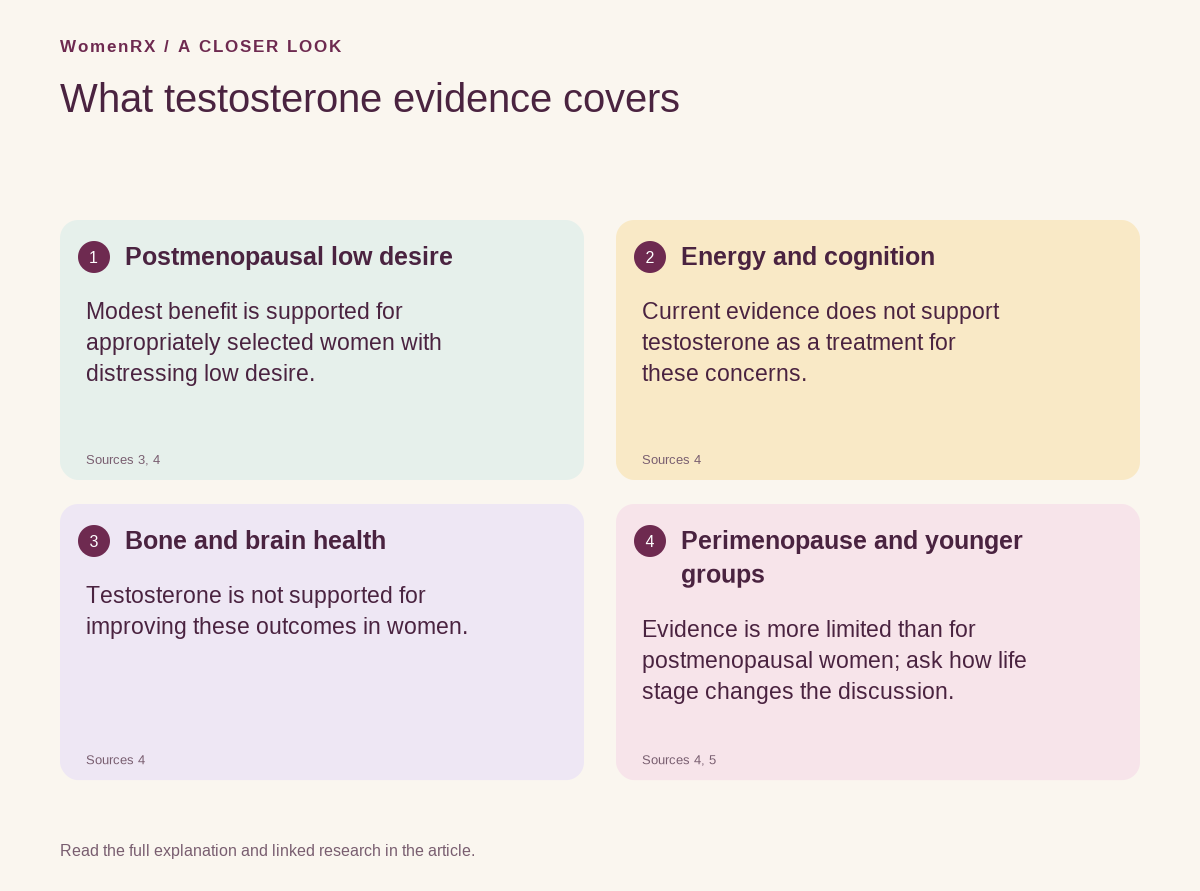
What testosterone evidence covers
Postmenopausal low desire: Modest benefit is supported for appropriately selected women with distressing low desire.34
Energy and cognition: Current evidence does not support testosterone as a treatment for these concerns.4
Bone and brain health: Testosterone is not supported for improving these outcomes in women.4
Perimenopause and younger groups: Evidence is more limited than for postmenopausal women; ask how life stage changes the discussion.45
Read the figure as text
The best-supported discussion is specific to distressing low desire after menopause. Other hoped-for benefits have a different or weaker evidence basis.- Postmenopausal low desire: Modest benefit is supported for appropriately selected women with distressing low desire.34
- Energy and cognition: Current evidence does not support testosterone as a treatment for these concerns.4
- Bone and brain health: Testosterone is not supported for improving these outcomes in women.4
- Perimenopause and younger groups: Evidence is more limited than for postmenopausal women; ask how life stage changes the discussion.45
More questions, answered
Can testosterone help with low energy or brain fog after menopause?
Current evidence doesn’t support testosterone as a treatment for low energy, cognition, or brain health in women. Its evidence-based role is narrower: distressing low sexual desire in appropriately selected postmenopausal women. 3 4
Does a low testosterone result mean I should take it?
No. There’s no established androgen-deficiency diagnosis in women that makes a testosterone result alone a test of candidacy. The discussion should center on distressing low desire, relevant contributors, and the expected benefits and uncertainties of treatment. 4 6
Sources you can check
- The 2022 hormone therapy position statement of The North American Menopause Society.“The 2022 Hormone Therapy Position Statement of The North American Menopause Society” Advisory Panel. · Menopause (New York, N.Y.) · 2022Return to first citation
- The 2023 nonhormone therapy position statement of The North American Menopause Society.Menopause (New York, N.Y.) · 2023Return to first citation
- Testosterone use for hypoactive sexual desire disorder in postmenopausal women.Parish SJ, Kling JM. · Menopause (New York, N.Y.) · 2023Return to first citation
- Testosterone for the Treatment of Hypoactive Sexual Desire Disorder in Perimenopausal and Postmenopausal Women.Kling JM. · Obstetrics and gynecology · 2025Return to first citation
- The clinical management of testosterone replacement therapy in postmenopausal women with hypoactive sexual desire disorder: a review.Uloko M, Rahman F, Puri LI, Rubin RS. · International journal of impotence research · 2022Return to first citation
- Systemic testosterone for the treatment of female sexual interest and arousal disorder (FSIAD) in the postmenopause.Ribera Torres L, Anglès-Acedo S, López Chardi L, Mension Coll E, Castelo-Branco C. · Gynecological endocrinology : the official journal of the International Society of Gynecological Endocrinology · 2024Return to first citation