Testosterone Therapy After Menopause: When Is It a Poor Fit?
The strongest case for testosterone after menopause is distressing low sexual desire, not a low lab result or a general wish to feel better.
Testosterone may modestly help appropriately selected postmenopausal women with distressing low sexual desire, known as hypoactive sexual desire disorder (HSDD). It’s a poor fit when the goal is more energy or better cognition or bone health. Cardiovascular history and the proposed treatment form call for a closer benefit-risk discussion, especially because long-term safety remains uncertain. 5 3 4
A low testosterone result doesn’t, by itself, establish that you need treatment. There’s no established androgen-deficiency diagnosis for women. The question is what you hope treatment will change and whether testosterone has evidence for that particular concern. 5
When the goal doesn’t match the evidence
The clearest evidence-supported use after menopause is for distressing low sexual desire, called hypoactive sexual desire disorder (HSDD). Even for appropriately selected women with HSDD, the expected benefit is modest. Research on sexual desire shouldn’t be taken as evidence that testosterone treats every menopause symptom. 5
For example, if you’re considering testosterone because you feel exhausted, forgetful, or worried about bone health, current data don’t support it for improving energy, cognition, or bone health. That makes it a poor match for the goal, not a statement that you have a medical contraindication. 5
Hot flashes are a different treatment question, too. The North American Menopause Society identifies menopausal hormone therapy as the most effective treatment for hot flashes and night sweats, and its nonhormone guidance identifies other evidence-supported options, including cognitive-behavioral therapy and certain prescription treatments. Those recommendations shouldn’t be confused with evidence for testosterone to treat HSDD. 1 2 5
Why cardiovascular history deserves a conversation
If you have a history of heart or vascular disease, bring it into the discussion before starting testosterone. The available short-term findings offer limited reassurance about one outcome, not a long-term safety answer: a systematic review found no cardiovascular deaths in 13 randomized trials involving 2,628 cisgender women receiving transdermal testosterone for 8 to 52 weeks. The review cautioned that this cannot establish long-term cardiovascular safety. 3
That finding doesn’t tell you that testosterone will cause cardiovascular harm, or that your history automatically rules it out. It does give you a concrete question for the prescriber: how does your health history affect the potential benefit and the uncertainty you’d be accepting? Don’t apply cautions about other types of menopausal hormone therapy to testosterone as though the treatments were interchangeable. 3 1
Why the proposed form matters
Ask which form is being proposed, not just whether it contains testosterone. A review of guidance describes transdermal treatment as the form supported for HSDD. Pellets raise a different concern: a 2025 review found that they can produce high early testosterone levels, with substantial variation between women. It described cardiovascular, metabolic, and endometrial outcome data for pellets as sparse and inconsistent. 4
That doesn’t prove every pellet will cause harm. It does mean a pellet shouldn’t be presented as simply an equivalent way to deliver a treatment studied in transdermal trials. Reports of improved energy or well-being from observational pellet studies can’t establish that pellets caused those changes. 4
What would make the decision clearer?
Start with the outcome you want. If it’s low desire that’s distressing to you, ask whether HSDD fits your situation and what degree of improvement would make treatment worthwhile. If it’s another symptom, ask about care directed at that symptom instead. Then discuss your cardiovascular history, why a particular testosterone form is being proposed, and how you and the prescriber would assess both benefit and unwanted effects, such as acne or unwanted hair growth. These questions help make a benefit-risk decision; they aren’t a test of whether you’re eligible. 5 3 4
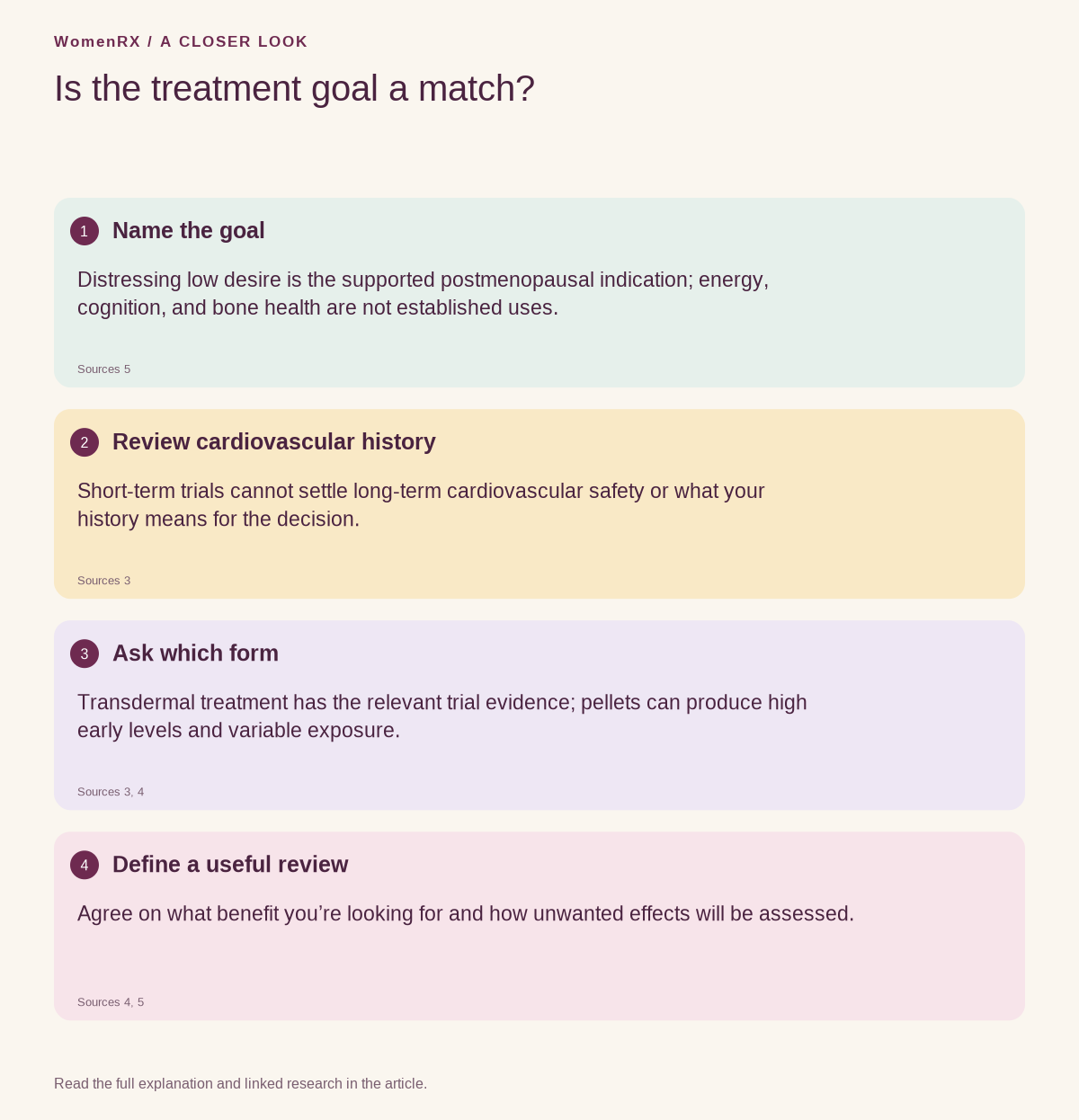
Is the treatment goal a match?
Name the goal: Distressing low desire is the supported postmenopausal indication; energy, cognition, and bone health are not established uses.5
Review cardiovascular history: Short-term trials cannot settle long-term cardiovascular safety or what your history means for the decision.3
Ask which form: Transdermal treatment has the relevant trial evidence; pellets can produce high early levels and variable exposure.34
Define a useful review: Agree on what benefit you’re looking for and how unwanted effects will be assessed.45
Read the figure as text
Use these steps to frame a prescribing discussion, not to decide eligibility on your own.- Name the goal: Distressing low desire is the supported postmenopausal indication; energy, cognition, and bone health are not established uses.5
- Review cardiovascular history: Short-term trials cannot settle long-term cardiovascular safety or what your history means for the decision.3
- Ask which form: Transdermal treatment has the relevant trial evidence; pellets can produce high early levels and variable exposure.34
- Define a useful review: Agree on what benefit you’re looking for and how unwanted effects will be assessed.45
Sources you can check
- The 2022 hormone therapy position statement of The North American Menopause Society.“The 2022 Hormone Therapy Position Statement of The North American Menopause Society” Advisory Panel. · Menopause (New York, N.Y.) · 2022Return to first citation
- The 2023 nonhormone therapy position statement of The North American Menopause Society.Menopause (New York, N.Y.) · 2023Return to first citation
- Cardiovascular mortality associated with testosterone therapy in cisgender women and transgender men: a systematic review.Viana DPDC, Câmara LC, Alto LSM. · Frontiers in endocrinology · 2026Return to first citation
- Testosterone Pellets in Women: Revisiting Safety and Clinical Outcomes.Pinto da Costa Viana D, Jacobsen L, Gabriel LH, Lobo de Souza Correia E, da Maia Fernandes D, Nagel ML, Comin A. · Cureus · 2025Return to first citation
- Testosterone for the Treatment of Hypoactive Sexual Desire Disorder in Perimenopausal and Postmenopausal Women.Kling JM. · Obstetrics and gynecology · 2025Return to first citation