Poor Sleep and Weight: What the Evidence Shows
Short or disrupted sleep is linked with eating patterns that may favor weight gain, but that doesn’t prove it caused your weight change.
Poor sleep and weight are connected, but the link isn’t a simple cause-and-effect story. In one randomized trial, extending sleep reduced energy intake and led to modest weight reduction in adults with overweight who usually slept very little; a separate study found no improvement in insulin sensitivity. Observational research also links poor sleep with some eating behaviors, but cannot show which came first. 6 5 7
What sleep research can, and can’t, say about weight
If your weight changed during a stretch of short or restless nights, sleep could be part of the picture. Research links short sleep with obesity risk and with eating patterns such as overeating or choosing energy-dense foods. But weight, health, daily routines, and sleep can influence one another, so an association alone can’t tell you whether poor sleep caused the change. 6 7
Sleep quality matters as well as hours. Frequent awakenings can interrupt sleep, and adults generally need about seven to nine hours a night, though individual needs vary. 2
A promising trial, with important limits
A randomized trial offers stronger evidence than an observational study that sleep can affect eating. It included 80 adults ages 21 to 40 with overweight who habitually slept less than 6.5 hours. Participants assigned to sleep-extension counseling increased sleep by about 1.2 hours a night compared with the control group. Their energy intake fell by an average of 270 calories a day relative to the control group, and they had modest weight reduction. The change in weight was primarily in fat-free mass, not a demonstrated loss of body fat. 6
That’s encouraging evidence that extending sleep may help some people who regularly cut their sleep short. It is not proof that better sleep alone will produce lasting weight loss, or that the same result applies to everyone. The trial included men and women, but did not report a separate result for women. 6
A different randomized study helps show why it’s worth separating outcomes. Among 29 people with overweight or obesity, insulin resistance, and habitual short sleep, extending sleep by about an hour nightly for roughly six weeks improved reported sleep health but did not produce a detectable difference in insulin sensitivity or blood sugar control between groups. Better sleep may help without changing every measure of metabolic health. 5
Sleep quality and appetite: a clue, not a verdict
In a cross-sectional study of 27,263 UK adults, including 40.5% women, people reporting short sleep or poor sleep quality also reported more behaviors such as eating in response to stress or boredom, overeating, skipping meals, and choosing energy-dense foods. Because sleep and eating were assessed at the same time, the study can’t establish whether sleep changes drove eating behavior, whether other factors affected both, or whether the pattern applies specifically to women. 7
Taken together, the evidence supports treating sleep as one possible contributor to weight change, not as a complete explanation. The research here doesn’t establish a uniquely female effect or determine how pregnancy, postpartum life, menstrual symptoms, or menopause change the sleep-weight relationship. If one of those life stages coincides with disrupted sleep or weight change, it’s useful context to share when discussing your symptoms, not proof of a specific cause.
When disrupted sleep may be a sleep disorder
Notice what the sleep problem looks like. Trouble falling asleep or staying asleep, with unrefreshing sleep, can fit insomnia. Ongoing insomnia can sometimes be related to another health problem, medicines, caffeine, tobacco, alcohol, stress, or shift work. 3
Loud snoring alone doesn’t diagnose sleep apnea, but repeated snoring alongside gasping, choking sounds, witnessed pauses in breathing, or significant daytime sleepiness deserves attention. Sleep apnea interrupts breathing and can leave you drowsy during the day; diagnosis is based on medical history, an exam, and sleep-study results. 1 2 4
A practical first step is to describe the pattern: whether you have trouble falling asleep, wake often, feel sleepy during the day, or someone has noticed snoring or pauses in breathing. If those symptoms are recurring or affecting daily life, ask about evaluation for a sleep disorder rather than assuming weight change is the only issue. Sleep apnea and insomnia have different causes and treatments, so identifying the problem matters. 1 2 3
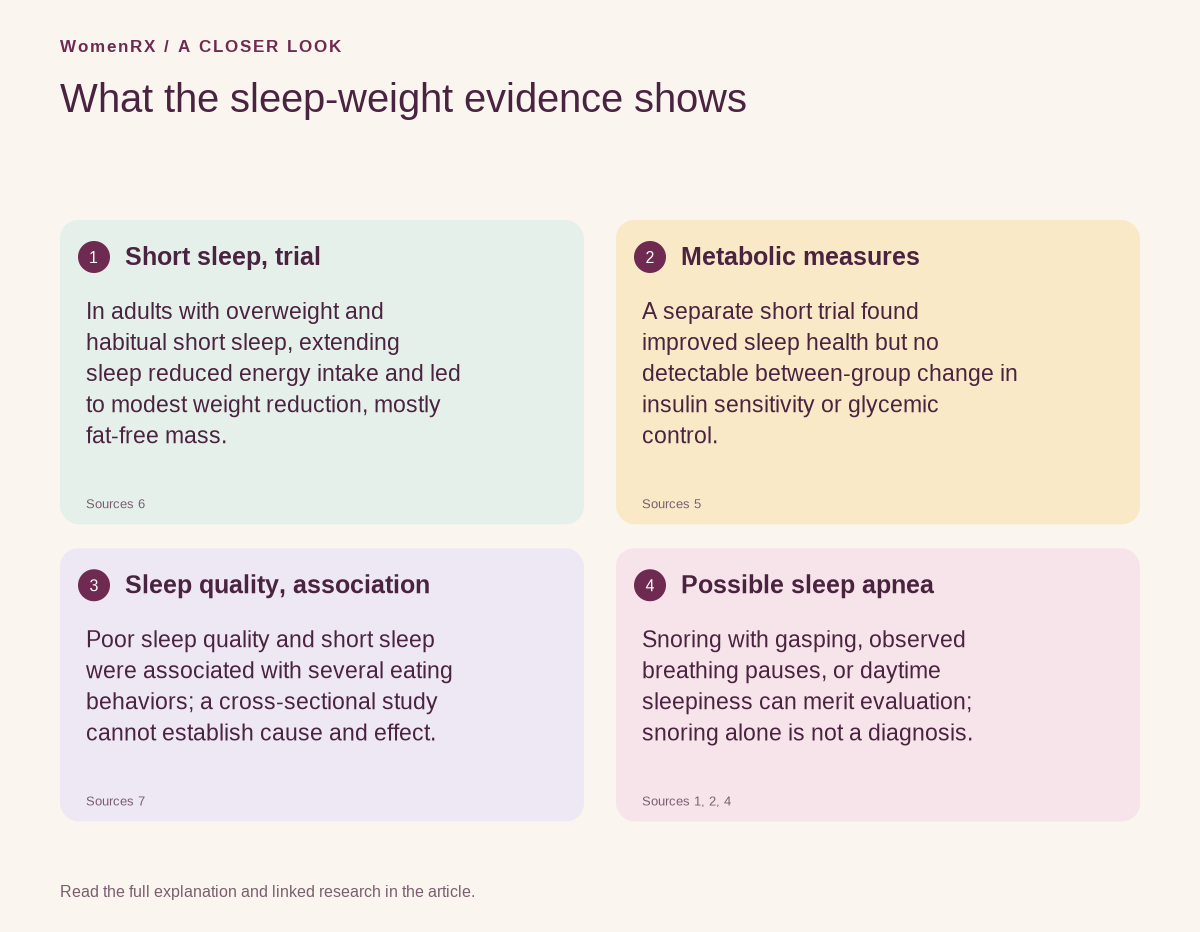
What the sleep-weight evidence shows
Short sleep, trial: In adults with overweight and habitual short sleep, extending sleep reduced energy intake and led to modest weight reduction, mostly fat-free mass.6
Metabolic measures: A separate short trial found improved sleep health but no detectable between-group change in insulin sensitivity or glycemic control.5
Sleep quality, association: Poor sleep quality and short sleep were associated with several eating behaviors; a cross-sectional study cannot establish cause and effect.7
Possible sleep apnea: Snoring with gasping, observed breathing pauses, or daytime sleepiness can merit evaluation; snoring alone is not a diagnosis.124
Read the figure as text
These findings answer different questions: one trial tested sleep extension, while observational research described sleep and eating patterns.- Short sleep, trial: In adults with overweight and habitual short sleep, extending sleep reduced energy intake and led to modest weight reduction, mostly fat-free mass.6
- Metabolic measures: A separate short trial found improved sleep health but no detectable between-group change in insulin sensitivity or glycemic control.5
- Sleep quality, association: Poor sleep quality and short sleep were associated with several eating behaviors; a cross-sectional study cannot establish cause and effect.7
- Possible sleep apnea: Snoring with gasping, observed breathing pauses, or daytime sleepiness can merit evaluation; snoring alone is not a diagnosis.124
More questions, answered
Does snoring mean I have sleep apnea?
No. Snoring is common and can happen without sleep apnea. But frequent daytime tiredness, waking up gasping, or a bed partner noticing pauses in breathing are reasons to ask about an evaluation. A sleep study may be part of diagnosis. 1 2 4
Sources you can check
- Sleep Apnea | MedlinePlusAccessed 2026-09-25Return to first citation
- Sleep Disorders | MedlinePlusAccessed 2026-09-25Return to first citation
- Insomnia | MedlinePlusAccessed 2026-09-25Return to first citation
- Snoring | MedlinePlusAccessed 2026-09-25Return to first citation
- Sleep Extension Improves Sleep Health but Not Insulin Sensitivity in People With Overweight or Obesity Who Maintain Habitual Short Sleep Schedules.Beals JW, Smith GI, Farabi SS, Patterson BW, Lucey BP, Broussard JL, Wright KP, Klein S. · Diabetes care · 2026Return to first citation
- Effect of Sleep Extension on Objectively Assessed Energy Intake Among Adults With Overweight in Real-life Settings: A Randomized Clinical Trial.Tasali E, Wroblewski K, Kahn E, Kilkus J, Schoeller DA. · JAMA internal medicine · 2022Return to first citation
- Associations of self-reported sleep quality and duration with dietary eating behaviours: a cross-sectional study of 27,263 UK adults.Willis SA, Alruwaili A, Hartescu I, Deighton K, Goodwin C, Henson J, Thackray AE, Stensel DJ, King JA. · Appetite · 2026Return to first citation