Sleep, Eating Behaviors, and Weight: What the Evidence Can Say
Short or poor-quality sleep is linked with some eating behaviors, but that doesn’t prove that sleeping longer will cause weight loss.
Sleep may be part of the picture: in a large UK adult study, shorter sleep and poorer self-rated sleep quality were associated with eating patterns such as more stress-related eating and overeating. The study did not directly measure hunger or changes in weight, and its cross-sectional design can’t show that sleep caused those eating behaviors. 7 Sleep symptoms such as persistent daytime sleepiness, gasping during sleep, or leg sensations that keep you awake deserve attention in their own right. 3
What the study found about eating
Sleep and eating are connected, but the best-supported takeaway is an association, not a weight-loss promise. In a cross-sectional study of 27,263 UK adults, 40.5% of whom were women, people reporting poorer sleep quality or shorter sleep also reported more eating behaviors associated with emotional or reward-driven eating, including eating in response to boredom, stress, or anger, overeating, and consuming energy-dense foods. The study relied on self-reports and measured sleep and eating behavior at one point in time. It did not directly measure hunger or changes in weight, and it cannot establish whether sleep caused the reported eating behaviors. The results also don’t establish a women-specific effect: the abstract doesn’t report a separate analysis for women. 7
That distinction matters if you’re working on weight management. A rough night might make your usual routines harder, but this study doesn’t show that extending sleep, by itself, leads to weight loss. It also found some associations with long sleep, including emotional eating, which is another reason not to treat “more sleep” as a universal weight strategy. 7
Duration isn’t the whole story
Sleep quality matters as well as hours. Frequently interrupted sleep may reduce time spent in certain sleep stages and affect daytime functioning. MedlinePlus says most adults need about 7-9 hours, while also noting that sleep needs vary with age, health, lifestyle, and sleep patterns. Think of that range as general context, not a personal pass-or-fail target. 3
For a practical check, note your bedtime and wake time, nighttime awakenings, how rested you feel, and any eating patterns you’re curious about. Include relevant context, such as a shift in your schedule or a difficult night. Look for patterns across days rather than blaming a single meal or poor night on sleep. This is an informal way to organize what you notice, not a validated test or proof of cause.
Women’s sleep can also be affected by different life circumstances, and the evidence shouldn’t be flattened into one explanation. MedlinePlus describes insomnia as more common in women than men. During menopause, sleep disturbance may occur alongside hot flashes or night sweats; a systematic review of randomized trials in menopausal women found that psychosocial interventions, particularly cognitive behavioral approaches, improved sleep outcomes. Those findings concern menopause symptoms and sleep, not weight loss. 4 5 If you’re postpartum or caring for someone and nighttime care interrupts your sleep, note those interruptions when looking at your patterns. The cited evidence does not establish appetite or weight effects specific to those circumstances.
When the sleep problem deserves attention
Consider raising sleep symptoms with a clinician when they’re persistent or affecting your daytime life, rather than waiting to see whether they change your weight. Examples include regularly taking more than 30 minutes to fall asleep, frequent daytime sleepiness, or a bed partner noticing loud snoring, gasping, choking sounds, or pauses in breathing. Those signs can point to a sleep disorder; loud snoring alone doesn’t diagnose sleep apnea. Diagnosis may involve a medical and sleep history, an exam, and sometimes a sleep study. 3 2
A strong urge to move your legs, often with uncomfortable sensations that ease when you move, can also disrupt sleep. If those symptoms are keeping you awake or affecting your well-being, they’re worth discussing; leg cramps and nerve problems can cause similar sensations, so the symptom alone doesn’t confirm restless legs syndrome. 1 3
If you’re pregnant, disrupted sleep may deserve attention beyond any questions you have about eating or weight. Pregnancy sleep interventions have been studied, but a protocol for a planned comparative review is not evidence that one approach is best. 6 Likewise, the menopause trials discussed above address sleep outcomes, not weight loss. 5 In either situation, a useful next step is to describe what interrupts your sleep and how you feel during the day, without assuming a sleep-and-weight effect specific to that life stage.
sleep can be one factor to notice alongside eating patterns and daily routines, but the observational study doesn’t show that changing sleep alone causes weight loss. If poor sleep or specific symptoms are affecting your life, address that problem on its own terms. 7
Sleep, Eating, and What’s Established
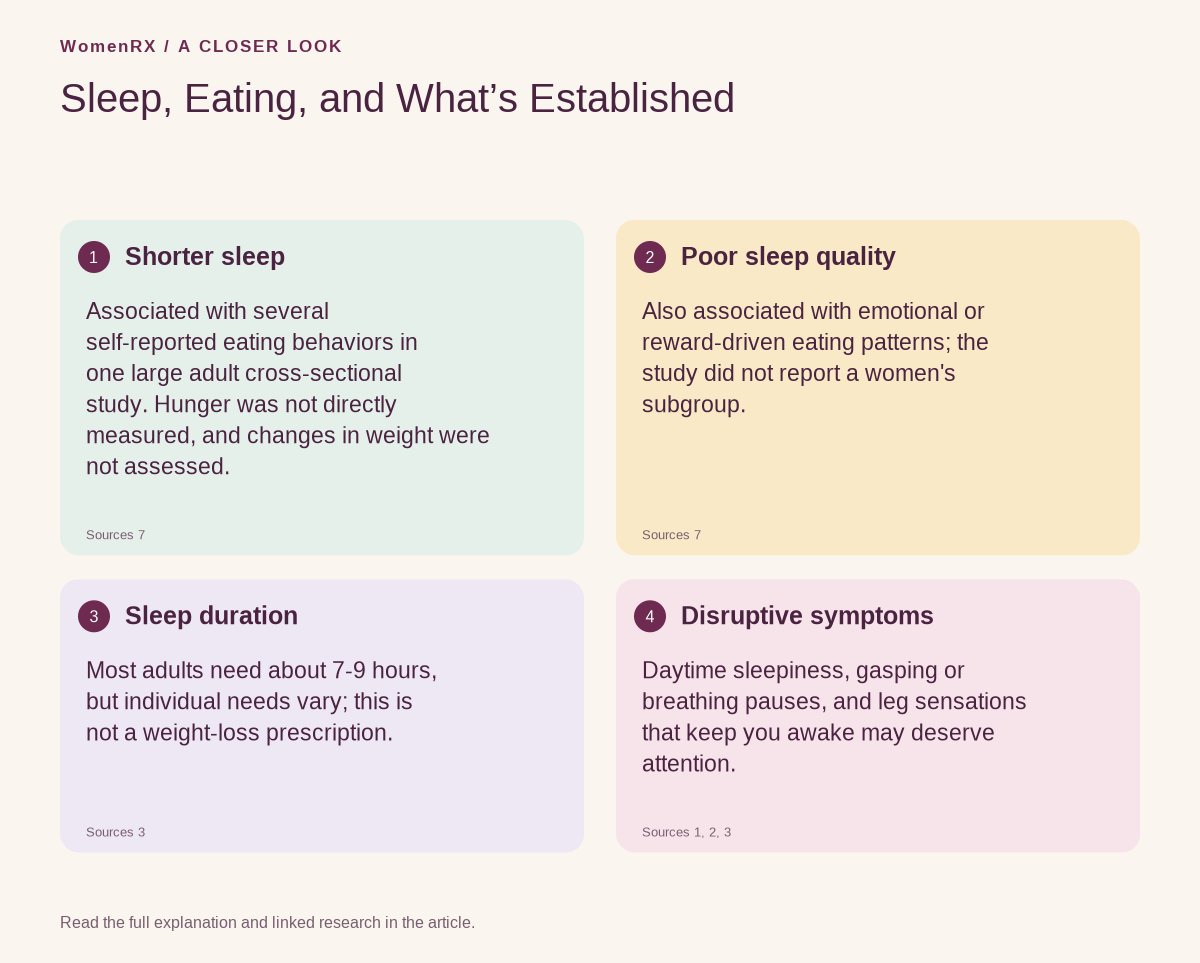
Shorter sleep: Associated with several self-reported eating behaviors in one large adult cross-sectional study. Hunger was not directly measured, and changes in weight were not assessed.7
Poor sleep quality: Also associated with emotional or reward-driven eating patterns; the study did not report a women's subgroup.7
Sleep duration: Most adults need about 7-9 hours, but individual needs vary; this is not a weight-loss prescription.3
Disruptive symptoms: Daytime sleepiness, gasping or breathing pauses, and leg sensations that keep you awake may deserve attention.123
Read the figure as text
A quick map of what sleep research can suggest about eating and weight, and where the evidence stops.- Shorter sleep: Associated with several self-reported eating behaviors in one large adult cross-sectional study. Hunger was not directly measured, and changes in weight were not assessed.7
- Poor sleep quality: Also associated with emotional or reward-driven eating patterns; the study did not report a women's subgroup.7
- Sleep duration: Most adults need about 7-9 hours, but individual needs vary; this is not a weight-loss prescription.3
- Disruptive symptoms: Daytime sleepiness, gasping or breathing pauses, and leg sensations that keep you awake may deserve attention.123
More questions, answered
Does sleeping more make you lose weight?
A cross-sectional adult study found associations between reported sleep and eating behaviors. It did not directly measure hunger or changes in weight, and it can’t show that sleeping longer causes weight loss. 7
Does a partner’s report of snoring mean I have sleep apnea?
No. Loud snoring, gasping, choking, or observed breathing pauses can be reasons to discuss possible sleep apnea, but snoring alone doesn’t confirm it. Diagnosis can involve a sleep study. 2 3
Sources you can check
- Restless legs syndrome - NHSAccessed 2026-09-25Return to first citation
- Sleep Apnea | MedlinePlusAccessed 2026-09-25Return to first citation
- Sleep Disorders | MedlinePlusAccessed 2026-09-25Return to first citation
- Insomnia | MedlinePlusAccessed 2026-09-25Return to first citation
- The effectiveness of psychosocial interventions on physiological symptoms of menopause: a systematic review and meta-analysis.Robinson K, Hardy R, Melville M, Saidel S, Desai R, Spector A. · BMC women's health · 2026Return to first citation
- Comparative efficacy and acceptability of nonpharmacological interventions for sleep disturbance among pregnant women: protocol for a systematic review and network meta-analysis.Zhang N, Wu Q, Tan X, Zeng Y, Tang S, Sun M. · BMJ open · 2025Return to first citation
- Associations of self-reported sleep quality and duration with dietary eating behaviours: a cross-sectional study of 27,263 UK adults.Willis SA, Alruwaili A, Hartescu I, Deighton K, Goodwin C, Henson J, Thackray AE, Stensel DJ, King JA. · Appetite · 2026Return to first citation