Flaxseed and Weight Loss: What the Evidence Can Say
In coronary artery disease trials, flaxseed interventions did not significantly change weight; in hemodialysis trials, flaxseed oil did not significantly change body measurements.
Flaxseed isn’t established as a weight-loss aid. In a review of randomized trials in people with coronary artery disease, flaxseed supplementation did not significantly change weight or BMI. A separate review of flaxseed oil trials in people on hemodialysis also found no significant effect on body measurements. The results presented here don’t establish a fullness benefit or a best form or amount for weight loss. 1 2
What happened to weight in the trials?
A 2024 meta-analysis included six randomized trials in people with coronary artery disease; five contributed to the pooled weight analysis. Flaxseed supplementation did not significantly change weight compared with the control groups: the estimated difference was −0.05 kg, with a 95% confidence interval from −0.39 to 0.28 kg. BMI also did not significantly change. 2
That’s evidence against expecting a noticeable weight effect from the interventions studied in that group. It doesn’t prove that every flaxseed product or eating pattern has the same effect, or predict what will happen for any one person.
Seeds and oil aren’t interchangeable evidence
The evidence for flaxseed oil comes from a different population. A 2024 review of randomized trials in people receiving hemodialysis found no significant effect of flaxseed oil on anthropometric measures. The review did report changes in some blood markers, but those are separate outcomes and don’t demonstrate weight loss. 1
The coronary artery disease review considered flaxseed and flaxseed oil interventions, but its pooled weight result doesn’t tell you whether whole seeds, ground seeds, or oil work differently. The available results also don’t establish that one form is better for weight loss. 2
So, if you’re deciding what to add to food, choose based on your food preferences rather than a promise that a particular form will cause weight loss. Don’t treat a result for oil as proof about ground or whole seeds, or vice versa.
What about fullness or women’s results?
Feeling fuller could matter to someone’s eating routine, but the results presented here don’t include a fullness outcome. They therefore can’t establish that flaxseed or flaxseed oil helps control appetite or leads to weight change through fullness. 1 2
The results presented here also don’t include separate weight estimates for women. That means the overall findings shouldn’t be presented as a demonstrated women-specific result, or as evidence of a benefit tied to menstrual cycles or menopause. 1 2
A practical way to judge the claim
When a product or recipe promises weight loss, check what form was studied, who took part, and whether the outcome was body weight rather than a blood test or another health measure. For flaxseed, these weight findings don’t show a significant change, and they don’t support a particular form or amount as a weight-loss strategy. 1 2
You can still choose flaxseed as a food you enjoy. Just keep that choice separate from the stronger claim that it will make the number on the scale go down.
Flax forms and weight outcomes
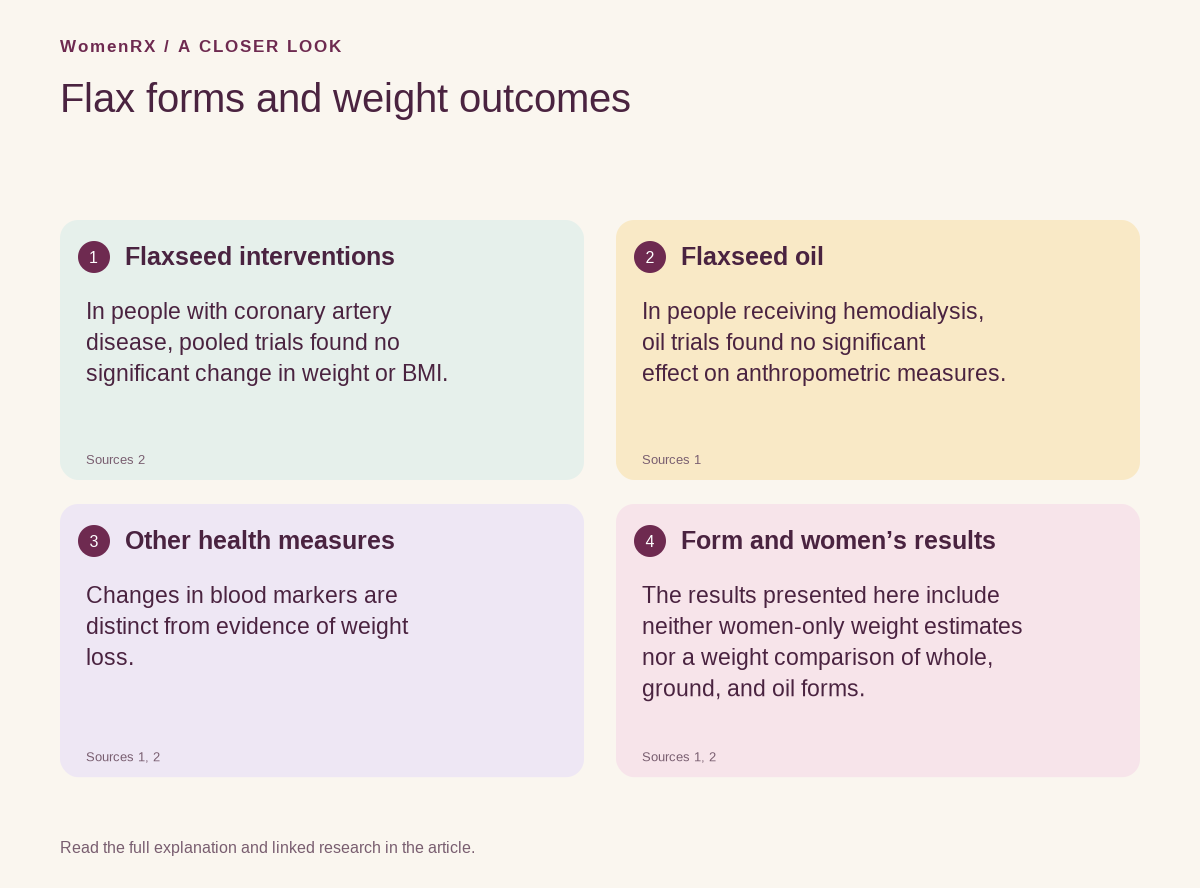
Flaxseed interventions: In people with coronary artery disease, pooled trials found no significant change in weight or BMI.2
Flaxseed oil: In people receiving hemodialysis, oil trials found no significant effect on anthropometric measures.1
Other health measures: Changes in blood markers are distinct from evidence of weight loss.12
Form and women’s results: The results presented here include neither women-only weight estimates nor a weight comparison of whole, ground, and oil forms.12
Read the figure as text
The findings differ by population and intervention, and they don’t establish a weight-loss advantage for a particular seed form.- Flaxseed interventions: In people with coronary artery disease, pooled trials found no significant change in weight or BMI.2
- Flaxseed oil: In people receiving hemodialysis, oil trials found no significant effect on anthropometric measures.1
- Other health measures: Changes in blood markers are distinct from evidence of weight loss.12
- Form and women’s results: The results presented here include neither women-only weight estimates nor a weight comparison of whole, ground, and oil forms.12
Sources you can check
- The impact of flaxseed oil on lipid profiles, weight loss, and inflammatory markers in hemodialysis patients: A systematic review and meta-analysis of randomized controlled trials.Tabrizi R, Azizi Z, Bazmi S, Keshavarzian O, Akbari M, Karimimoghadam Z, Haghpanah A. · Therapeutic apheresis and dialysis : official peer-reviewed journal of the International Society for Apheresis, the Japanese Society for Apheresis, the Japanese Society for Dialysis Therapy · 2024Return to first citation
- Effects of flaxseed supplementation on weight loss, lipid profiles, glucose, and high-sensitivity C-reactive protein in patients with coronary artery disease: A systematic review and meta-analysis of randomized controlled trials.Sabet HR, Ahmadi M, Akrami M, Motamed M, Keshavarzian O, Abdollahi M, Rezaei M, Akbari H. · Clinical cardiology · 2024Return to first citation