Can Kiwi Fit Into a Weight-Management Snack or Meal?
Kiwi can be part of a satisfying eating routine, but trials haven’t shown that the fruit itself reliably changes body weight.
Yes. Kiwi can fit into a snack or meal, but current trial reviews don’t show a reliable effect on body weight from eating kiwi itself. 34 If one kiwi feels like enough between meals, have it on its own; if you want something more substantial, pair it with a food such as yogurt, nuts, or cheese. The useful choice is the one that fits your appetite and overall eating pattern.
Kiwi is a food choice, not a weight-loss treatment
Kiwi can be a pleasant, convenient part of your routine. But there’s no good reason to expect it to cause weight loss on its own. In a 2024 systematic review and meta-analysis of six randomized trials in adults, kiwi consumption did not produce a statistically significant change in body weight, BMI, or waist circumference compared with control groups. For body weight, the pooled difference was 0.85 kg, with a 95% confidence interval from −1.34 to 3.04 kg. 3
A 2019 review of five randomized trials involving 489 participants with various cardiovascular risk factors also found no statistically significant effect on body weight. The estimate was −1.08 kg, with a confidence interval from −4.22 to 2.05 kg. 4 These findings don’t prove kiwi can never affect weight in any circumstance. They do mean that the available trial evidence doesn’t establish kiwi as a weight-loss strategy.
That distinction matters: fruit can be part of an overall eating pattern, while a particular fruit hasn’t necessarily been shown to change body weight. Weight management depends on the broader pattern, including food choices and energy intake, rather than a special effect from one food. 1
When kiwi alone may suit you
If you want a small, simple snack and fruit meets your appetite, kiwi on its own is a reasonable option. Fruit provides dietary fiber, and fiber can add bulk and help you feel full faster. But that general point about fiber isn’t proof that kiwi specifically keeps you full longer or leads to weight loss. 2
Notice what works for you in practice. If a kiwi leaves you comfortable until your next meal, there may be no need to add more. If you’re still hungry, choose a more substantial snack rather than treating hunger as something you should ignore.
When to pair it with something else
For a snack that feels more substantial, try kiwi alongside plain yogurt, a handful of nuts, or cheese. These are examples of pairings, not combinations proven to cause weight loss. The point is to make the snack fit your appetite and day, not to give kiwi a special fat-burning role.
Kiwi can also sit alongside other foods at breakfast or as part of a meal. If you’re using it as part of a weight-management routine, consider the whole meal and your overall pattern. Adding kiwi to what you already eat is different from choosing it in place of another snack; the fruit itself hasn’t been shown to produce a predictable change in weight. 13
What the studies can and can’t tell you
The 2024 review combined randomized trials that examined whole kiwi or kiwi juice in adults and included body weight among the outcomes. Its pooled results found no significant change in body weight, BMI, or waist circumference. 3 The older review focused on people with cardiovascular risk factors and likewise found no significant body-weight effect. 4
These reviews don’t establish a kiwi-specific effect for women. The reported results don’t provide a women-only weight estimate or explain whether effects differed by sex. They also don’t tell us whether kiwi works differently during cycling years, perimenopause, or after menopause. So there’s no basis here for recommending it as a stage-specific weight-management food.
The practical takeaway is simple: choose kiwi because you enjoy it and it fits your snack or meal. Have it alone when that suits your appetite, or pair it with another food when you want more. Neither choice turns kiwi into a proven weight-loss tool.
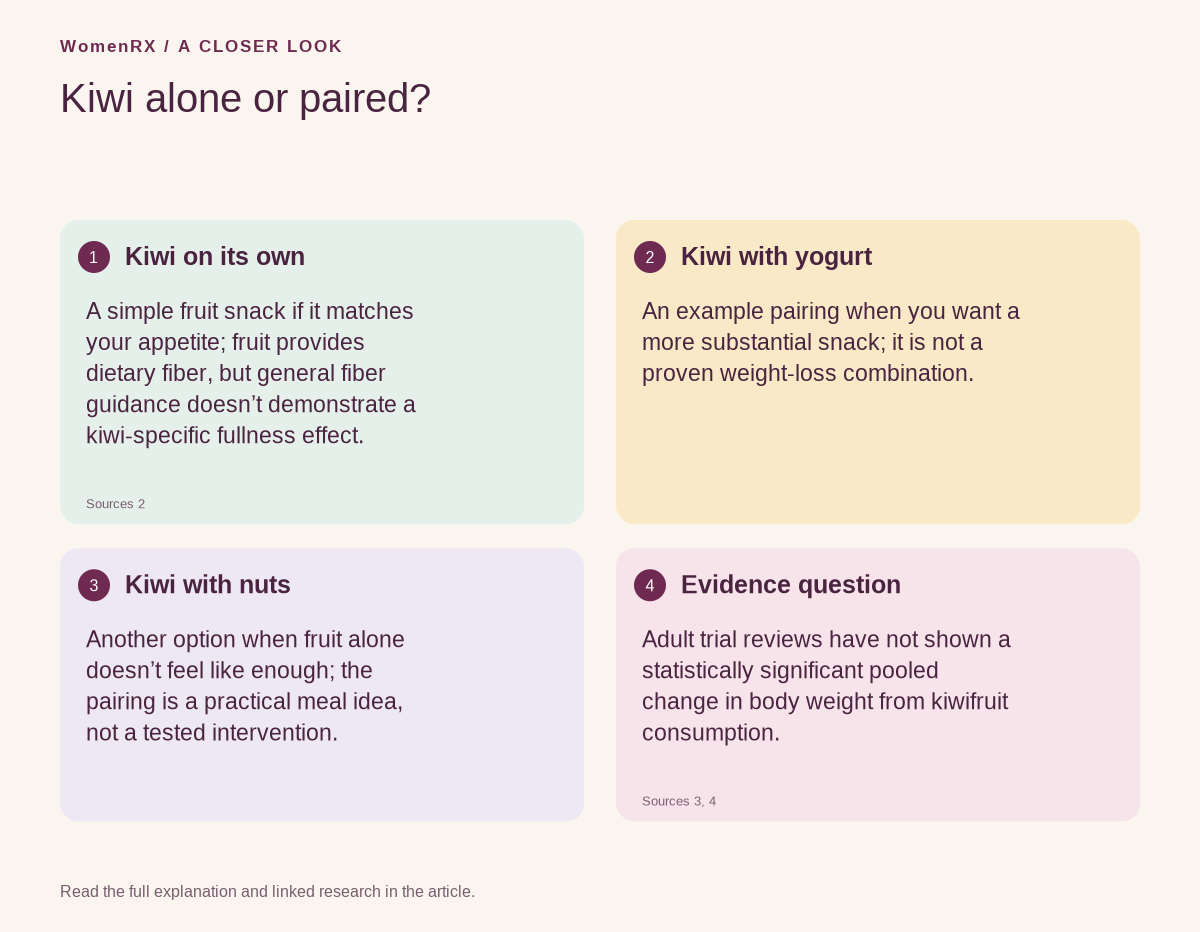
Kiwi alone or paired?
Kiwi on its own: A simple fruit snack if it matches your appetite; fruit provides dietary fiber, but general fiber guidance doesn’t demonstrate a kiwi-specific fullness effect.2
Kiwi with yogurt: An example pairing when you want a more substantial snack; it is not a proven weight-loss combination.
Kiwi with nuts: Another option when fruit alone doesn’t feel like enough; the pairing is a practical meal idea, not a tested intervention.
Evidence question: Adult trial reviews have not shown a statistically significant pooled change in body weight from kiwifruit consumption.34
Read the figure as text
Compare snack formats by what they offer in the moment, while keeping the weight-loss evidence separate from the meal idea.- Kiwi on its own: A simple fruit snack if it matches your appetite; fruit provides dietary fiber, but general fiber guidance doesn’t demonstrate a kiwi-specific fullness effect.2
- Kiwi with yogurt: An example pairing when you want a more substantial snack; it is not a proven weight-loss combination.
- Kiwi with nuts: Another option when fruit alone doesn’t feel like enough; the pairing is a practical meal idea, not a tested intervention.
- Evidence question: Adult trial reviews have not shown a statistically significant pooled change in body weight from kiwifruit consumption.34
Sources you can check
- Dietary Supplements for Weight Loss - Health Professional Fact SheetAccessed 2026-09-25Return to first citation
- Dietary Fiber: MedlinePlusAccessed 2026-09-25Return to first citation
- The effects of kiwifruit consumption on anthropometric and cardiometabolic indices in adults: A systematic review and meta-analysis.Pam P, Goudarzi MA, Ghotboddin Mohammadi S, Asbaghi O, Aghakhani L, Clark CCT, Hashempur MH, Haghighat N. · Food science & nutrition · 2024Return to first citation
- Effect of kiwifruit on metabolic health in patients with cardiovascular risk factors: a systematic review and meta-analysis.Suksomboon N, Poolsup N, Lin W. · Diabetes, metabolic syndrome and obesity : targets and therapy · 2019Return to first citation