Can Salmon Fit Into a Weight-Management Meal?
Salmon can fit into a weight-management meal, but the whole meal matters more than the form of fish you choose.
Yes. Salmon can fit into weight-management meals, but the trial tested it within an energy-restricted diet, not on its own. For a concrete starting point, its salmon portions were 150 g, about 5 oz. That’s a practical reference, not a proven ideal serving. The diets did not differ in their effect on weight loss in women. 2
What the salmon trial actually tested
A randomized trial assigned 324 adults ages 20 to 40 with overweight to one of four energy-restricted diets for eight weeks. One group ate salmon three times a week; the others ate cod, took fish-oil capsules, or had no seafood. The diets had similar macronutrient composition, so this was a test of salmon within a weight-loss plan, not a test of salmon by itself. The salmon group ate three 150 g portions each week. 2
If you’d like a practical starting point for one meal, you could use roughly 150 g, about 5 oz, of salmon and adjust the amount to your appetite and what else is on your plate. That’s the serving used in the trial, not evidence that it’s right for everyone. The study did not test different salmon portion sizes or establish an ideal portion or frequency for weight management. 2
At the four-week midpoint, the study estimated about 1 kg more weight loss for men in the salmon group than for men in the no-seafood group. That estimate was for an average man in the study, described as weighing 95 kg at the start and receiving 1,600 calories a day. Among women, the diets did not differ in their effect on weight loss. That’s a useful distinction: this trial doesn’t support promising a weight-loss advantage for women from adding salmon. It also doesn’t show that the result applies to other ages, people without overweight, or everyday eating without an energy-restricted plan. 2
The study tested salmon as part of a broader diet. It doesn’t establish that salmon has a special effect independent of the overall eating plan, or that fish-oil capsules and salmon are interchangeable. A broader approach to weight management still centers on a healthy eating pattern and an appropriate reduction in calorie intake, rather than on one particular food. 12
How fresh, canned, and prepared salmon fit differently
These options can serve different needs, even though the trial didn’t compare their weight outcomes. The useful distinction is how much of the meal you’re assembling yourself and what comes with the fish.
- Fresh salmon: If you’re cooking a fillet, you choose the cooking additions and sides. For example, you could build a meal around salmon and vegetables, then decide whether a sauce fits what you want from that meal.
- Canned salmon: You can add it directly to a sandwich or salad without cooking a fillet. That makes the other ingredients worth considering: a salmon salad mixed with dressing is a different meal from canned salmon added to vegetables.
- Prepared salmon: A breaded entrée or salmon served with sauce may already include ingredients you’d otherwise add yourself. Look at what’s included, then consider the sides you’ll serve with it. You don’t need to rule out a prepared option to recognize that the fish isn’t the whole meal.
The trial didn’t test weight outcomes for different cooking methods or package types. If you’re deciding between two salmon meals, compare what you’ll actually eat, including additions and sides, rather than assuming the one labeled “salmon” has a particular weight effect. That keeps the decision connected to the broader eating pattern and calorie intake that matter for weight management. 12
What about women and life stages?
Women were included in the trial, and its reported result was that the diets did not differ in their effect on weight loss in women. It doesn’t establish a special benefit for women, nor does it report whether effects vary by menstrual cycle, perimenopause, or menopause. The study does not answer pregnancy-related fish-safety questions. 2
If salmon suits your preferences, it can be one part of a weight-management meal. The clearest takeaway from the evidence is narrower: salmon was tested as one component of a structured, energy-restricted diet, and that trial did not find a different weight-loss effect among the diets for women. 2
Salmon forms and the trial portion
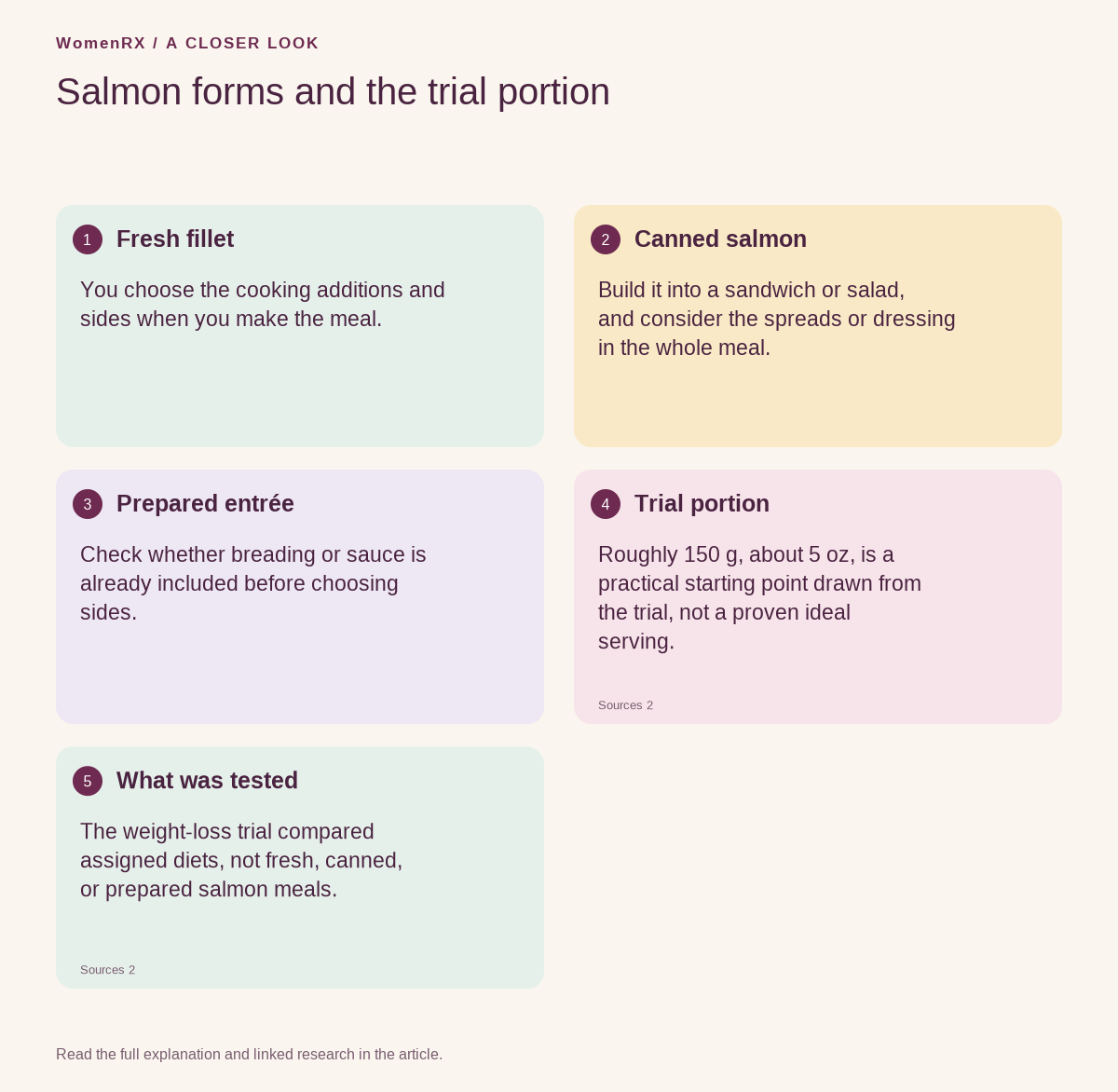
Fresh fillet: You choose the cooking additions and sides when you make the meal.
Canned salmon: Build it into a sandwich or salad, and consider the spreads or dressing in the whole meal.
Prepared entrée: Check whether breading or sauce is already included before choosing sides.
Trial portion: Roughly 150 g, about 5 oz, is a practical starting point drawn from the trial, not a proven ideal serving.2
What was tested: The weight-loss trial compared assigned diets, not fresh, canned, or prepared salmon meals.2
Read the figure as text
Compare what you assemble yourself with what may already come with the fish. The portion shown offers a meal-planning reference, not a proven ideal serving.- Fresh fillet: You choose the cooking additions and sides when you make the meal.
- Canned salmon: Build it into a sandwich or salad, and consider the spreads or dressing in the whole meal.
- Prepared entrée: Check whether breading or sauce is already included before choosing sides.
- Trial portion: Roughly 150 g, about 5 oz, is a practical starting point drawn from the trial, not a proven ideal serving.2
- What was tested: The weight-loss trial compared assigned diets, not fresh, canned, or prepared salmon meals.2
More questions, answered
How much salmon could I put in one meal?
For a concrete starting point, you could use roughly 150 g, about 5 oz, of salmon, then adjust to your appetite and the rest of the meal. That was the portion used in one weight-loss trial, not a proven ideal serving or a reason to eat salmon at the trial’s three-times-weekly frequency. 2
Sources you can check
- Dietary Supplements for Weight Loss - Health Professional Fact SheetAccessed 2026-09-25Return to first citation
- Randomized trial of weight-loss-diets for young adults varying in fish and fish oil content.Thorsdottir I, Tomasson H, Gunnarsdottir I, Gisladottir E, Kiely M, Parra MD, Bandarra NM, Schaafsma G, Martinéz JA. · International journal of obesity (2005) · 2007Return to first citation