How to Fit Farro Into a Weight-Management Meal
Farro can be one satisfying grain choice, but research on whole grains doesn’t show that farro itself causes weight loss.
Yes, you can use farro in a weight-management meal if you enjoy it. As a meal-planning starting point, try about ½ cup cooked farro alongside vegetables and a protein food, then adjust the amount to suit your appetite. That portion isn’t proven to cause weight loss. Farro is wheat, so it isn’t suitable for a gluten-free diet. 2 1
Farro is a meal choice, not a weight-loss trick
Farro can work in a meal when you like its taste and texture. As a practical starting point, try about ½ cup of cooked farro as the grain part of your meal, alongside vegetables and a protein food. For example, you might pair it with roasted vegetables and beans, or with greens and fish. If that doesn’t feel like enough food, adjust the farro, the vegetables, the protein food, or a combination. These are meal-planning ideas, not a proven formula or a farro-specific weight-loss plan.
Research hasn’t established a cooked-farro portion that causes weight loss. The ½-cup suggestion is simply a place to start, not a target you need to hit. You don’t need to treat farro as either a “free” food or something to avoid.
What whole-grain research can, and can’t, tell you
Research on whole grains is broader than research on farro. A systematic review and network meta-analysis of 152 randomized trials found that whole-grain interventions were associated with a very small estimated difference in weight compared with control diets: about 0.44 kg lower, with very low certainty of evidence. The authors described effects from single foods or food groups as trivial overall, particularly for people with overweight or obesity. 3
A separate meta-analysis of randomized trials estimated a 0.20 kg lower body weight for each 48 g/day increase in whole-grain intake, measured as dry weight. That result is a small average difference across whole-grain research, not a prediction for an individual meal or a result for farro alone. 4
The two reviews don’t give identical estimates, and neither establishes that adding farro will make you lose weight. They study whole grains as a broad category, not a particular cooked-grain portion of farro. The reported results also don’t provide a women-only estimate or an effect broken down by adult age, so they can’t establish a special benefit for women across life stages. 3 4
The useful takeaway is modest: farro may be one grain in an overall eating pattern that supports your goals, but swapping it in isn’t a stand-alone weight-loss strategy. If you’re choosing between farro, rice, or quinoa for a meal, this research doesn’t establish that farro is better for weight management. Let taste, meal fit, and dietary needs guide the choice. 3 4
The gluten issue changes the decision
Farro is a type of wheat, and wheat is a source of gluten. 2 1 If you need to follow a gluten-free diet because of celiac disease, farro isn’t an appropriate grain choice. Celiac disease is triggered by gluten, and its treatment is a gluten-free diet. 1
Research on different farro varieties doesn’t make farro a safe workaround. In one laboratory study, farro varieties differed in the immune response they triggered in T-cells from people with celiac disease. That finding is about laboratory responses to particular varieties, not proof that any farro is safe to eat. 2 Choose a different grain if you must avoid gluten, and check the product rather than assuming it’s gluten-free because of its name. 1
If gluten isn’t a concern for you, farro can remain on the menu. If it is, the gluten question settles the choice regardless of any possible whole-grain benefit.
Choosing the Grain for Your Meal
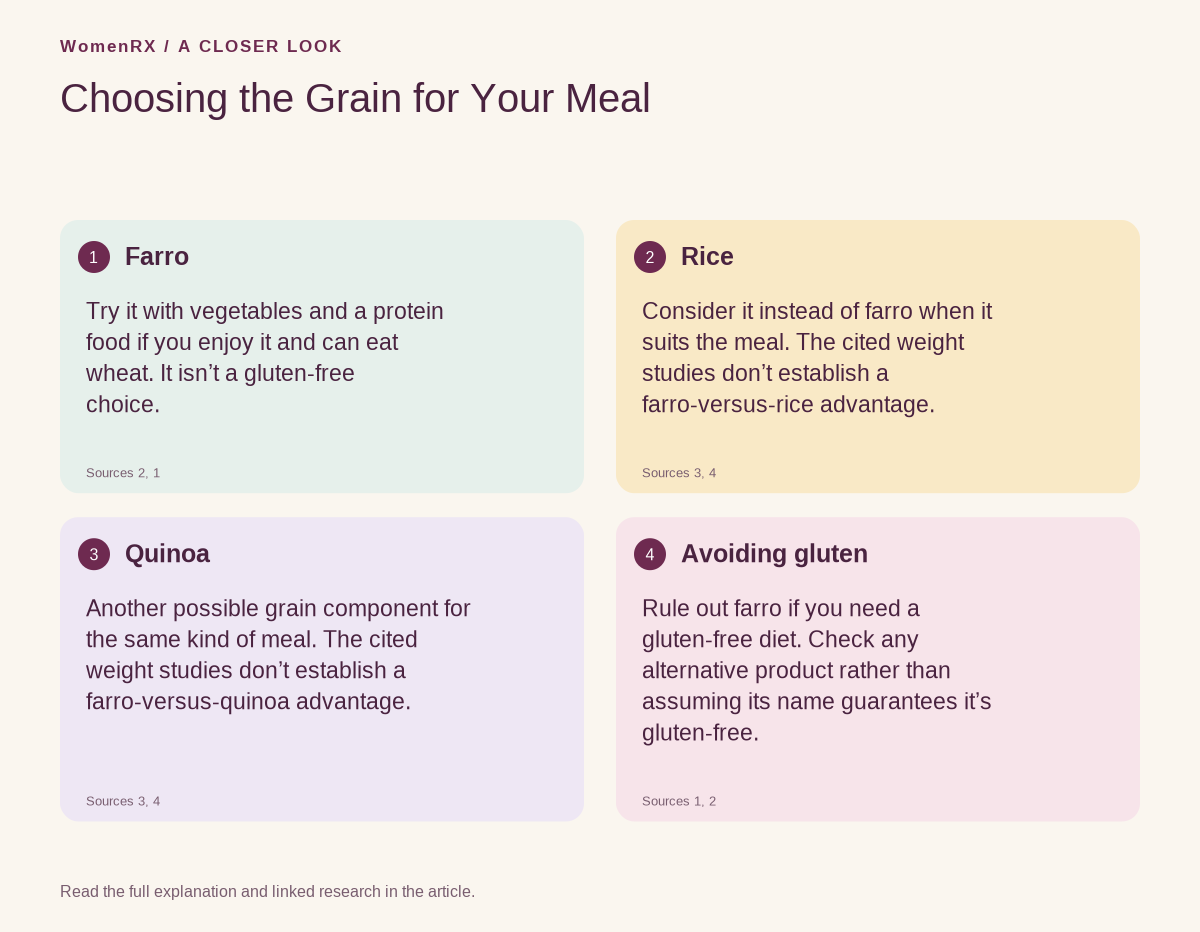
Farro: Try it with vegetables and a protein food if you enjoy it and can eat wheat. It isn’t a gluten-free choice.21
Rice: Consider it instead of farro when it suits the meal. The cited weight studies don’t establish a farro-versus-rice advantage.34
Quinoa: Another possible grain component for the same kind of meal. The cited weight studies don’t establish a farro-versus-quinoa advantage.34
Avoiding gluten: Rule out farro if you need a gluten-free diet. Check any alternative product rather than assuming its name guarantees it’s gluten-free.12
Read the figure as text
Farro, rice, and quinoa can each be considered for the grain part of a mixed meal. These weight studies don’t rank them against one another; a need to avoid gluten changes which products you can choose.- Farro: Try it with vegetables and a protein food if you enjoy it and can eat wheat. It isn’t a gluten-free choice.21
- Rice: Consider it instead of farro when it suits the meal. The cited weight studies don’t establish a farro-versus-rice advantage.34
- Quinoa: Another possible grain component for the same kind of meal. The cited weight studies don’t establish a farro-versus-quinoa advantage.34
- Avoiding gluten: Rule out farro if you need a gluten-free diet. Check any alternative product rather than assuming its name guarantees it’s gluten-free.12
Sources you can check
- Celiac Disease | MedlinePlusAccessed 2026-09-25Return to first citation
- T-cell response to different cultivars of farro wheat, Triticum turgidum ssp. dicoccum, in celiac disease patients.Vincentini O, Borrelli O, Silano M, Gazza L, Pogna N, Luchetti R, De Vincenzi M. · Clinical nutrition (Edinburgh, Scotland) · 2009Return to first citation
- Comparative effectiveness of single foods and food groups on body weight: a systematic review and network meta-analysis of 152 randomized controlled trials.Jayedi A, Ge L, Johnston BC, Shahinfar H, Safabakhsh M, Mohamadpur S, Ghorbaninejad P, Abyadeh M, Zeraattalab-Motlagh S, Soltani S, Jibril AT, Shab-Bidar S. · European journal of nutrition · 2023Return to first citation
- Whole-grain consumption and cardiometabolic risk: a meta-analysis of randomized trials.Naghshi S, Kiani S, Ostadrahimi A, Jayedi A, Mobasseri M, Arefhosseini S, Tutunchi H, Aune D. · European heart journal · 2026Return to first citation