Is Quinoa Better Than Other Grains for Weight Management?
Quinoa can fit a weight-management meal, but studies of other grains don’t establish a special weight-loss advantage for it.
Yes, quinoa can belong in a weight-management meal, especially if you like it and use it as the grain portion alongside vegetables and a protein food. But its protein content doesn’t prove it helps people lose more weight than rice, oats, or other grains. Human trials suggest grain choice can matter in some settings, not that quinoa is the winning choice.467
What grain studies can tell us about quinoa
The most useful comparison isn’t quinoa versus every other grain on a nutrition label. It’s quinoa versus the grain you would otherwise eat, in the meal you would actually make.
Human studies show why the distinction matters. In a 12-week trial, 242 adults with overweight or obesity followed a calorie-reduced diet and ate either high-fiber rye products or refined wheat products. The rye group lost an average of 1.08 kg (about 2.4 pounds) more body weight. Researchers did not find consistent differences in reported appetite between the groups. That’s evidence for that particular rye-versus-refined-wheat swap, not a result you can transfer to quinoa versus rice.6
Another trial tested whole-grain-rich versus refined-grain diets in 81 men and postmenopausal women. Both diets were designed to maintain weight, and weight was maintained over the six-week intervention. The trial found differences in measures of energy use and energy lost in stool, but it wasn’t a demonstration that eating quinoa produces weight loss.7
Even a study in which whole-grain intake rises can’t necessarily isolate the grains’ effect. In a 16-week trial of a low-fat vegan diet versus usual eating, participants changed several food groups at once, including legumes, vegetables, whole grains, animal foods, and added fats. Its findings cannot tell us what swapping one cooked grain for another would do.5
Compare the meal, not just the grain
For a dinner comparison, picture the same plate with a similar serving of cooked quinoa one night and cooked brown rice another night. Keep the vegetables, protein food, and dressing similar. That lets you judge a practical question: Which version do you enjoy and find satisfying? It does not turn your dinner into a weight-loss trial, and the cited grain trials don’t establish which of those two versions would lead to more weight loss.67
Breakfast calls for a different comparison: cooked quinoa in a bowl versus oatmeal, with similar fruit and other additions. If one bowl includes a generous pour of syrup, nuts, or cream and the other doesn’t, the meal has changed in more ways than its grain. General healthy-eating guidance recommends a varied pattern that includes whole grains, produce, and protein foods; it doesn’t single out quinoa as necessary for weight management.4
That’s also why quinoa’s protein reputation needs perspective. A systematic review looked for human intervention studies of extracted plant proteins, including quinoa protein, and identified none on extracted quinoa protein among the studies it included. More importantly for your plate, an isolated protein ingredient wouldn’t answer how a bowl of cooked quinoa compares with a bowl of another cooked grain. Protein content alone cannot establish a fullness or weight-loss advantage.2
Does the answer change in midlife?
The six-week whole-grain trial included 32 postmenopausal women among its 81 participants, but the reported findings don’t give a quinoa result or a separate result for those women. A study of female mice fed a high-fat diet found lower body weight in the group given the highest amount of quinoa over eight weeks. Mouse findings don’t show that quinoa has a female-specific effect in people.73
If quinoa makes a meal you enjoy, use it. If you prefer oats at breakfast or brown rice at dinner, this evidence gives you no reason to replace them solely in hopes of faster weight loss. The useful choice is the one that helps you build a satisfying eating pattern you can keep, rather than treating one grain as the deciding ingredient.14
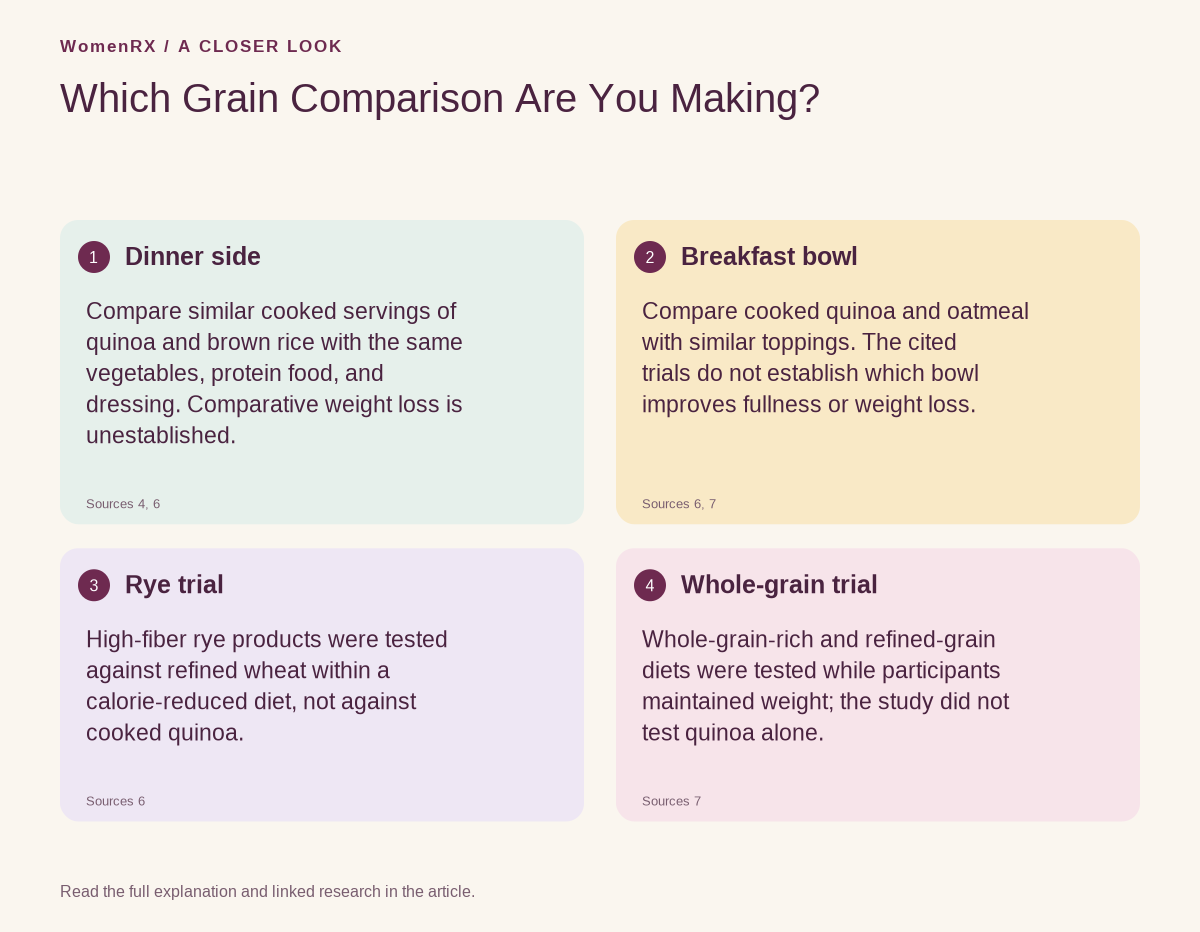
Which Grain Comparison Are You Making?
Dinner side: Compare similar cooked servings of quinoa and brown rice with the same vegetables, protein food, and dressing. Comparative weight loss is unestablished.46
Breakfast bowl: Compare cooked quinoa and oatmeal with similar toppings. The cited trials do not establish which bowl improves fullness or weight loss.67
Rye trial: High-fiber rye products were tested against refined wheat within a calorie-reduced diet, not against cooked quinoa.6
Whole-grain trial: Whole-grain-rich and refined-grain diets were tested while participants maintained weight; the study did not test quinoa alone.7
Read the figure as text
Two everyday meal swaps are useful for choosing what to eat; two research comparisons show why they cannot be treated as quinoa results.- Dinner side: Compare similar cooked servings of quinoa and brown rice with the same vegetables, protein food, and dressing. Comparative weight loss is unestablished.46
- Breakfast bowl: Compare cooked quinoa and oatmeal with similar toppings. The cited trials do not establish which bowl improves fullness or weight loss.67
- Rye trial: High-fiber rye products were tested against refined wheat within a calorie-reduced diet, not against cooked quinoa.6
- Whole-grain trial: Whole-grain-rich and refined-grain diets were tested while participants maintained weight; the study did not test quinoa alone.7
More questions, answered
Would quinoa keep me fuller than another grain?
That hasn’t been established for the cooked-grain comparisons here. In the rye-versus-refined-wheat weight-loss trial, the rye group lost more weight, but researchers found no consistent difference in reported appetite. That result can’t predict how filling quinoa will feel compared with your usual grain.6
Sources you can check
- Dietary Supplements for Weight Loss - Health Professional Fact SheetAccessed 2026-09-25Return to first citation
- Exploring Health-Promoting Attributes of Plant Proteins as a Functional Ingredient for the Food Sector: A Systematic Review of Human Interventional Studies.Lonnie M, Laurie I, Myers M, Horgan G, Russell WR, Johnstone AM. · Nutrients · 2020Return to first citation
- Quinoa Ameliorates High-Fat Diet-Induced Obesity in Female Mice by Regulating Gut Microbiota and Adipogenesis.Liu Y, Pan Q, Bao X, Zhang Y, Liu X, Liu Y, Liu Y, Zhang Y, Xie Q, Liang Z, Sun F, Li J, Li H, Li Z. · Food science & nutrition · 2025Return to first citation
- MedlinePlus: Managing weight with healthy eatingAccessed 2026-09-25Return to first citation
- Changes in Food and Nutrient Intake and Diet Quality on a Low-Fat Vegan Diet Are Associated with Changes in Body Weight, Body Composition, and Insulin Sensitivity in Overweight Adults: A Randomized Clinical Trial.Crosby L, Rembert E, Levin S, Green A, Ali Z, Jardine M, Nguyen M, Elliott P, Goldstein D, Freeman A, Bradshaw M, Holtz DN, Holubkov R, Barnard ND, Kahleova H. · Journal of the Academy of Nutrition and Dietetics · 2022Return to first citation
- A hypocaloric diet rich in high fiber rye foods causes greater reduction in body weight and body fat than a diet rich in refined wheat: A parallel randomized controlled trial in adults with overweight and obesity (the RyeWeight study).Iversen KN, Carlsson F, Andersson A, Michaëlsson K, Langton M, Risérus U, Hellström PM, Landberg R. · Clinical nutrition ESPEN · 2021Return to first citation
- Substituting whole grains for refined grains in a 6-wk randomized trial favorably affects energy-balance metrics in healthy men and postmenopausal women.Karl JP, Meydani M, Barnett JB, Vanegas SM, Goldin B, Kane A, Rasmussen H, Saltzman E, Vangay P, Knights D, Chen CO, Das SK, Jonnalagadda SS, Meydani SN, Roberts SB. · The American journal of clinical nutrition · 2017Return to first citation